



 Chat with AI
Exam 16: Thermodynamics: Entropy, free Energy, and Equilibrium

Exam 1: Chemistry: Matter and Measurement219 Questions
Exam 2: Atoms, molecules, and Ions257 Questions
Exam 3: Formulas, equations, and Moles208 Questions
Exam 4: Reactions in Aqueous Solutions174 Questions
Exam 5: Periodicity and the Atomic Structure of Atoms158 Questions
Exam 6: Ionic Bonds and Some Main-Group Chemistry173 Questions
Exam 7: Covalent Bonds and Molecular Structure232 Questions
Exam 8: Thermochemistry: Chemical Energy163 Questions
Exam 9: Gases: Their Properties and Behavior182 Questions
Exam 10: Liquids,solids,and Phase Changes186 Questions
Exam 11: Solutions and Their Properties192 Questions
Exam 12: Chemical Kinetics206 Questions
Exam 13: Chemical Equilibrium166 Questions
Exam 14: Aqueous Equilibria: Acids and Bases224 Questions
Exam 15: Applications of Aqueous Equilibria190 Questions
Exam 16: Thermodynamics: Entropy, free Energy, and Equilibrium144 Questions
Exam 17: Electrochemistry176 Questions
Exam 18: Hydrogen, oxygen, and Water175 Questions
Exam 19: The Main-Group Elements202 Questions
Exam 20: Transition Elements and Coordination Chemistry185 Questions
Exam 21: Metals and Solid-State Materials149 Questions
Exam 22: Nuclear Chemistry85 Questions
Exam 23: Organic and Biological Chemistry285 Questions
Select questions type


The figure represents the spontaneous deposition of iodine in which iodine vapor,I2(g),becomes crystalline iodine solid I2(s): I2(g): → I2(s).What are the signs (+ or -)of ΔH,ΔS,and ΔG for this process? 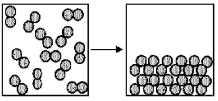
(Multiple Choice)
4.9/5  (63)
(63) At high temperatures boron carbide vaporizes according to the equation
B4C(s)⇌ 4 B(g)+ C(s)
Which equation describes the relationship between ΔG° and ΔG for this reaction?
(Multiple Choice)
4.8/5 (82)
(82) For the reaction N2(g)+2 O2(g)→ 2 NO2(g),ΔH° = 66.4 kJ/mol and ΔS° = -121.5 J/K.ΔStotal for this reaction is ________ J/K,and the reaction is ________ (spontaneous,nonspontaneous)at 25°C.
(Short Answer)
4.9/5 (81)
(81) In figure (1)below oxygen molecules,represented by unshaded spheres,and chlorine molecules,represented by shaded spheres,are in separate compartments.Figure (2)shows the equilibrium state of the system after the stopcock separating the two compartments is opened.Assuming the oxygen and the chlorine behave as ideal gases,what are the signs (+,-,or 0)of ΔH,ΔS,and ΔG for this process? 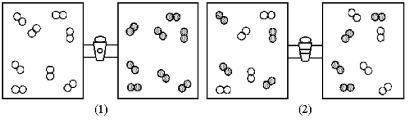
(Multiple Choice)
4.7/5 (74)
(74) Which statement is true about the formation of CaCO3(s)from CaO(s)and CO2(g)at 1.00 atm?
CaO(s)+ CO2(g)→ CaCO3(s)ΔH° = -178.7 kJ and ΔS° = -150.4 J/K
(Multiple Choice)
4.9/5 (76)
(76) When equilibrium is reached at constant temperature and pressure,
(Multiple Choice)
4.9/5 (80)
(80) Other than only PV work,what reaction conditions must be satisfied for the sign of ΔG to be used as a criterion for spontaneity?
(Multiple Choice)
4.9/5 (77)
(77) Standard molar entropies,S°,in J/Kmol,are given below each reactant and product in the reaction shown below.The standard entropy of reaction,ΔS°,for this reaction is ________ J/K.
S(s,rhombic)+ O2(g)→ SO2(g)
31.8 205.0 248.1
(Short Answer)
4.8/5 (81)
(81) The entropy of water at 25° is ________ than the entropy of water at 35°C.
(Short Answer)
4.9/5 (80)
(80) According to the second law of thermodynamics,all reactions proceed spontaneously in the direction that increases the entropy of the
(Multiple Choice)
4.9/5 (76)
(76) The most commonly used white pigment is titanium white,which is titanium(IV)oxide,TiO2.Titanium white can be formed from TiCl4 as shown in the reaction below.
TiCl4(l)+ 2 H2O(l)→ TiO2(s)+ 4 HCl(g)
If ΔH° = 61.9 kJ/mol and ΔS° = 405.4 J/K,what are ΔSsurr and ΔStotal for this reaction at 25°C?
(Short Answer)
4.7/5 (77)
(77) The entropy change associated with the expansion of one mole of an ideal gas from an initial volume of Vi to a final volume of Vf at constant temperature is given by the equation,ΔS = R ln (Vf/Vi).What is the entropy change associated with the expansion of three moles of an ideal gas from an initial volume of Vi to a final volume of Vf at constant temperature?
(Multiple Choice)
4.8/5 (72)
(72) Consider the reaction 2A(g)⇌ A2(g).The following pictures represent two possible initial states and the equilibrium state of the system.  -For initial state 1 what is the relationship between the reaction quotient,Qp,and the equilibrium constant,Kp?
 (Multiple Choice)
4.8/5 (73)
(73) A reaction has ΔG° = + 21.5 kJ/mol,ΔH° = + 25.0 kJ/mol,and ΔS° = + 15.0 J/mol∙K can become spontaneous at a temperature of ________ K.
(Short Answer)
4.8/5 (93)
(93) Calculate the standard free energy change at 25°C for the reaction
2 NO(g)+ O2(g)→ 2 NO2(g). 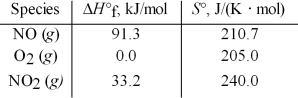
(Multiple Choice)
4.7/5 (80)
(80) Standard molar entropies,S°,in J/Kmol,are given below each reactant and product in the reaction shown below.The standard entropy of reaction,ΔS°,for this reaction is ________ J/K.
2 SO2(g)+ O2(g)→ 2 SO3(g)
248.1 205.0 256.6
(Short Answer)
4.8/5 (67)
(67) A 1.0 mole sample of gas at STP has a ________ entropy than 1.0 mole of gas at 273 K and
835 mm Hg.
(Short Answer)
4.9/5 (77)
(77) Standard molar entropies,S°,in J/K∙mol,are given below each reactant and product in the reaction shown below.The standard entropy of reaction,ΔS°,for this reaction is ________ J/K.
CH4(g)+ 2 O2(g)→ CO2(g)+ 2 H2O(l)
186.2 205.0 213.6 69.9
(Short Answer)
4.8/5 (69)
(69) 
Filters
- Essay(0)
- Multiple Choice(0)
- Short Answer(0)
- True False(0)
- Matching(0)