



 Chat with AI
Exam 16: Thermodynamics: Entropy, free Energy, and Equilibrium

Exam 1: Chemistry: Matter and Measurement219 Questions
Exam 2: Atoms, molecules, and Ions257 Questions
Exam 3: Formulas, equations, and Moles208 Questions
Exam 4: Reactions in Aqueous Solutions174 Questions
Exam 5: Periodicity and the Atomic Structure of Atoms158 Questions
Exam 6: Ionic Bonds and Some Main-Group Chemistry173 Questions
Exam 7: Covalent Bonds and Molecular Structure232 Questions
Exam 8: Thermochemistry: Chemical Energy163 Questions
Exam 9: Gases: Their Properties and Behavior182 Questions
Exam 10: Liquids,solids,and Phase Changes186 Questions
Exam 11: Solutions and Their Properties192 Questions
Exam 12: Chemical Kinetics206 Questions
Exam 13: Chemical Equilibrium166 Questions
Exam 14: Aqueous Equilibria: Acids and Bases224 Questions
Exam 15: Applications of Aqueous Equilibria190 Questions
Exam 16: Thermodynamics: Entropy, free Energy, and Equilibrium144 Questions
Exam 17: Electrochemistry176 Questions
Exam 18: Hydrogen, oxygen, and Water175 Questions
Exam 19: The Main-Group Elements202 Questions
Exam 20: Transition Elements and Coordination Chemistry185 Questions
Exam 21: Metals and Solid-State Materials149 Questions
Exam 22: Nuclear Chemistry85 Questions
Exam 23: Organic and Biological Chemistry285 Questions
Select questions type


At 25°C,?G°f is -620 kJ/mol for SiCl4(g)and -592 kJ/mol for MgCl2(s).Calculate ?G° for the reaction,SiCl4(g)+ 2 MG(s) 2 MgCl2(s)+ Si(s)and determine if the reaction is spontaneous at 25°C if the pressure of SiCl4(g)is 1 atm.
(Multiple Choice)
5.0/5  (74)
(74) The sign (+ or -)of ΔH is ________ and the sign (+ or -)of ΔS is ________ for the evaporation of water.
(Short Answer)
4.8/5 (75)
(75) A hot penny is dropped into cold water inside a polystyrene foam cup.Assuming negligible heat loss to the atmosphere and the cup,
(Multiple Choice)
4.8/5 (89)
(89) Which of the following processes are spontaneous?
I.dissolving more solute in an unsaturated solution
II.dissolving more solute in a saturated solution
III.dissolving more solute in a supersaturated solution
(Multiple Choice)
4.9/5 (79)
(79) For the reaction below ΔG° = +33.0 kJ,ΔH° = +92.2 kJ,and ΔS° = +198.7 J/K.Estimate the temperature at which this reaction becomes spontaneous.
2 NH3(g)→ N2(g)+ 3 H2(g)
(Multiple Choice)
4.9/5 (84)
(84) An electron in an oxygen p orbital on which of the following would have the highest entropy?
(Multiple Choice)
4.8/5 (74)
(74) 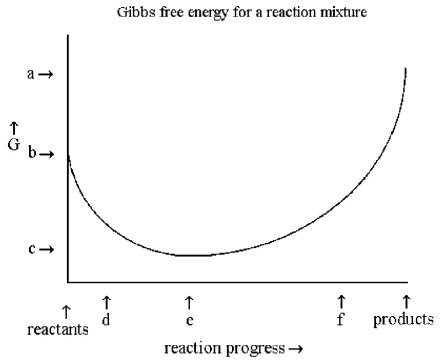 -According to the diagram above,
At 2600 K,ΔG° = 775 kJ for the vaporization of boron carbide:
B4C(s)⇌ 4 B(g)+ C(s)
Find ΔG and determine if the process is spontaneous if the reaction vessel contains 4.00 mol B4C(s),0.400 mol of C(s),and B(g)at a partial pressure of 1.0 × 10⁻⁵ atm.At this temperature,R T = 21.6 kJ.
(Multiple Choice)
4.8/5 (78)
(78) Classify each of the following processes as spontaneous or nonspontaneous.
I.H2O(l)→ H2O(g)T = 25°C,vessel open to atmosphere with 50% relative humidity
II.H2O(s)→ H2O(l)T = 25°C,P = 1 atm
(Multiple Choice)
4.9/5 (75)
(75) Why is the sign of ΔG rather than the sign of ΔStotal generally used to determine the spontaneity of a chemical reaction?
(Multiple Choice)
4.9/5 (76)
(76) A reaction has ΔH° = 61.9 kJ/mol and ΔS° = 405.4 J/K.Is this reaction spontaneous or nonspontaneous? At what temperature (if any)can the spontaneity be reversed?
(Multiple Choice)
4.9/5 (77)
(77) For the following reaction find Kp at 25°C and indicate whether Kp should increase or decrease as the temperature rises.
NH4HS(s)⇌ H2S(g)+ NH3(g)ΔH° = 83.47 kJ and ΔG° = 17.5 kJ at 25°C.
(Multiple Choice)
4.8/5 (77)
(77) At 25°C,ΔH° = 1.895 kJ and ΔS° = -3.363 J/K for the transition
C(graphite)→ C(diamond)
Based on these data,
(Multiple Choice)
5.0/5 (82)
(82) 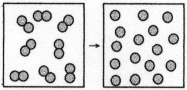 -The figure above represents the reaction O2(g)→ 2O(g),which is nonspontaneous at 25°C.How will the spontaneity of this reaction vary with temperature? This reaction is
 (Multiple Choice)
4.8/5 (92)
(92) A reaction for which ΔH° = + 98.8 kJ and ΔS° = + 141.5 J/K is ________ (spontaneous or nonspontaneous)at low temperatures and ________ (spontaneous or nonspontaneous)at high temperatures.
(Short Answer)
4.7/5 (74)
(74) Which of the following is a criterion for spontaneity that holds for any process?
(Multiple Choice)
4.9/5 (75)
(75) Which of the three laws of thermodynamics provides a criterion for spontaneity?
(Multiple Choice)
4.9/5 (74)
(74) The figure below represents the spontaneous reaction of H2 (shaded spheres)with O2 (unshaded spheres)to produce gaseous H2O. 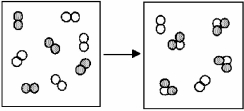 -How will the spontaneity of this reaction vary with temperature? This reaction is
 (Multiple Choice)
4.8/5 (65)
(65) 
Filters
- Essay(0)
- Multiple Choice(0)
- Short Answer(0)
- True False(0)
- Matching(0)