



 Chat with AI
Exam 4: Reactions in Aqueous Solutions

Exam 1: Chemistry: Matter and Measurement219 Questions
Exam 2: Atoms, molecules, and Ions257 Questions
Exam 3: Formulas, equations, and Moles208 Questions
Exam 4: Reactions in Aqueous Solutions174 Questions
Exam 5: Periodicity and the Atomic Structure of Atoms158 Questions
Exam 6: Ionic Bonds and Some Main-Group Chemistry173 Questions
Exam 7: Covalent Bonds and Molecular Structure232 Questions
Exam 8: Thermochemistry: Chemical Energy163 Questions
Exam 9: Gases: Their Properties and Behavior182 Questions
Exam 10: Liquids,solids,and Phase Changes186 Questions
Exam 11: Solutions and Their Properties192 Questions
Exam 12: Chemical Kinetics206 Questions
Exam 13: Chemical Equilibrium166 Questions
Exam 14: Aqueous Equilibria: Acids and Bases224 Questions
Exam 15: Applications of Aqueous Equilibria190 Questions
Exam 16: Thermodynamics: Entropy, free Energy, and Equilibrium144 Questions
Exam 17: Electrochemistry176 Questions
Exam 18: Hydrogen, oxygen, and Water175 Questions
Exam 19: The Main-Group Elements202 Questions
Exam 20: Transition Elements and Coordination Chemistry185 Questions
Exam 21: Metals and Solid-State Materials149 Questions
Exam 22: Nuclear Chemistry85 Questions
Exam 23: Organic and Biological Chemistry285 Questions
Select questions type


Using the following portion of the activity series for oxidation half reactions
K(s)→ K+(aq)+ e-
Al(s)→ Al3+(aq)+ 3e-
Fe(s)→ Fe2+(aq)+ 2e-
Sn(s)→ Sn2+(aq)+ 2e-
Determine which reaction will occur.

Free
(Multiple Choice)
4.8/5  (82)
(82) Correct Answer: Verified
D
What is the oxidation number of the sulfur atom in K2SO4 ?
Free
(Multiple Choice)
4.9/5 (76)
(76) Correct Answer:Verified
VerifiedD
What is the molarity of a potassium triiodide solution,KI3(aq),if 30.00 mL of the solution is required to completely react with 25.00 mL of a 0.200 M thiosulfate solution,Na2S2O3(aq)? The chemical equation for the reaction is:
2 S2O32-(aq)+ I3-(aq)→ S4O62-(aq)+ 3 I-(aq)
Free
(Multiple Choice)
4.8/5 (89)
(89) Correct Answer:Verified
VerifiedA
What is the oxidation number change for the bromine atom in the following unbalanced reduction half reaction?
Br O3- (aq)+ H+(aq)→ Br-(aq)+ H2O(l)
(Multiple Choice)
4.8/5 (85)
(85) What are the coefficients in front of NO3-(aq)and Cu(s)when the following redox equation is balanced in an acidic solution:
_____ NO3-(aq)+ _____ Cu(s)→ _____ NO(g)+ _____ Cu2+(aq)?
(Multiple Choice)
4.8/5 (76)
(76) The reaction Na3PO4(aq)+ 3 AgNO3(aq)→ Ag3PO4(s)+ 3 NaNO3(aq)is best classified as a(n)
(Multiple Choice)
4.8/5 (88)
(88) Using the following portion of the activity series for oxidation half reactions,determine which combination of reactants will result in a reaction.
Na(s)→ Na +(aq)+ e-
Cr(s)→ Cr3+(aq)+ 3 e-
(Multiple Choice)
5.0/5 (69)
(69) Using the following portion of the activity series for oxidation half reactions
Ca(s)→ Ca2+(aq)+ 2e-
Mg(s)→ Mg2+(aq)+ 2e-
Zn(s)→ Zn2+(aq)+ 2e-
Cu(s)→ Cu2+(aq)+ 2e-
Determine which reaction will not occur.
(Multiple Choice)
4.8/5 (79)
(79) Disproportionation is a reaction in which a substance is both oxidized and reduced in the reaction.Which is a disproportionation reaction?
(Multiple Choice)
5.0/5 (72)
(72) In the unbalanced equation shown below how many moles of electrons are transferred per mole of reducing agent?
C2O42- (aq)+ MnO4-(aq)→ CO2(aq)+ Mn2+(aq)
(Multiple Choice)
4.9/5 (73)
(73) Which of the compounds of H2C2O4, Ca(OH)2,KOH,and H I,behave as acids when they are dissolved in water?
(Multiple Choice)
4.8/5 (82)
(82) When the equation below is balanced in basic solution using the smallest whole numbers,the coefficient in front of the OH-(aq)is ________.
CN-(aq)+ MnO4-(aq)→ CNO-(aq)+ MnO2(s)
(Short Answer)
4.8/5 (88)
(88) The mixing of which pair of reactants will result in a precipitation reaction?
(Multiple Choice)
4.9/5 (72)
(72) Write a balanced net ionic equation for the reaction of AgNO3(aq)with Cu(s).
(Multiple Choice)
4.8/5 (81)
(81) Write a net ionic equation for the neutralization reaction of CH3CO2H(aq)with CsOH(aq).
(Multiple Choice)
4.8/5 (81)
(81) Write a net ionic equation for the neutralization reaction of HCN(aq)with NaOH(aq).
(Multiple Choice)
4.8/5 (69)
(69) Which species functions as the reducing agent in the following reduction-oxidation reaction?
ZnO(s)+ C(s)→ Zn(s)+ CO(g)
(Multiple Choice)
4.9/5 (81)
(81) 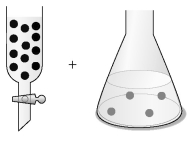 -Which of the above graphs corresponds to titration II?

Filters
- Essay(0)
- Multiple Choice(0)
- Short Answer(0)
- True False(0)
- Matching(0)