



 Chat with AI
Exam 16: Thermodynamics: Entropy, free Energy, and Equilibrium

Exam 1: Chemistry: Matter and Measurement219 Questions
Exam 2: Atoms, molecules, and Ions257 Questions
Exam 3: Formulas, equations, and Moles208 Questions
Exam 4: Reactions in Aqueous Solutions174 Questions
Exam 5: Periodicity and the Atomic Structure of Atoms158 Questions
Exam 6: Ionic Bonds and Some Main-Group Chemistry173 Questions
Exam 7: Covalent Bonds and Molecular Structure232 Questions
Exam 8: Thermochemistry: Chemical Energy163 Questions
Exam 9: Gases: Their Properties and Behavior182 Questions
Exam 10: Liquids,solids,and Phase Changes186 Questions
Exam 11: Solutions and Their Properties192 Questions
Exam 12: Chemical Kinetics206 Questions
Exam 13: Chemical Equilibrium166 Questions
Exam 14: Aqueous Equilibria: Acids and Bases224 Questions
Exam 15: Applications of Aqueous Equilibria190 Questions
Exam 16: Thermodynamics: Entropy, free Energy, and Equilibrium144 Questions
Exam 17: Electrochemistry176 Questions
Exam 18: Hydrogen, oxygen, and Water175 Questions
Exam 19: The Main-Group Elements202 Questions
Exam 20: Transition Elements and Coordination Chemistry185 Questions
Exam 21: Metals and Solid-State Materials149 Questions
Exam 22: Nuclear Chemistry85 Questions
Exam 23: Organic and Biological Chemistry285 Questions
Select questions type


Which has the highest entropy in each set?
I.H2O(s),H2O(l),H2O(g)at 0.1°C,4.58 atm
II.H2O(l)at 0°C,H2O(l)at 25°C,H2O(l)at 100°C (all at 1.0 atm pressure)
(Multiple Choice)
4.8/5  (82)
(82) Without doing any calculations,determine whether the standard entropy change,ΔS° is positive or negative for each of the following reactions.
Reaction 1: S(s,rhombic)+ O2(g)→ SO2(g)
Reaction 2: 2 SO2(g)+ O2(g)→ 2 SO3(g)
(Multiple Choice)
4.8/5 (85)
(85) A positive value of ΔG°f for a solid compound at 25°C means the
(Multiple Choice)
4.9/5 (79)
(79) Assume a heteronuclear diatomic molecule,AB,forms a one-dimensional crystal by lining up along the x-axis.Also assume that each molecule can only have one of six possible orientations,corresponding to atom A facing in either the positive or negative direction along the x-,y-,or z-axis.If the molecules are arranged randomly in the six directions,the molar entropy at absolute zero should be
(Multiple Choice)
5.0/5 (75)
(75) For the reaction N2(g)+ 2 O2(g)→ 2 NO2(g),ΔH° = 66.4 kJ/mol and ΔS° = -121.5 J/K.Is there a temperature at which the spontaneity of this reaction be changed,either from spontaneous to nonspontaneous or nonspontaneous to spontaneous? If so,estimate the temperature.
(Essay)
4.8/5 (90)
(90) 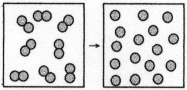 -The figure above represents the nonspontaneous reaction O2(g)→ 2O(g).What are the signs (+ or -)of ΔH,ΔS,and ΔG for this process?
 (Multiple Choice)
4.9/5 (80)
(80) A reaction has ΔH° = -60.9 kJ/mol and ΔS° = 266.6 J/K.Is this reaction spontaneous or nonspontaneous? At what temperature (if any)can the spontaneity be reversed?
(Multiple Choice)
4.8/5 (82)
(82) 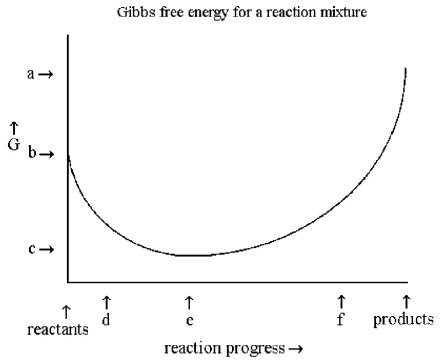 -According to the diagram above,
Which one of the following would be expected to have the lowest standard molar entropy,S°,at 25°C?
(Multiple Choice)
4.7/5 (70)
(70) For which process is the sign of ΔS negative in the system?
(Multiple Choice)
4.7/5 (77)
(77) Chemical and physical changes can be classified as spontaneous or nonspontaneous.At 25°C and
1 atm pressure the decomposition of water into hydrogen and oxygen is classified as ________,and the melting of ice is classified as ________.
(Short Answer)
4.8/5 (77)
(77) Which of the following are unstable with respect to their constituent elements at 25°C? 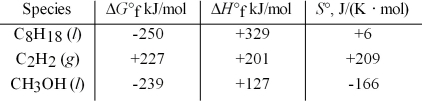
(Multiple Choice)
5.0/5 (67)
(67) Consider the reaction 2A(g)⇌ A2(g).The following pictures represent two possible initial states and the equilibrium state of the system.  -For initial state 2 what is the relationship between the reaction quotient,Qp,and the equilibrium constant,Kp?
 (Multiple Choice)
5.0/5 (83)
(83) 
Filters
- Essay(0)
- Multiple Choice(0)
- Short Answer(0)
- True False(0)
- Matching(0)