



 Chat with AI
Exam 16: Thermodynamics: Entropy, free Energy, and Equilibrium

Exam 1: Chemistry: Matter and Measurement219 Questions
Exam 2: Atoms, molecules, and Ions257 Questions
Exam 3: Formulas, equations, and Moles208 Questions
Exam 4: Reactions in Aqueous Solutions174 Questions
Exam 5: Periodicity and the Atomic Structure of Atoms158 Questions
Exam 6: Ionic Bonds and Some Main-Group Chemistry173 Questions
Exam 7: Covalent Bonds and Molecular Structure232 Questions
Exam 8: Thermochemistry: Chemical Energy163 Questions
Exam 9: Gases: Their Properties and Behavior182 Questions
Exam 10: Liquids,solids,and Phase Changes186 Questions
Exam 11: Solutions and Their Properties192 Questions
Exam 12: Chemical Kinetics206 Questions
Exam 13: Chemical Equilibrium166 Questions
Exam 14: Aqueous Equilibria: Acids and Bases224 Questions
Exam 15: Applications of Aqueous Equilibria190 Questions
Exam 16: Thermodynamics: Entropy, free Energy, and Equilibrium144 Questions
Exam 17: Electrochemistry176 Questions
Exam 18: Hydrogen, oxygen, and Water175 Questions
Exam 19: The Main-Group Elements202 Questions
Exam 20: Transition Elements and Coordination Chemistry185 Questions
Exam 21: Metals and Solid-State Materials149 Questions
Exam 22: Nuclear Chemistry85 Questions
Exam 23: Organic and Biological Chemistry285 Questions
Select questions type


What is the sign of ΔS for each of the following processes?
I.The separation of gaseous molecules of UF6,into 238UF6 and 235UF6 at
Constant temperature and pressure.
II.The dissolving of I2(s)in CCl4(l).
(Multiple Choice)
4.7/5  (81)
(81) For the evaporation of water during perspiration on a hot,dry day,
(Multiple Choice)
4.9/5 (85)
(85) In figure (1)below argon atoms,represented by unshaded spheres,and neon atoms,represented by shaded spheres,are in separate compartments.Figure (2)shows the equilibrium state of the system after the stopcock separating the two compartments is opened.Assuming that argon and neon behave as ideal gases,what are the signs (+,-,or 0)of ΔH,ΔS,and ΔG for this process? 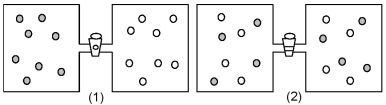
(Multiple Choice)
4.9/5 (76)
(76) The standard molar entropy for Br2(g)is 245.46 J/(mol ∙ K)at 25°C.Given that ΔS° = 104.58 J/K for the dissociation of one mole of Br2(g)into Br(g)at 25°C,find the standard molar entropy for Br(g)at 25°C.
(Multiple Choice)
4.8/5 (81)
(81) Consider the reaction 2A(g)⇌ A2(g).The following pictures represent two possible initial states and the equilibrium state of the system.  -What are the signs (+ or -)of ΔH,ΔS,and ΔG when the system spontaneously goes from initial state 1 to the equilibrium state?
 (Multiple Choice)
4.7/5 (74)
(74) Standard free energies of formation,ΔG°,in kJ/mol,are given below each reactant and product in the reaction shown below.The standard free energy of reaction,ΔG°,for this reaction is ________ kJ.
CH4(g)+ 2 O2(g)→ CO2(g)+ 2 H2O(l)
-50.8 0 -394.4 -237.2
(Short Answer)
4.8/5 (74)
(74) Which of the following statements must be true for the entropy of a pure solid to be zero?
I.The temperature must be 0 K.
II.The solid must be crystalline,not amorphous.
III).The solid must be perfectly ordered.
IV.The solid must be an element.
(Multiple Choice)
4.9/5 (76)
(76) ΔS° = -198.7 J/K for the reaction shown below.Calculate S° for NH3(g).
N2(g)+ 3 H2(g)→ 2 NH3(g) 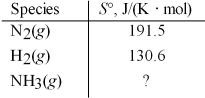
(Multiple Choice)
4.8/5 (92)
(92) Under which of the following conditions would one mole of He have the highest entropy,S?
(Multiple Choice)
5.0/5 (98)
(98) Predict the sign of ΔS of the system for both of the following.
I.2 C(graphite)+ O2(g)→ 2 CO(g)
II.C4H10(g)→ C4H10(l)
(Multiple Choice)
4.8/5 (72)
(72) For a particular process,ΔG = ΔH at a given temperature and pressure.Therefore,
(Multiple Choice)
4.7/5 (76)
(76) What is the entropy of 10 molecules in a system of 100 boxes?
(Short Answer)
4.9/5 (88)
(88) The following pictures represent three equilibrium mixtures for the interconversion of A,B,and C molecules (unshaded spheres)into X,Y,and Z molecules (shaded spheres),respectively.What is the sign of ΔG ° for each of the three reactions? 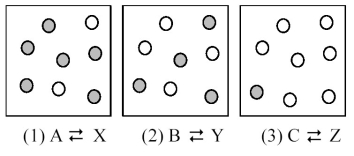
(Multiple Choice)
4.8/5 (74)
(74) The chemical system shown below is at equilibrium.Which change in conditions will not result in a spontaneous forward reaction?
N2(g)+ 3 H2(g)⇌ 2 NH3(g)Kp = 4 × 10⁵
(Multiple Choice)
5.0/5 (80)
(80) Calculate Ksp for PbI2 at 25°C based on the following data: 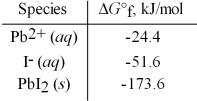
(Multiple Choice)
4.8/5 (75)
(75) Consider the reaction 2A(g)⇌ A2(g).The following pictures represent two possible initial states and the equilibrium state of the system.
-What are the signs (+ or -)of ΔH,ΔS,and ΔG when the system spontaneously goes from initial state 2 to the equilibrium state?
-What are the signs (+ or -)of ΔH,ΔS,and ΔG when the system spontaneously goes from initial state 2 to the equilibrium state? (Multiple Choice)
4.9/5 (87)
(87) At 25°C,ΔG° = -198 kJ for the reaction,NO(g)+ O3(g)⇌ NO2(g)+ O2(g).
Calculate ΔG under the following conditions: 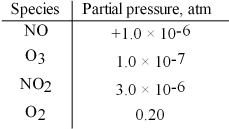
(Multiple Choice)
4.8/5 (74)
(74) 
Filters
- Essay(0)
- Multiple Choice(0)
- Short Answer(0)
- True False(0)
- Matching(0)