



 Chat with AI
Exam 8: Thermochemistry: Chemical Energy

Exam 1: Chemistry: Matter and Measurement219 Questions
Exam 2: Atoms, molecules, and Ions257 Questions
Exam 3: Formulas, equations, and Moles208 Questions
Exam 4: Reactions in Aqueous Solutions174 Questions
Exam 5: Periodicity and the Atomic Structure of Atoms158 Questions
Exam 6: Ionic Bonds and Some Main-Group Chemistry173 Questions
Exam 7: Covalent Bonds and Molecular Structure232 Questions
Exam 8: Thermochemistry: Chemical Energy163 Questions
Exam 9: Gases: Their Properties and Behavior182 Questions
Exam 10: Liquids,solids,and Phase Changes186 Questions
Exam 11: Solutions and Their Properties192 Questions
Exam 12: Chemical Kinetics206 Questions
Exam 13: Chemical Equilibrium166 Questions
Exam 14: Aqueous Equilibria: Acids and Bases224 Questions
Exam 15: Applications of Aqueous Equilibria190 Questions
Exam 16: Thermodynamics: Entropy, free Energy, and Equilibrium144 Questions
Exam 17: Electrochemistry176 Questions
Exam 18: Hydrogen, oxygen, and Water175 Questions
Exam 19: The Main-Group Elements202 Questions
Exam 20: Transition Elements and Coordination Chemistry185 Questions
Exam 21: Metals and Solid-State Materials149 Questions
Exam 22: Nuclear Chemistry85 Questions
Exam 23: Organic and Biological Chemistry285 Questions
Select questions type


Which thermodynamic function is most related to disorder and probability?
(Multiple Choice)
4.9/5  (91)
(91) When the reaction below is performed in a water bath,will the temperature of the water bath increase or decrease?
432 kJ + A + 2 B → 3 C
(Short Answer)
4.7/5 (72)
(72) 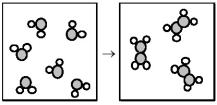 -What are the signs of ΔH and ΔS for the reaction represented in the above drawing?
 (Multiple Choice)
4.9/5 (74)
(74) The following drawing is a representation of a reaction for which ΔH° = +62 kJ.This reaction is likely to be 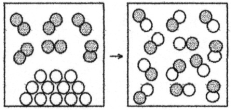
(Multiple Choice)
5.0/5 (60)
(60) When 1.50 g of Ba(s)is added to 100.00 g of water in a container open to the atmosphere,the reaction shown below occurs and the temperature of the resulting solution rises from 22.00°C to 33.10°C.If the specific heat of the solution is 4.18 J/(g ∙ °C),calculate ΔH for the reaction,as written.
Ba(s)+ 2 H2O(l)→ Ba(OH)2(aq)+ H2(g)ΔH = ?
(Multiple Choice)
4.8/5 (72)
(72) Calculate the total quantity of heat required to convert 25.0 g of liquid CCl4(l)from 35.0°C to gaseous CCl4 76.8°C (the normal boiling point for CCl4)? The specific heat of CCl4(l)is
0)857 J/(g ∙°C),its heat of fusion is 3.27 kJ/mol,and its heat of vaporization is 29.82 kJ/mol.
(Multiple Choice)
4.9/5 (68)
(68) He gas is contained in a one-liter flask that is connected to an empty one-liter flask with a closed stopcock between the two flasks.When the stopcock is opened some of the He enters the evacuated flask.For this system
(Multiple Choice)
4.8/5 (75)
(75) Kinetic energy increases with increasing ________ and increasing ________.
(Short Answer)
4.7/5 (88)
(88) At constant pressure for the reaction shown below,what can be said about PΔV and ΔE?
N2(g)+ 3 H2(g)→ 2 NH3(g)ΔH° = - 92.2 kJ
(Multiple Choice)
5.0/5 (80)
(80) How much heat is absorbed/released when 20.00 g of NH3(g)reacts in the presence of excess O2(g)to produce NO(g)and H2O(l)according to the following chemical equation?
4 NH3(g)+ 5 O2(g)→ 4 NO(g)+ 6 H2O(l)ΔH° = +1168 kJ
(Multiple Choice)
4.9/5 (91)
(91) The heat of vaporization of water at 100°C is 40.66 kJ/mol.Calculate the quantity of heat that is absorbed/released when 9.00 g of steam condenses to liquid water at 100°C.
(Multiple Choice)
5.0/5 (64)
(64) Acetylene torches utilize the following reaction:
2 C2H2(g)+ 5 O2(g)→ 4 CO2(g)+ 2 H2O(g)
Use the given standard enthalpies of formation to calculate ΔH° for this reaction. 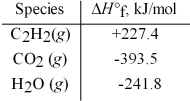
(Multiple Choice)
5.0/5 (75)
(75) Methanol can be produced from carbon monoxide and hydrogen with suitable catalysts:
CO(g)+ 2 H2(g)→ CH3OH(l)at 25°C ΔH° = -128.1 kJ and ΔS° = -332 J/K
Find ΔG° at 25°C.
(Multiple Choice)
4.9/5 (76)
(76) At 298 K the average kinetic energy is the same for H2,He,and N2.The gas with the highest average velocity is
(Multiple Choice)
4.8/5 (78)
(78) For the reaction 2CH4 (g)+ 3 Cl2 (g)→ 2 CHCl3 (l)+ 3 H2 (g),ΔH° = -118.6 kJ.
ΔH°f = -134.1 kJ/mol for CHCl3 (l).Find ΔH°f for CH4 (g).
(Multiple Choice)
4.8/5 (74)
(74) 
Filters
- Essay(0)
- Multiple Choice(0)
- Short Answer(0)
- True False(0)
- Matching(0)