



 Chat with AI
Exam 8: Thermochemistry: Chemical Energy

Exam 1: Chemistry: Matter and Measurement219 Questions
Exam 2: Atoms, molecules, and Ions257 Questions
Exam 3: Formulas, equations, and Moles208 Questions
Exam 4: Reactions in Aqueous Solutions174 Questions
Exam 5: Periodicity and the Atomic Structure of Atoms158 Questions
Exam 6: Ionic Bonds and Some Main-Group Chemistry173 Questions
Exam 7: Covalent Bonds and Molecular Structure232 Questions
Exam 8: Thermochemistry: Chemical Energy163 Questions
Exam 9: Gases: Their Properties and Behavior182 Questions
Exam 10: Liquids,solids,and Phase Changes186 Questions
Exam 11: Solutions and Their Properties192 Questions
Exam 12: Chemical Kinetics206 Questions
Exam 13: Chemical Equilibrium166 Questions
Exam 14: Aqueous Equilibria: Acids and Bases224 Questions
Exam 15: Applications of Aqueous Equilibria190 Questions
Exam 16: Thermodynamics: Entropy, free Energy, and Equilibrium144 Questions
Exam 17: Electrochemistry176 Questions
Exam 18: Hydrogen, oxygen, and Water175 Questions
Exam 19: The Main-Group Elements202 Questions
Exam 20: Transition Elements and Coordination Chemistry185 Questions
Exam 21: Metals and Solid-State Materials149 Questions
Exam 22: Nuclear Chemistry85 Questions
Exam 23: Organic and Biological Chemistry285 Questions
Select questions type


What are the signs of ΔH,ΔS,and ΔG for the following spontaneous change? 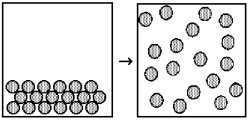
(Multiple Choice)
4.8/5  (79)
(79) The following drawing is a representation of a reaction of the type A → B,where different shaded spheres represent different molecular structures.For this reaction ΔH° = -30 kJ.This reaction is likely to be 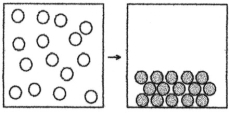
(Multiple Choice)
4.9/5 (88)
(88) A process is carried out at constant pressure.Given that ΔE is positive and ΔH is negative,
(Multiple Choice)
4.9/5 (87)
(87) An ideal gas expands into a vacuum (external pressure = 0)without gaining or losing heat.For this expansion
(Multiple Choice)
4.9/5 (82)
(82) How much heat is absorbed/released when 35.00 g of NH3(g)reacts in the presence of excess O2(g)to produce NO(g)and H2O(l)according to the following chemical equation?
4 NH3(g)+ 5 O2(g)→ 4 NO(g)+ 6 H2O(l)ΔH° = 1168 kJ
(Multiple Choice)
4.9/5 (69)
(69) A slice of cheese pizza has a caloric content of 150 Cal.If this energy could be used to power a 2500 Watt microwave oven,how many minutes could the microwave oven be operated?
(Multiple Choice)
5.0/5 (62)
(62) The law of conservation of energy is also known as the ________ law of thermodynamics.
(Short Answer)
4.8/5 (77)
(77) Calculate the work,w,gained or lost by the system when a gas expands from 15 L to 40 L against a constant external pressure of 1.5 atm.1 L ∙ atm = 101 J
(Multiple Choice)
4.8/5 (80)
(80) The following drawing is a representation of a reaction for which ΔH° = -22 kJ.This reaction is likely to be 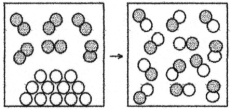
(Multiple Choice)
4.8/5 (79)
(79) A reaction that absorbs 49.6 kJ from the surroundings in a vessel that undergoes a volume decrease of 1.25 L at a constant 4.00 atm pressure has an energy change,ΔE = ________ kJ.
(Short Answer)
4.8/5 (80)
(80) When 50.0 mL of 0.400 M Ca(NO3)2 is added to 50.0 mL of 0.800 M NaF,CaF2 precipitates,as shown in the net ionic equation below.The initial temperature of both solutions is 23.0°C.Assuming that the reaction goes to completion,and that the resulting solution has a mass of 100.00 g and a specific heat of 4.18 J/(g ∙ °C),calculate the final temperature of the solution.
Ca2+(aq)+ 2 F-(aq)→ CaF2(s)ΔH° = -11.5 kJ
(Multiple Choice)
4.8/5 (89)
(89) At constant pressure,the combustion of 15.0 g of C2H6(g)releases 777 kJ of heat.What is ΔH for the reaction given below?
2 C2H6(g)+ 7 O2(g)→ 4 CO2(g)+ 6 H2O(l)
(Multiple Choice)
4.8/5 (85)
(85) For which should the standard heat of formation ΔH°f,be zero at 25°C?
(Multiple Choice)
4.9/5 (86)
(86) The sum of the potential and kinetic energies for every molecule or ion in a system is the ________ energy of the system and is given the symbol ________.
(Short Answer)
4.8/5 (81)
(81) Given: S (s)+ O2 (g)→ SO2 (g)ΔH° = -296.1 kJ
2 SO3 (g)→ 2 SO2 (g)+ O2 (g)ΔH° = 198.2 kJ
Find ΔH° for : 2 S(s)+ 3 O2(g)→ 2 SO3(g)
(Multiple Choice)
5.0/5 (83)
(83) In the reaction shown below,________ kJ of heat are released per mole of O2(g)that reacts.
C3H8(g)+ 5 O2(g)→ 3 CO2(g)+ 4 H2O(g)ΔH = -2045 kJ
(Short Answer)
4.8/5 (72)
(72) 10.0 g of a metal,initially at 25°C,are placed into 10.0 g of water,initially at 100°C.Which metal will have the highest final temperature? Shown after each metal is its specific heat in J/(g∙°C).
(Multiple Choice)
4.9/5 (78)
(78) Given: 4 NO2(g)+ O2(g)→ 2 N2O5(g)ΔH° = -110.2 kJ
Find ΔH° for N2O5(g)→ 2 NO2(g)+ 1/2 O2(g).
(Multiple Choice)
4.9/5 (80)
(80) 
Filters
- Essay(0)
- Multiple Choice(0)
- Short Answer(0)
- True False(0)
- Matching(0)