



 Chat with AI
Exam 8: Thermochemistry: Chemical Energy

Exam 1: Chemistry: Matter and Measurement219 Questions
Exam 2: Atoms, molecules, and Ions257 Questions
Exam 3: Formulas, equations, and Moles208 Questions
Exam 4: Reactions in Aqueous Solutions174 Questions
Exam 5: Periodicity and the Atomic Structure of Atoms158 Questions
Exam 6: Ionic Bonds and Some Main-Group Chemistry173 Questions
Exam 7: Covalent Bonds and Molecular Structure232 Questions
Exam 8: Thermochemistry: Chemical Energy163 Questions
Exam 9: Gases: Their Properties and Behavior182 Questions
Exam 10: Liquids,solids,and Phase Changes186 Questions
Exam 11: Solutions and Their Properties192 Questions
Exam 12: Chemical Kinetics206 Questions
Exam 13: Chemical Equilibrium166 Questions
Exam 14: Aqueous Equilibria: Acids and Bases224 Questions
Exam 15: Applications of Aqueous Equilibria190 Questions
Exam 16: Thermodynamics: Entropy, free Energy, and Equilibrium144 Questions
Exam 17: Electrochemistry176 Questions
Exam 18: Hydrogen, oxygen, and Water175 Questions
Exam 19: The Main-Group Elements202 Questions
Exam 20: Transition Elements and Coordination Chemistry185 Questions
Exam 21: Metals and Solid-State Materials149 Questions
Exam 22: Nuclear Chemistry85 Questions
Exam 23: Organic and Biological Chemistry285 Questions
Select questions type


Imagine a reaction that results in a change in both volume and temperature,as shown in the diagram below.What is the sign of the work being done,and what is the sign of the enthalpy change involved in this reaction? 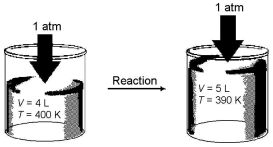
(Multiple Choice)
4.9/5  (77)
(77) The reaction 4 Ag(s)+ O2(g)→ 2 Ag2O(s)favors Ag2O at low temperature,but it favors Ag and O2 at high temperatures.How can this be explained in terms of ΔH and ΔS?
(Multiple Choice)
5.0/5 (91)
(91) For the reaction I2(g)→ I2(s),ΔH° = -62.4 kJ at 25°C.Based on these data,at 25°C
(Multiple Choice)
4.9/5 (81)
(81) When 1.50 mol of CH4(g)reacts with excess Cl2(g)at constant pressure according to the chemical equation shown below,1062 kJ of heat are released.Calculate the value of ΔH for this reaction,as written.
2 CH4(g)+ 3 Cl2(g)→ 2 CHCl3(l)+ 3 H2(g)ΔH = ?
(Multiple Choice)
4.9/5 (72)
(72) Most chemical reactions are carried out in one of two ways:
I.in an open vessel at constant atmospheric pressure
II.in a closed vessel
Which is true?
(Multiple Choice)
4.7/5 (79)
(79) When 1.0 mole of MgSO4 is dissolved in water contained in a calorimeter,the temperature of the water and dissolved ions increases.Therefore the sign of ΔH for this reaction is ________,heat is transferred ________ the system ________ the surroundings,and the reaction is classified as ________.
(Short Answer)
4.9/5 (80)
(80) At 1 atm pressure,the heat of sublimation of gallium is 277 kJ/mol and the heat of vaporization is 271 kJ/mol.To the correct number of significant figures,how much heat is required to melt 2.50 mol of gallium at 1 atm pressure?
(Multiple Choice)
4.9/5 (95)
(95) For a system at constant pressure,12,400 calories of heat are released.This quantity of heat is equivalent to
(Multiple Choice)
4.8/5 (79)
(79) When 0.250 mol of CH4(g)reacts with excess Cl2(g)at constant pressure according to the chemical equation shown below,177 kJ of heat are released.Calculate the value of ΔH for this reaction,as written.
2 CH4(g)+ 3 Cl2(g)→ 2 CHCl3(l)+ 3 H2(g)ΔH = ?
(Multiple Choice)
4.8/5 (84)
(84) Energy can be classified as either ________ energy (energy of motion)or ________ energy (stored energy).
(Short Answer)
4.8/5 (93)
(93) Calculate the total quantity of heat required to convert 25.0 g of liquid CCl4(l)from 25.0°C to gaseous CCl4 at 76.8°C (the normal boiling point for CCl4)? The specific heat of CCl4(l)is
0)857 J/(g·°C),its heat of fusion is 3.27 kJ/mol,and its heat of vaporization is 29.82 kJ/mol.
(Multiple Choice)
4.8/5 (89)
(89) Consider the conversion of white tin to gray tin:
Sn(white)→ Sn(gray)ΔH° = -2.09 kJ ΔS° = -7.41 J/K
Based on these data,
(Multiple Choice)
4.7/5 (88)
(88) The heat of combustion per mole for acetylene,C2H2(g),is -1299.5 kJ/mol.Assuming that the combustion products are CO2(g)and H2O(l),and given that the enthalpy of formation is -393.5 kJ/mol for CO2(g)and -285.8 kJ/mol for H2O(l),find the enthalpy of formation of C2H2(g).
(Multiple Choice)
4.8/5 (81)
(81) Which equation represents the reaction whose ΔH,represents the standard enthalpy of formation of CHCl3(l)at 25°C? (i.e. ,for which is ΔH = ΔH°f of CHCl3)
(Multiple Choice)
4.8/5 (92)
(92) 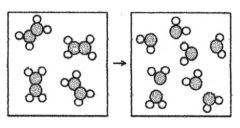 -What are the signs of ΔH and ΔS for the reaction represented in the above drawing?
 (Multiple Choice)
4.9/5 (77)
(77) The values of ΔH°f for the three states of benzene are approximately -22 kcal/mol,-11 kcal/mol,and 20 kcal/mol.Which is the value for solid benzene?
(Multiple Choice)
4.7/5 (90)
(90) The heat of vaporization of water at 100°C is 40.66 kJ/mol.Calculate the quantity of heat that is absorbed/released when 5.00 g of steam condenses to liquid water at 100°C.
(Multiple Choice)
4.9/5 (66)
(66) 
Filters
- Essay(0)
- Multiple Choice(0)
- Short Answer(0)
- True False(0)
- Matching(0)