



 Chat with AI
Exam 12: Chemical Kinetics

Exam 1: Chemistry: Matter and Measurement219 Questions
Exam 2: Atoms, molecules, and Ions257 Questions
Exam 3: Formulas, equations, and Moles208 Questions
Exam 4: Reactions in Aqueous Solutions174 Questions
Exam 5: Periodicity and the Atomic Structure of Atoms158 Questions
Exam 6: Ionic Bonds and Some Main-Group Chemistry173 Questions
Exam 7: Covalent Bonds and Molecular Structure232 Questions
Exam 8: Thermochemistry: Chemical Energy163 Questions
Exam 9: Gases: Their Properties and Behavior182 Questions
Exam 10: Liquids,solids,and Phase Changes186 Questions
Exam 11: Solutions and Their Properties192 Questions
Exam 12: Chemical Kinetics206 Questions
Exam 13: Chemical Equilibrium166 Questions
Exam 14: Aqueous Equilibria: Acids and Bases224 Questions
Exam 15: Applications of Aqueous Equilibria190 Questions
Exam 16: Thermodynamics: Entropy, free Energy, and Equilibrium144 Questions
Exam 17: Electrochemistry176 Questions
Exam 18: Hydrogen, oxygen, and Water175 Questions
Exam 19: The Main-Group Elements202 Questions
Exam 20: Transition Elements and Coordination Chemistry185 Questions
Exam 21: Metals and Solid-State Materials149 Questions
Exam 22: Nuclear Chemistry85 Questions
Exam 23: Organic and Biological Chemistry285 Questions
Select questions type


The following reaction is second order in A and first order in B:
A + B → Products Rate = k[A]2[B]
What is the rate constant k of this reaction in vessel (b)relative to the rate constant k of this reaction in vessel (a)? Each vessel has the same volume.Shaded spheres represent A molecules,and unshaded spheres represent B molecules. 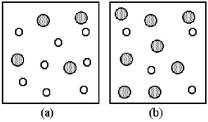
(Multiple Choice)
4.8/5  (83)
(83) For a reaction that follows the general rate law,Rate = k[A][B]2,what will happen to the rate of reaction if the concentration of A is increased by a factor of 5.00? The rate will
(Multiple Choice)
4.9/5 (66)
(66) For a reaction that follows the general rate law,Rate = k[A][B]2,what will happen to the rate of reaction if the concentration of A is increased by a factor of 3.00? The rate will
(Multiple Choice)
4.8/5 (81)
(81) The decay curve shown below approximates the decay of iodine-123.What is the approximate half-life of iodine-123? 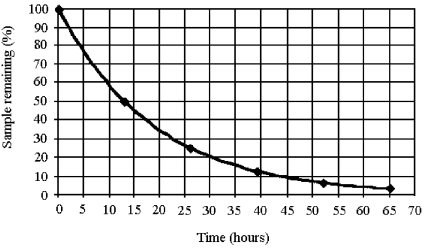
(Multiple Choice)
4.9/5 (69)
(69) The following reaction is second order in A and first order in B:
A + B → Products Rate = k[A]2[B]
What is the rate constant k of this reaction in vessel (b)relative to the rate constant k of this reaction in vessel (a)? Each vessel has the same volume.Shaded spheres represent A molecules,and unshaded spheres represent B molecules. 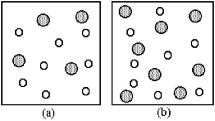
(Multiple Choice)
4.9/5 (70)
(70) Fluorine-18 is an isotope used in Positron Emission Tomography (PET)to scan the brain.If a researcher has 1.50 μg of 18F,how long before it decays to 1.0 ng? The half-life of 18F is 109.8 minutes.
(Multiple Choice)
5.0/5 (70)
(70) 
Filters
- Essay(0)
- Multiple Choice(0)
- Short Answer(0)
- True False(0)
- Matching(0)