



 Chat with AI
Exam 12: Chemical Kinetics

Exam 1: Chemistry: Matter and Measurement219 Questions
Exam 2: Atoms, molecules, and Ions257 Questions
Exam 3: Formulas, equations, and Moles208 Questions
Exam 4: Reactions in Aqueous Solutions174 Questions
Exam 5: Periodicity and the Atomic Structure of Atoms158 Questions
Exam 6: Ionic Bonds and Some Main-Group Chemistry173 Questions
Exam 7: Covalent Bonds and Molecular Structure232 Questions
Exam 8: Thermochemistry: Chemical Energy163 Questions
Exam 9: Gases: Their Properties and Behavior182 Questions
Exam 10: Liquids,solids,and Phase Changes186 Questions
Exam 11: Solutions and Their Properties192 Questions
Exam 12: Chemical Kinetics206 Questions
Exam 13: Chemical Equilibrium166 Questions
Exam 14: Aqueous Equilibria: Acids and Bases224 Questions
Exam 15: Applications of Aqueous Equilibria190 Questions
Exam 16: Thermodynamics: Entropy, free Energy, and Equilibrium144 Questions
Exam 17: Electrochemistry176 Questions
Exam 18: Hydrogen, oxygen, and Water175 Questions
Exam 19: The Main-Group Elements202 Questions
Exam 20: Transition Elements and Coordination Chemistry185 Questions
Exam 21: Metals and Solid-State Materials149 Questions
Exam 22: Nuclear Chemistry85 Questions
Exam 23: Organic and Biological Chemistry285 Questions
Select questions type


In aqueous solution,hypobromite ion,BrO-,reacts to produce bromate ion,BrO3-,and bromide ion,Br-,according to the following chemical equation.
3 BrO-(aq)→ BrO3-(aq)+ 2 Br-(aq)
A plot of 1/[BrO-] vs.time is linear and the slope is equal to 0.056 M-1s-1.If the initial concentration of BrO- is 0.80 M,how long will it take one-half of the BrO- ion to react?
(Multiple Choice)
4.8/5  (77)
(77) The relative initial rates of the reaction A2 + B2 → products in vessels (a)-(d)are 1:1:4:4.Unshaded spheres represent A2 molecules,and shaded spheres represent B2 molecules present at the beginning of the reaction.  -What is the rate law for this reaction?
 (Multiple Choice)
4.8/5 (78)
(78) The reaction shown below has the rate law: Rate = k[BrO3-][Br-][H+]2.The order of reaction with respect to H+ is ________ and the overall order is ________.
BrO3-(aq)+ 5 Br-(aq)+ 6 H+(aq)→ 3 Br2(aq)+ 3 H2O(l)
(Short Answer)
4.8/5 (86)
(86) 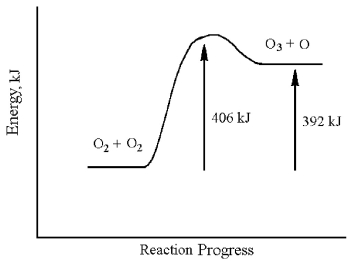 -What is the activation energy for the destruction of ozone?
 (Multiple Choice)
4.9/5 (76)
(76) What is the overall reaction order for the reaction that has the rate law: Rate = k[H2][NO]2?
(Multiple Choice)
4.9/5 (73)
(73) The following reaction is first order: C2H6 → 2 CH3.If the rate constant is equal to 5.5 × 10⁻⁴ s-1 at 1000 K,how long will it take for 0.35 mol of C2H6 in a 1.00 L container to decrease to 0.10 mol in the same container?
(Multiple Choice)
4.7/5 (83)
(83) The reaction that occurs in a Breathalyzer,a device used to determine the alcohol level in a person's bloodstream,is given below.If the rate of appearance of Cr2(SO4)3 is 1.24 mol/min at a particular moment,what is the rate of disappearance of C2H6O at that moment? 
(Multiple Choice)
4.8/5 (84)
(84) Hydrochloric acid in the hydrolysis of an ester to form an alcohol and a carboxylic acid is an example of a ________ (heterogeneous,homogeneous)catalyst.
(Short Answer)
4.9/5 (76)
(76) An aqueous reaction occurs by a two-step mechanism,shown below.
Step 1: A2X2 + Y → A2X + XY
Step 2: A2X2 + XY → A2X + X2 + Y
In this reaction the intermediate is ________,and the catalyst is ________.
(Short Answer)
4.7/5 (85)
(85) The decomposition of dinitrogen pentoxide is described by the chemical equation
2 N2O5(g)→ 4 NO2(g)+ O2(g)
If the rate of appearance of O2 is equal to 3.00 mol/min at a particular moment,what is the rate of disappearance of N2O5 at that moment?
(Multiple Choice)
4.8/5 (87)
(87)  has a decay constant,k = 1.209 × 10⁻⁴ yr-1 and a half-life of ________ years.
 (Short Answer)
4.8/5 (86)
(86) The rate-determining step in a reaction is shown below.The molecularity of this reaction is ________.
NO2(g)+ NO2(g)→ NO(g)+ NO3(g)
(Short Answer)
4.9/5 (72)
(72) An experiment with 55Co takes 47.5 hours.At the end of the experiment,1.90 ng of 55Co remains.If the half life is 18.0 hours,how many ng of 55Co were originally present?
(Multiple Choice)
4.9/5 (82)
(82) 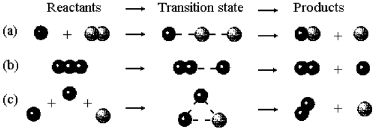 -Which of the elementary reactions shown above has a molecularity of two?
 (Multiple Choice)
4.8/5 (72)
(72) An aqueous reaction occurs by a two-step mechanism,shown below.
Step 1: A2X2 + Y → A2X + XY
Step 2: A2X2 + XY → A2X + X2 + Y
What is the catalyst in this reaction?
(Multiple Choice)
4.9/5 (84)
(84) A reaction occurs by a two-step mechanism,shown below.
Step 1: AX2(g)→ AX(g)+ X(g)
Step 2: AX2(g)+ X(g)→ AX + X2(g)
The intermediate in this reaction is ________,and the molecularity of the second step is ________.
(Short Answer)
4.8/5 (78)
(78) The decomposition of ammonia to nitrogen and hydrogen on a tungsten filament at 800°C is independent of the concentration of ammonia at high pressures of ammonia.What is the order of the reaction with respect to ammonia?
(Multiple Choice)
4.8/5 (91)
(91) For the reaction shown below,the rate of reaction of Br- is ________ times the rate of formation of Br2
over the same time period.
ClO2-(aq)+ 4 Br-(aq)+ 4 H+(aq)→ Cl-(aq)+ 2 Br2(aq)+2 H2O(l)
(Short Answer)
4.9/5 (64)
(64) The following reaction is second order in A and first order in B:
A + B → Products Rate = k[A]2[B]
What is the rate constant k of this reaction in vessel (b)relative to the rate constant k of this reaction in vessel (a)? Each vessel has the same volume.Shaded spheres represent A molecules,and unshaded spheres represent B molecules. 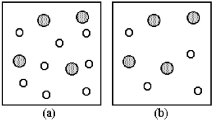
(Multiple Choice)
4.9/5 (74)
(74) Consider a reaction that occurs by the following one-step mechanism:
A2 + B2 → 2 AB
The potential energy profile for this reaction is shown below.  -What is the species present at reaction stage 3?
 (Multiple Choice)
4.9/5 (83)
(83) 
Filters
- Essay(0)
- Multiple Choice(0)
- Short Answer(0)
- True False(0)
- Matching(0)