



 Chat with AI
Exam 10: Externalities

Exam 1: Ten Principles of Economics439 Questions
Exam 2: Thinking Like an Economist617 Questions
Exam 3: Interdependence and the Gains From Trade527 Questions
Exam 4: The Market Forces of Supply and Demand698 Questions
Exam 5: Elasticity and Its Application595 Questions
Exam 6: Supply, Demand, and Government Policies644 Questions
Exam 7: Consumers, Producers, and the Efficiency of Markets549 Questions
Exam 8: Application: The Costs of Taxation511 Questions
Exam 9: Application: International Trade493 Questions
Exam 10: Externalities524 Questions
Exam 11: Public Goods and Common Resources433 Questions
Exam 12: The Design of the Tax System551 Questions
Exam 13: The Costs of Production420 Questions
Exam 14: Firms in Competitive Markets543 Questions
Exam 15: Monopoly637 Questions
Exam 16: Monopolistic Competition587 Questions
Exam 17: Oligopoly496 Questions
Exam 18: The Markets for the Factors of Production564 Questions
Exam 19: Earnings and Discrimination490 Questions
Exam 20: Income Inequality and Poverty457 Questions
Exam 21: The Theory of Consumer Choice440 Questions
Exam 22: Frontiers of Microeconomics441 Questions
Select questions type


Suppose that an MBA degree creates no externality because the benefits of an MBA are internalized by the student in the form of higher wages. If the government offers subsidies for MBAs, then which of the following statements is correct?
(Multiple Choice)
4.8/5  (77)
(77) Which of the following is an example of a positive externality?
(Multiple Choice)
4.8/5 (73)
(73) The social cost of pollution includes the private costs of the producers plus the costs to those bystanders adversely affected by the pollution.
(True/False)
4.9/5 (73)
(73) Table 10-5
The following table shows the marginal costs for each of four firms (A, B, C, and D) to eliminate units of pollution from their production processes. For example, for Firm A to eliminate one unit of pollution, it would cost $54, and for Firm A to eliminate a second unit of pollution it would cost an additional $67.
 -Refer to Table 10-5. If the government wanted to eliminate exactly 11 units of pollution, which of the following fees per unit of pollution would achieve that goal?
 (Multiple Choice)
4.9/5 (78)
(78) Figure 10-15  -Refer to Figure 10-15. The supply of pollution permits is
 (Multiple Choice)
4.9/5 (85)
(85) An example of a private solution to externalities is charities. The government encourages this private solution by allowing .
(Short Answer)
4.8/5 (89)
(89) What is the difference between command-and-control policies and market-based policies toward externalities?
(Multiple Choice)
4.8/5 (87)
(87) Figure 10-9
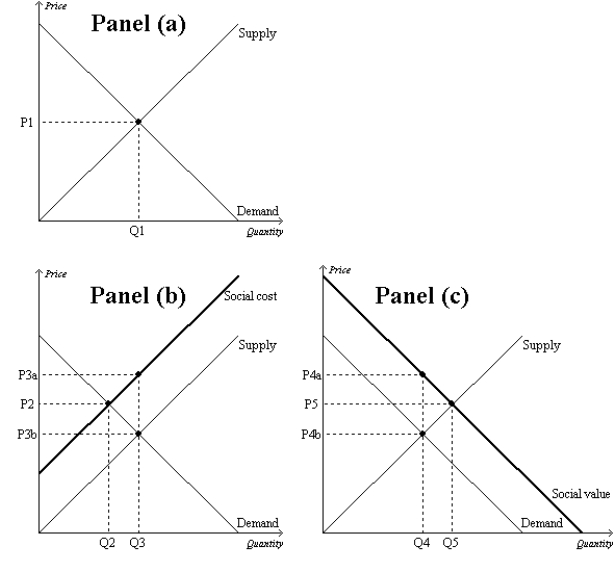 -Refer to Figure 10-9. Which graph represents a market with a positive externality?
 (Multiple Choice)
4.7/5 (83)
(83) Table 10-5
The following table shows the marginal costs for each of four firms (A, B, C, and D) to eliminate units of pollution from their production processes. For example, for Firm A to eliminate one unit of pollution, it would cost $54, and for Firm A to eliminate a second unit of pollution it would cost an additional $67.
-Refer to Table 10-5. If the government charged a fee of $69 per unit of pollution, how many units of pollution would the firms eliminate altogether?
-Refer to Table 10-5. If the government charged a fee of $69 per unit of pollution, how many units of pollution would the firms eliminate altogether? (Multiple Choice)
4.7/5 (78)
(78) Scenario 10-3
 Suppose the equation for the demand curve in a market is
where is the quantity demanded and is the price.


 Also, suppose the equation for the supply curve in the same market is ,
where is the quantity supplied.
 -Refer to Scenario 10-3. Suppose there is an external cost of $12 associated with the production of each unit of the good. What is the social cost of producing 30 units of the good?
Suppose the equation for the demand curve in a market is
where is the quantity demanded and is the price.
Also, suppose the equation for the supply curve in the same market is ,
where is the quantity supplied.
-Refer to Scenario 10-3. Suppose there is an external cost of $12 associated with the production of each unit of the good. What is the social cost of producing 30 units of the good? (Essay)
4.7/5 (87)
(87) Thurman is a writer who works from his home. Thurman lives next door to Phil, the drummer for a local band. Phil needs a lot of practice to earn $250, which is his share of the band's profit. Thurman gets distracted by Phil's drumming but he needs to get his writing done to earn $500 for his current article. Which of the following is an efficient solution?
(Multiple Choice)
4.9/5 (71)
(71) The concept of external cost is associated with a negative externality, but not with a positive externality.
(True/False)
4.9/5 (62)
(62) Suppose that electricity producers create a negative externality equal to $6 per unit. Further suppose that the government imposes a $8 per-unit tax on the producers. What is the relationship between the after-tax equilibrium quantity and the socially optimal quantity of electricity to be produced?
(Multiple Choice)
4.9/5 (84)
(84) Figure 10-9
-Refer to Figure 10-9, Panel (b) and Panel (c). The installation of a scrubber in a smokestack reduces the emission of harmful chemicals from the smokestack. Therefore, the socially optimal quantity of smokestack scrubbers is represented by point
-Refer to Figure 10-9, Panel (b) and Panel (c). The installation of a scrubber in a smokestack reduces the emission of harmful chemicals from the smokestack. Therefore, the socially optimal quantity of smokestack scrubbers is represented by point (Multiple Choice)
4.7/5 (79)
(79) Figure 10-19  -Refer to Figure 10-19. Each additional unit of the good that is produced yields an external benefit of
 (Multiple Choice)
4.9/5 (84)
(84) A negative externality will cause a private market to produce
(Multiple Choice)
4.8/5 (81)
(81) If the social value of producing robots is greater than the private value of producing robots, the private market produces too few robots.
(True/False)
4.8/5 (101)
(101) If the government were to limit the release of air pollution produced by a glue factory to 75 parts per million, the policy would be considered a
(Multiple Choice)
4.9/5 (63)
(63) 
Filters
- Essay(0)
- Multiple Choice(0)
- Short Answer(0)
- True False(0)
- Matching(0)