



 Chat with AI
Exam 10: Externalities

Exam 1: Ten Principles of Economics439 Questions
Exam 2: Thinking Like an Economist617 Questions
Exam 3: Interdependence and the Gains From Trade527 Questions
Exam 4: The Market Forces of Supply and Demand698 Questions
Exam 5: Elasticity and Its Application595 Questions
Exam 6: Supply, Demand, and Government Policies644 Questions
Exam 7: Consumers, Producers, and the Efficiency of Markets549 Questions
Exam 8: Application: The Costs of Taxation511 Questions
Exam 9: Application: International Trade493 Questions
Exam 10: Externalities524 Questions
Exam 11: Public Goods and Common Resources433 Questions
Exam 12: The Design of the Tax System551 Questions
Exam 13: The Costs of Production420 Questions
Exam 14: Firms in Competitive Markets543 Questions
Exam 15: Monopoly637 Questions
Exam 16: Monopolistic Competition587 Questions
Exam 17: Oligopoly496 Questions
Exam 18: The Markets for the Factors of Production564 Questions
Exam 19: Earnings and Discrimination490 Questions
Exam 20: Income Inequality and Poverty457 Questions
Exam 21: The Theory of Consumer Choice440 Questions
Exam 22: Frontiers of Microeconomics441 Questions
Select questions type


To economists, good environmental policy begins by acknowledging one of the Ten Principles of Economics:
(Multiple Choice)
4.8/5  (86)
(86) When a driver enters a crowded highway he increases the travel times of all other drivers on the highway. This is an example of a negative externality.
(True/False)
5.0/5 (91)
(91) If the social value of producing a good is always higher than the private value of producing it, then there is a
(Multiple Choice)
4.9/5 (81)
(81) Corrective taxes that are imposed upon the producer of a nasty smell can be successful in reducing that smell because the tax makes the producer
(Multiple Choice)
4.7/5 (70)
(70) Table 10-6
The following table shows the total costs for each of four firms (A, B, C, and D) to eliminate units of pollution from their production processes. For example, for Firm A to eliminate one unit of pollution, it would cost $46, and for Firm A to eliminate two units of pollution, it would cost a total of $103.
 -Refer to Table 10-6. If the government charged a fee of $93 per unit of pollution, how many units of pollution would the firms eliminate altogether?
 (Multiple Choice)
4.8/5 (73)
(73) Figure 10-7 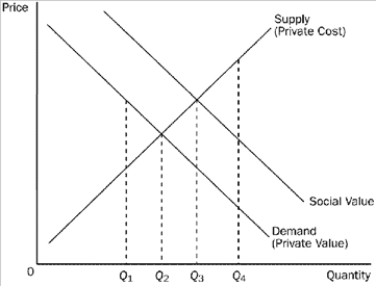 -Refer to Figure 10-7. Which quantity represents the social optimum for this market?
 (Multiple Choice)
4.9/5 (80)
(80) The tax on gasoline causes deadweight losses, as is the case with all taxes.
(True/False)
4.8/5 (61)
(61) Which of the following policies is an example of a command-and-control policy?
(Multiple Choice)
4.8/5 (89)
(89) Education is heavily subsidized through public schools and government scholarships. This subsidization of education reflects the fact that
(Multiple Choice)
4.9/5 (79)
(79) Figure 10-12  -Refer to Figure 10-12. Which of the following is an appropriate label for Line 1?
 (Multiple Choice)
4.8/5 (79)
(79) Honey producers provide a positive externality to orchards because
(Multiple Choice)
4.7/5 (77)
(77) When we identify public policies toward externalities, we contrast command-and-control policies with what other type of policies?
(Essay)
4.8/5 (76)
(76) Figure 10-9
 -Refer to Figure 10-9, Panel (b) and Panel (c). Which of the following is correct?
 (Multiple Choice)
4.9/5 (72)
(72) Figure 10-6  -Refer to Figure 10-6. Which price represents the equilibrium price of the product in this market?
 (Multiple Choice)
4.9/5 (73)
(73) Suppose that elementary education creates a positive externality. If the government does not subsidize education, then
(Multiple Choice)
4.9/5 (81)
(81) Two firms, A and B, each currently dump 20 tons of chemicals into the local river. The government has decided to reduce the pollution and from now on will require a pollution permit for each ton of pollution dumped into the river. The government gives each firm 10 pollution permits, which it can either use or sell to the other firm. It costs Firm A $100 for each ton of pollution that it eliminates before it reaches the river, and it costs Firm B $50 for each ton of pollution that it eliminates before it reaches the river. After the two firms buy or sell pollution permits from each other, we would expect that
(Multiple Choice)
4.7/5 (101)
(101) Which of the following is a difference between corrective taxes and tradable pollution permits?
(Multiple Choice)
4.9/5 (72)
(72) Figure 10-4  -Refer to Figure 10-4. Without government intervention, the equilibrium quantity would be
 (Multiple Choice)
4.8/5 (82)
(82) Figure 10-11  -Refer to Figure 10-11. Which of the following statements is correct?
 (Multiple Choice)
4.8/5 (78)
(78) 
Filters
- Essay(0)
- Multiple Choice(0)
- Short Answer(0)
- True False(0)
- Matching(0)