



 Chat with AI
Exam 10: Externalities

Exam 1: Ten Principles of Economics439 Questions
Exam 2: Thinking Like an Economist617 Questions
Exam 3: Interdependence and the Gains From Trade527 Questions
Exam 4: The Market Forces of Supply and Demand698 Questions
Exam 5: Elasticity and Its Application595 Questions
Exam 6: Supply, Demand, and Government Policies644 Questions
Exam 7: Consumers, Producers, and the Efficiency of Markets549 Questions
Exam 8: Application: The Costs of Taxation511 Questions
Exam 9: Application: International Trade493 Questions
Exam 10: Externalities524 Questions
Exam 11: Public Goods and Common Resources433 Questions
Exam 12: The Design of the Tax System551 Questions
Exam 13: The Costs of Production420 Questions
Exam 14: Firms in Competitive Markets543 Questions
Exam 15: Monopoly637 Questions
Exam 16: Monopolistic Competition587 Questions
Exam 17: Oligopoly496 Questions
Exam 18: The Markets for the Factors of Production564 Questions
Exam 19: Earnings and Discrimination490 Questions
Exam 20: Income Inequality and Poverty457 Questions
Exam 21: The Theory of Consumer Choice440 Questions
Exam 22: Frontiers of Microeconomics441 Questions
Select questions type


Figure 10-11  -Refer to Figure 10-11. Taking into account private value and external benefits, the maximum total surplus that can be achieved in this market is
 (Multiple Choice)
4.8/5  (81)
(81) Table 10-5
The following table shows the marginal costs for each of four firms (A, B, C, and D) to eliminate units of pollution from their production processes. For example, for Firm A to eliminate one unit of pollution, it would cost $54, and for Firm A to eliminate a second unit of pollution it would cost an additional $67.
 -Refer to Table 10-5. If the government charged a fee of $84 per unit of pollution, how many units of pollution would the firms eliminate altogether?
 (Multiple Choice)
4.9/5 (89)
(89) Altering incentives so that people take account of the external effects of their actions
(Multiple Choice)
4.8/5 (78)
(78) Table 10-5
The following table shows the marginal costs for each of four firms (A, B, C, and D) to eliminate units of pollution from their production processes. For example, for Firm A to eliminate one unit of pollution, it would cost $54, and for Firm A to eliminate a second unit of pollution it would cost an additional $67.
-Refer to Table 10-5. If the government wanted to reduce pollution from 16 units to 6 units, which of the following fees per unit of pollution would achieve that goal?
-Refer to Table 10-5. If the government wanted to reduce pollution from 16 units to 6 units, which of the following fees per unit of pollution would achieve that goal? (Multiple Choice)
4.9/5 (79)
(79) Figure 10-4 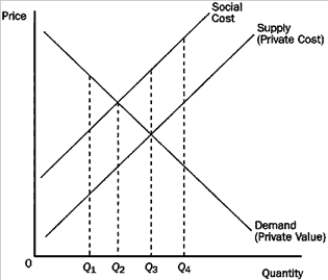 -Refer to Figure 10-4. If this market is currently producing at Q2, then total economic well-being would increase if output
 (Multiple Choice)
4.8/5 (88)
(88) When the production of a good results in a positive externality, the social value curve is
(Multiple Choice)
4.8/5 (77)
(77) Figure 10-11
-Refer to Figure 10-11. Taking only private value and private cost into account, total surplus at the market equilibrium amounts to
-Refer to Figure 10-11. Taking only private value and private cost into account, total surplus at the market equilibrium amounts to (Multiple Choice)
4.8/5 (70)
(70) When the government reduces my income tax by $0.30 for every $1.00 that I contribute to a charity, the government is effectively
(Multiple Choice)
4.9/5 (79)
(79) According to the Coase theorem, private markets will solve externality problems and allocate resources efficiently as long as
(Multiple Choice)
4.9/5 (95)
(95) Table 10-3
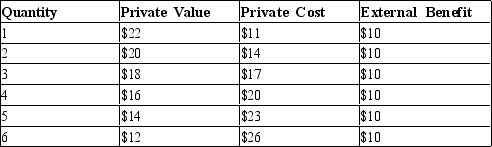 -Refer to Table 10-3. The socially optimal quantity of output is
 (Multiple Choice)
4.9/5 (84)
(84) Beverly owns a rabbit and receives a $600 benefit from owning it. Sometimes Beverly's rabbit makes its way onto the lawn of her neighbor, Charles, and eats the vegetables in Charles' garden. This intrusion by the rabbit costs Charles $400. Can both individuals become better off if Charles pays Beverly some amount of money to get rid of the rabbit? Explain.
(Essay)
4.8/5 (79)
(79) Suppose that candy producers create a positive externality equal to $1 per pound of candy. Further suppose that the government offers a $1-per-pound subsidy to the producers. What is the relationship between the equilibrium quantity and the socially optimal quantity of candy?
(Multiple Choice)
5.0/5 (73)
(73) Table 10-4
 -Refer to Table 10-4. Take into account private and external costs and assume the quantity of output is always a whole number (that is, fractional units of output are not possible). The maximum total surplus that can be achieved in this market is
 (Multiple Choice)
4.7/5 (72)
(72) Patent protection is one way to deal with technology spillovers.
(True/False)
4.8/5 (71)
(71) Figure 10-6 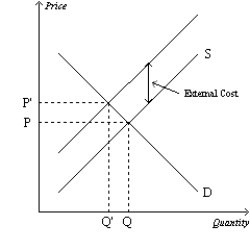 -Refer to Figure 10-6. Which quantity represents the socially-optimal quantity of output in this market?
 (Multiple Choice)
4.9/5 (74)
(74) In many cases the Coase theorem does not work well because
(Multiple Choice)
4.8/5 (80)
(80) 
Filters
- Essay(0)
- Multiple Choice(0)
- Short Answer(0)
- True False(0)
- Matching(0)