



 Chat with AI
Exam 10: Externalities

Exam 1: Ten Principles of Economics439 Questions
Exam 2: Thinking Like an Economist617 Questions
Exam 3: Interdependence and the Gains From Trade527 Questions
Exam 4: The Market Forces of Supply and Demand698 Questions
Exam 5: Elasticity and Its Application595 Questions
Exam 6: Supply, Demand, and Government Policies644 Questions
Exam 7: Consumers, Producers, and the Efficiency of Markets549 Questions
Exam 8: Application: The Costs of Taxation511 Questions
Exam 9: Application: International Trade493 Questions
Exam 10: Externalities524 Questions
Exam 11: Public Goods and Common Resources433 Questions
Exam 12: The Design of the Tax System551 Questions
Exam 13: The Costs of Production420 Questions
Exam 14: Firms in Competitive Markets543 Questions
Exam 15: Monopoly637 Questions
Exam 16: Monopolistic Competition587 Questions
Exam 17: Oligopoly496 Questions
Exam 18: The Markets for the Factors of Production564 Questions
Exam 19: Earnings and Discrimination490 Questions
Exam 20: Income Inequality and Poverty457 Questions
Exam 21: The Theory of Consumer Choice440 Questions
Exam 22: Frontiers of Microeconomics441 Questions
Select questions type


Figure 10-2. The graph depicts the market for plastic.  -Refer to Figure 10-2. A benevolent social planner would like to see
 (Multiple Choice)
4.9/5  (77)
(77) Table 10-3
 -Refer to Table 10-3. Taking into account private and external costs, the maximum total surplus that can be achieved in this market is
 (Multiple Choice)
4.8/5 (86)
(86) Figure 10-8 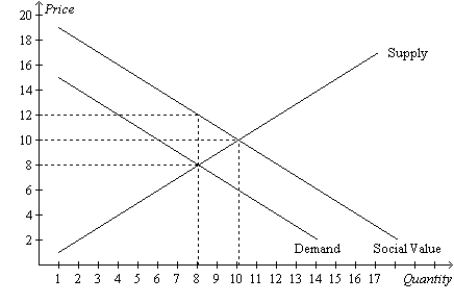 -Refer to Figure 10-8. If the government wanted to tax or subsidize this good to achieve the socially-optimal level of output, it would
 (Multiple Choice)
4.9/5 (82)
(82) Figure 10-13. On the graph, Q represents the quantity of plastics and P represents the price of plastics.  Multiple Choice - Section 02: Public Policies toward Externalities
-Refer to Figure 10-13. If the government imposed a corrective tax that successfully moved the market from the market equilibrium to the social optimum, then tax revenue for the government would amount to
Multiple Choice - Section 02: Public Policies toward Externalities
-Refer to Figure 10-13. If the government imposed a corrective tax that successfully moved the market from the market equilibrium to the social optimum, then tax revenue for the government would amount to (Multiple Choice)
4.8/5 (80)
(80) Scenario 10-1
The demand curve for gasoline slopes downward and the supply curve for gasoline slopes upward. The production of the 1,000th gallon of gasoline entails the following:
-a private cost of $3.10;
-a social cost of $3.55;
-a value to consumers of $3.70.
-Refer to Scenario 10-1. Let QMARKET represent the equilibrium quantity of gasoline, and let QOPTIMUM represent the socially optimal quantity of gasoline. Which of the following inequalities is correct?
(Multiple Choice)
4.8/5 (90)
(90) Because there are positive externalities from higher education,
(Multiple Choice)
4.9/5 (74)
(74) Figure 10-13. On the graph, Q represents the quantity of plastics and P represents the price of plastics. Multiple Choice - Section 02: Public Policies toward Externalities
-Refer to Figure 10-13. Each unit of plastics that is produced results in an external
Multiple Choice - Section 02: Public Policies toward Externalities
-Refer to Figure 10-13. Each unit of plastics that is produced results in an external (Multiple Choice)
4.9/5 (69)
(69) Since externalities tend to keep markets from reaching a socially optimal equilibrium, government action
(Multiple Choice)
4.8/5 (81)
(81) Sheryl sits on her patio and plays her guitar while her neighbors are outside. Sheryl neither pays nor receives any compensation for playing her guitar. Under what condition does her guitar-playing give rise to a positive externality?
(Essay)
4.8/5 (76)
(76) Figure 10-9
 -Refer to Figure 10-9. The overuse of antibiotics leads to the development of antibiotic-resistant diseases. Therefore, the market for antibiotics is shown in
 (Multiple Choice)
4.9/5 (81)
(81) Suppose that flu shots create a positive externality equal to $9 per shot. Further suppose that the government offers a $9-per-shot subsidy to producers. What is the relationship between the equilibrium quantity and the socially optimal quantity of flu shots produced?
(Multiple Choice)
5.0/5 (88)
(88) When a transaction between a buyer and seller directly affects a third party, the effect is called an externality.
(True/False)
4.9/5 (73)
(73) Since almost all forms of transportation produce some type of pollution,
(Multiple Choice)
4.9/5 (77)
(77) Government subsidized scholarships are an example of a government policy aimed at correcting negative externalities associated with education.
(True/False)
4.8/5 (87)
(87) When the social cost curve is above a product's supply curve,
(Multiple Choice)
4.9/5 (84)
(84) Government intervention is necessary to correct all externalities.
(True/False)
5.0/5 (78)
(78) Scenario 10-4
The demand curve for fire extinguishers slopes downward and the supply curve for fire extinguishers slopes upward. The production of the 500th fire extinguisher entails the following:
-a private cost of $10;
-an external cost of $0;
-a private value of $9;
-an external benefit of $3.
-
-Refer to Scenario 10-4. In order to maximize the total benefit of fire extinguishers to society as a whole, should the number of fire extinguishers produced be less than, equal to, or greater than 500? Explain.
(Essay)
4.9/5 (81)
(81) Alexander lives in an apartment building and gets a $250 benefit from playing his stereo. Mary, who lives next door to Alexander and often loses sleep due to the loud music coming from Alexander's stereo, bears a $350 cost from the noise. Mary would like to offer Alexander some money to turn down the volume on his stereo. If Mary had to hire a lawyer to draw up the contract, what is the maximum amount she could pay to the lawyer to ensure that both Alexander and Mary would benefit from the agreement?
(Multiple Choice)
4.9/5 (77)
(77) Suppose that cookie producers create a positive externality equal to $2 per dozen. What is the relationship between the equilibrium quantity and the socially optimal quantity of cookies to be produced?
(Multiple Choice)
4.7/5 (76)
(76) 
Filters
- Essay(0)
- Multiple Choice(0)
- Short Answer(0)
- True False(0)
- Matching(0)