



 Chat with AI
Exam 10: Externalities

Exam 1: Ten Principles of Economics439 Questions
Exam 2: Thinking Like an Economist617 Questions
Exam 3: Interdependence and the Gains From Trade527 Questions
Exam 4: The Market Forces of Supply and Demand698 Questions
Exam 5: Elasticity and Its Application595 Questions
Exam 6: Supply, Demand, and Government Policies644 Questions
Exam 7: Consumers, Producers, and the Efficiency of Markets549 Questions
Exam 8: Application: The Costs of Taxation511 Questions
Exam 9: Application: International Trade493 Questions
Exam 10: Externalities524 Questions
Exam 11: Public Goods and Common Resources433 Questions
Exam 12: The Design of the Tax System551 Questions
Exam 13: The Costs of Production420 Questions
Exam 14: Firms in Competitive Markets543 Questions
Exam 15: Monopoly637 Questions
Exam 16: Monopolistic Competition587 Questions
Exam 17: Oligopoly496 Questions
Exam 18: The Markets for the Factors of Production564 Questions
Exam 19: Earnings and Discrimination490 Questions
Exam 20: Income Inequality and Poverty457 Questions
Exam 21: The Theory of Consumer Choice440 Questions
Exam 22: Frontiers of Microeconomics441 Questions
Select questions type


Suppose that a negative externality is created by the production of good X. Which of the following statements is correct?
(Multiple Choice)
4.9/5  (77)
(77) Scenario 10-2
The demand curve for restored historic buildings slopes downward and the supply curve for restored historic buildings slopes upward. The production of the 50th restored historic building entails the following:
-a private cost of $800,000;
-a private value of $650,000;
-a social value of $800,000.
-Refer to Scenario 10-2. Is the socially optimal quantity of restored historic buildings less than, equal to, or greater than 50?
(Essay)
4.9/5 (87)
(87) Figure 10-19  -Refer to Figure 10-19. The social optimum can be reached if
 (Multiple Choice)
4.9/5 (73)
(73) Table 10-1
The following table shows the private value, private cost, and external cost for various quantities of output in a market.
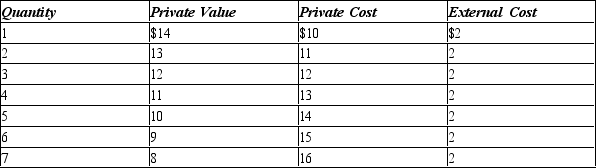 -Refer to Table 10-1. How large would a corrective tax need to be to move this market from the equilibrium outcome to the socially-optimal outcome?
 (Multiple Choice)
4.8/5 (73)
(73) Private markets fail to reach a socially optimal equilibrium when negative externalities are present because
(Multiple Choice)
4.9/5 (73)
(73) Which of the following statements is true of both pollution permits and corrective taxes?
(Multiple Choice)
5.0/5 (87)
(87) Suppose that flower gardens create a positive externality equal to $1 per plant. What is the relationship between the equilibrium quantity and the socially optimal quantity of plants grown?
(Multiple Choice)
4.8/5 (79)
(79) Suppose that Company A's railroad cars pass through Farmer B's corn fields. The railroad causes an externality to the farmer because the railroad cars emit sparks that cause $1,500 in damage to the farmer's crops. There is a special soy-based grease that the railroad could purchase that would eliminate the damaging sparks. The grease costs $1,200. Suppose that the farmer has the right to compensation for any damage that his crops suffer. Assume that there are no transaction costs. Which of the following characterizes the efficient outcome?
(Multiple Choice)
4.8/5 (87)
(87) Suppose that a firm produces electricity by burning coal. The production process creates a negative externality of air pollution. If the firm does not internalize the cost of the externality, it will produce where
(Multiple Choice)
4.8/5 (74)
(74) If education produces positive externalities and the government does not intervene in the market, we would expect
(Multiple Choice)
4.8/5 (91)
(91) Figure 10-19
-Refer to Figure 10-19. Which of the following quantities decreases as the quantity of the good is increased?
-Refer to Figure 10-19. Which of the following quantities decreases as the quantity of the good is increased? (Multiple Choice)
4.9/5 (86)
(86) Figure 10-10 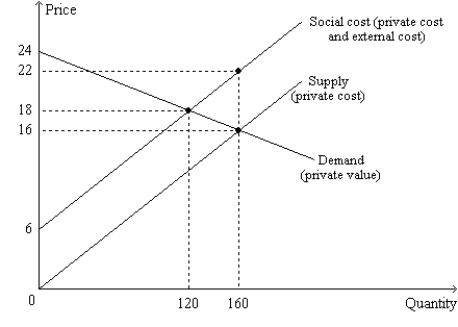 -Refer to Figure 10-10. The graph represents a market in which
 (Multiple Choice)
4.9/5 (82)
(82) Dioxin emission that results from the production of paper is a good example of a negative externality because
(Multiple Choice)
4.9/5 (73)
(73) Private parties may choose not to solve an externality problem if the transaction costs are large enough.
(True/False)
4.8/5 (83)
(83) Suppose planting flowering shrubs creates a positive externality equal to $7 per shrub. Further suppose that the local government offers a $7 per-shrub subsidy to planters. The number of shrubs that are planted is then
(Multiple Choice)
4.9/5 (85)
(85) Figure 10-11  -Refer to Figure 10-11. Which of the following statements is correct?
 (Multiple Choice)
4.8/5 (72)
(72) Which of the following policies is not an example of a command-and-control policy?
(Multiple Choice)
4.9/5 (73)
(73) Table 10-1
The following table shows the private value, private cost, and external cost for various quantities of output in a market.
-Refer to Table 10-1. Which of the following statements is correct?
-Refer to Table 10-1. Which of the following statements is correct? (Multiple Choice)
4.9/5 (82)
(82) Two firms, A and B, each currently dump 50 tons of chemicals into the local river. The government has decided to reduce the pollution and from now on will require a pollution permit for each ton of pollution dumped into the river. It costs Firm A $100 for each ton of pollution that it eliminates before it reaches the river, and it costs Firm B $50 for each ton of pollution that it eliminates before it reaches the river. The government gives each firm 20 pollution permits. Government officials are not sure whether to allow the firms to buy or sell the pollution permits to each other. What is the total cost of reducing pollution if firms are not allowed to buy and sell pollution permits from each other? What is the total cost of reducing pollution if the firms are allowed to buy and sell permits from each other?
(Multiple Choice)
5.0/5 (84)
(84) 
Filters
- Essay(0)
- Multiple Choice(0)
- Short Answer(0)
- True False(0)
- Matching(0)