



 Chat with AI
Exam 10: Externalities

Exam 1: Ten Principles of Economics439 Questions
Exam 2: Thinking Like an Economist617 Questions
Exam 3: Interdependence and the Gains From Trade527 Questions
Exam 4: The Market Forces of Supply and Demand698 Questions
Exam 5: Elasticity and Its Application595 Questions
Exam 6: Supply, Demand, and Government Policies644 Questions
Exam 7: Consumers, Producers, and the Efficiency of Markets549 Questions
Exam 8: Application: The Costs of Taxation511 Questions
Exam 9: Application: International Trade493 Questions
Exam 10: Externalities524 Questions
Exam 11: Public Goods and Common Resources433 Questions
Exam 12: The Design of the Tax System551 Questions
Exam 13: The Costs of Production420 Questions
Exam 14: Firms in Competitive Markets543 Questions
Exam 15: Monopoly637 Questions
Exam 16: Monopolistic Competition587 Questions
Exam 17: Oligopoly496 Questions
Exam 18: The Markets for the Factors of Production564 Questions
Exam 19: Earnings and Discrimination490 Questions
Exam 20: Income Inequality and Poverty457 Questions
Exam 21: The Theory of Consumer Choice440 Questions
Exam 22: Frontiers of Microeconomics441 Questions
Select questions type


The Coase theorem suggests that private markets may not be able to solve the problem of externalities
(Multiple Choice)
4.9/5  (81)
(81) Table 10-2
The following table shows the private value, private cost, and social value for a market with a positive externality.
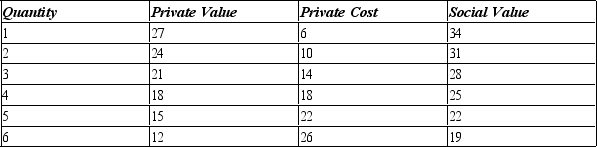 -Refer to Table 10-2. How large would a subsidy need to be in this market to move the market from the equilibrium level of output to the socially-optimal level of output?
 (Multiple Choice)
4.9/5 (85)
(85) In Singapore, littering fines are strictly enforced. This is an example of a policy that
(Multiple Choice)
4.9/5 (85)
(85) Figure 10-13. On the graph, Q represents the quantity of plastics and P represents the price of plastics.  Multiple Choice - Section 02: Public Policies toward Externalities
-Refer to Figure 10-13. If 325 units of plastics are produced and consumed, then the
Multiple Choice - Section 02: Public Policies toward Externalities
-Refer to Figure 10-13. If 325 units of plastics are produced and consumed, then the (Multiple Choice)
4.8/5 (68)
(68) If only a few people are affected by an externality, then it is likely that
(Multiple Choice)
4.9/5 (86)
(86) If a market is characterized by a positive externality that is not the result of a technology spillover,
(Multiple Choice)
4.8/5 (83)
(83) Figure 10-9
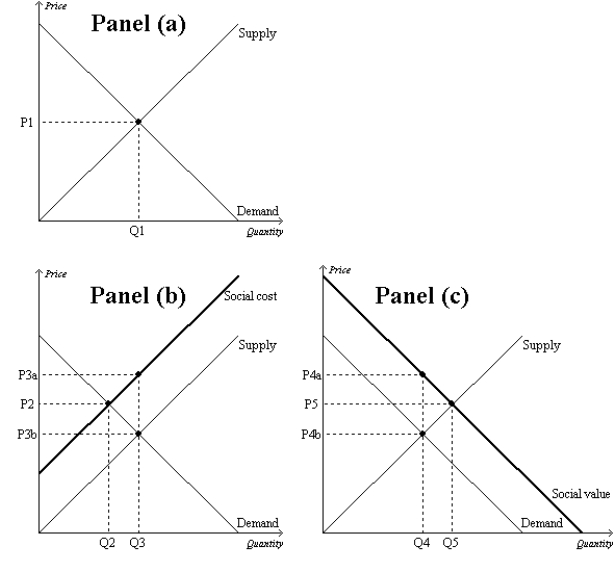 -Refer to Figure 10-9, Panel (b) and Panel (c). The installation of a scrubber in a smokestack reduces the emission of harmful chemicals from the smokestack. Therefore, a government policy that internalized the externality would move the quantity of smokestack scrubbers installed from point
 (Multiple Choice)
4.9/5 (74)
(74) Suppose that cigarette smokers create a negative externality. Further suppose that the government imposes a tax on cigarettes equal to the per-unit externality. What is the relationship between the after-tax equilibrium quantity and the socially optimal quantity of cigarettes?
(Multiple Choice)
4.9/5 (77)
(77) Cameron lives in an apartment building and gets a $700 benefit from playing his stereo. Renee, who lives next door to Cameron and often loses sleep due to the music coming from Cameron's stereo, bears a $1,000 cost from the noise. At which of the following offers from Renee could both Renee and Cameron benefit from the silencing of Cameron's stereo?
(Multiple Choice)
4.9/5 (81)
(81) Scenario 10-2
The demand curve for restored historic buildings slopes downward and the supply curve for restored historic buildings slopes upward. The production of the 50th restored historic building entails the following:
-a private cost of $800,000;
-a private value of $650,000;
-a social value of $800,000.
-Refer to Scenario 10-2. Is the market equilibrium quantity of restored historic buildings less than, equal to, or greater than 50?
(Essay)
4.9/5 (91)
(91) Table 10-2
The following table shows the private value, private cost, and social value for a market with a positive externality.
-Refer to Table 10-2. What is the equilibrium quantity of output in this market?
-Refer to Table 10-2. What is the equilibrium quantity of output in this market? (Multiple Choice)
4.9/5 (87)
(87) Suppose the Environmental Protection Agency uses a corrective tax to set a price for pollution. Under this policy, is the supply curve for pollution rights vertical or is it horizontal?
(Short Answer)
4.8/5 (76)
(76) Government intervention in the economy with the goal of promoting technology-producing industries is known as patent policy.
(True/False)
4.8/5 (87)
(87) When the government uses a command-and-control policy to solve an externality, it
(Multiple Choice)
5.0/5 (70)
(70) 
Filters
- Essay(0)
- Multiple Choice(0)
- Short Answer(0)
- True False(0)
- Matching(0)