



 Chat with AI
Exam 10: Externalities

Exam 1: Ten Principles of Economics439 Questions
Exam 2: Thinking Like an Economist617 Questions
Exam 3: Interdependence and the Gains From Trade527 Questions
Exam 4: The Market Forces of Supply and Demand698 Questions
Exam 5: Elasticity and Its Application595 Questions
Exam 6: Supply, Demand, and Government Policies644 Questions
Exam 7: Consumers, Producers, and the Efficiency of Markets549 Questions
Exam 8: Application: The Costs of Taxation511 Questions
Exam 9: Application: International Trade493 Questions
Exam 10: Externalities524 Questions
Exam 11: Public Goods and Common Resources433 Questions
Exam 12: The Design of the Tax System551 Questions
Exam 13: The Costs of Production420 Questions
Exam 14: Firms in Competitive Markets543 Questions
Exam 15: Monopoly637 Questions
Exam 16: Monopolistic Competition587 Questions
Exam 17: Oligopoly496 Questions
Exam 18: The Markets for the Factors of Production564 Questions
Exam 19: Earnings and Discrimination490 Questions
Exam 20: Income Inequality and Poverty457 Questions
Exam 21: The Theory of Consumer Choice440 Questions
Exam 22: Frontiers of Microeconomics441 Questions
Select questions type


Two types of private solutions to the problem of externalities are
(Multiple Choice)
4.9/5  (70)
(70) Which of the following problems can not be alleviated by a gasoline tax?
(Multiple Choice)
4.8/5 (74)
(74) Figure 10-9
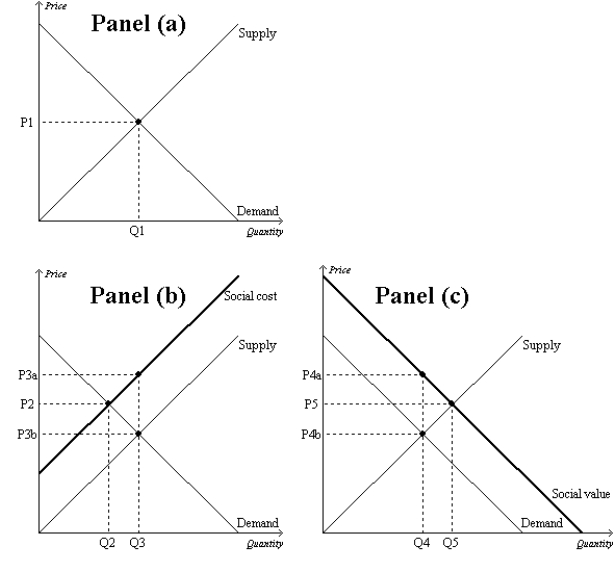 -Refer to Figure 10-9. Which graph represents a market with a negative externality?
 (Multiple Choice)
4.9/5 (81)
(81) What economic argument suggests that if transactions costs are sufficiently low, the equilibrium is economically efficient regardless of how property rights are distributed?
(Multiple Choice)
4.9/5 (83)
(83) Figure 10-4 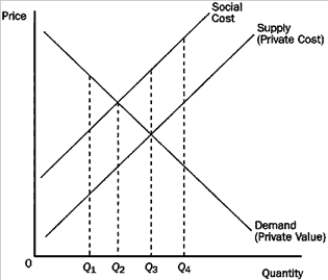 -Refer to Figure 10-4. If all external costs were internalized, then the market's equilibrium output would be
 (Multiple Choice)
4.7/5 (76)
(76) Suppose that an MBA degree creates no externality because the benefits of an MBA are internalized by the student in the form of higher wages. If there are no government subsidies for MBAs, then which of the following statements is correct?
(Multiple Choice)
4.7/5 (78)
(78) Which of the following is not a necessary condition for the Coase theorem?
(Multiple Choice)
4.9/5 (70)
(70) Scenario 10-3
 Suppose the equation for the demand curve in a market is
where is the quantity demanded and is the price.


 Also, suppose the equation for the supply curve in the same market is ,
where is the quantity supplied.
 -Refer to Scenario 10-3. Suppose there is an external cost of $12 associated with the production of each unit of the good. What are the socially optimal quantity and price?
Suppose the equation for the demand curve in a market is
where is the quantity demanded and is the price.
Also, suppose the equation for the supply curve in the same market is ,
where is the quantity supplied.
-Refer to Scenario 10-3. Suppose there is an external cost of $12 associated with the production of each unit of the good. What are the socially optimal quantity and price? (Essay)
4.9/5 (65)
(65) Scenario 10-1
The demand curve for gasoline slopes downward and the supply curve for gasoline slopes upward. The production of the 1,000th gallon of gasoline entails the following:
-a private cost of $3.10;
-a social cost of $3.55;
-a value to consumers of $3.70.
-Refer to Scenario 10-1. Let Q represent the number of gallons of gasoline and let P represent the price of a gallon of gasoline. Which of the following statements is correct?
(Multiple Choice)
4.8/5 (77)
(77) Figure 10-9
-Refer to Figure 10-9, Panel (b). The market equilibrium price is
-Refer to Figure 10-9, Panel (b). The market equilibrium price is (Multiple Choice)
4.7/5 (75)
(75) Although regulation and corrective taxes are both capable of reducing pollution, regulation accomplishes this goal more efficiently.
(True/False)
4.7/5 (69)
(69) The Coase theorem asserts that, if externalities are present and if private parties can bargain over the allocation of resources at no cost, then
(Multiple Choice)
4.8/5 (81)
(81) In many cases selling pollution permits is a better method for reducing pollution than imposing a corrective tax because
(Multiple Choice)
4.8/5 (73)
(73) Table 10-1
The following table shows the private value, private cost, and external cost for various quantities of output in a market.
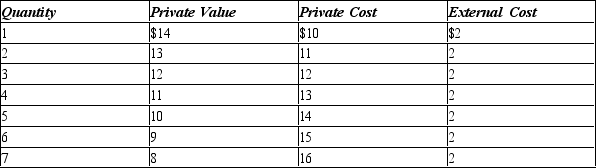 -Refer to Table 10-1. What is the equilibrium quantity of output in the market?
 (Multiple Choice)
4.8/5 (79)
(79) Table 10-3
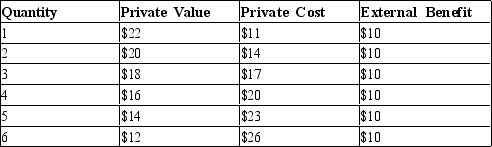 -Refer to Table 10-3. What amount of subsidy per unit of output would move the market from the equilibrium level of output to the socially optimal level of output?
 (Multiple Choice)
5.0/5 (84)
(84) Suppose that alcohol consumption creates a negative externality. What can the government do to equate the equilibrium quantity of alcohol and the socially optimal quantity of alcohol?
(Multiple Choice)
4.8/5 (101)
(101) A congestion toll imposed on a highway driver to force the driver to take into account the increase in travel time she imposes on all other drivers is an example of internalizing the externality.
(True/False)
4.9/5 (84)
(84) 
Filters
- Essay(0)
- Multiple Choice(0)
- Short Answer(0)
- True False(0)
- Matching(0)