



 Chat with AI
Exam 10: Externalities

Exam 1: Ten Principles of Economics439 Questions
Exam 2: Thinking Like an Economist617 Questions
Exam 3: Interdependence and the Gains From Trade527 Questions
Exam 4: The Market Forces of Supply and Demand698 Questions
Exam 5: Elasticity and Its Application595 Questions
Exam 6: Supply, Demand, and Government Policies644 Questions
Exam 7: Consumers, Producers, and the Efficiency of Markets549 Questions
Exam 8: Application: The Costs of Taxation511 Questions
Exam 9: Application: International Trade493 Questions
Exam 10: Externalities524 Questions
Exam 11: Public Goods and Common Resources433 Questions
Exam 12: The Design of the Tax System551 Questions
Exam 13: The Costs of Production420 Questions
Exam 14: Firms in Competitive Markets543 Questions
Exam 15: Monopoly637 Questions
Exam 16: Monopolistic Competition587 Questions
Exam 17: Oligopoly496 Questions
Exam 18: The Markets for the Factors of Production564 Questions
Exam 19: Earnings and Discrimination490 Questions
Exam 20: Income Inequality and Poverty457 Questions
Exam 21: The Theory of Consumer Choice440 Questions
Exam 22: Frontiers of Microeconomics441 Questions
Select questions type


Buyers and sellers neglect the external effects of their actions when deciding how much to demand or supply.
(True/False)
4.8/5  (69)
(69) Table 10-4
 -Refer to Table 10-4. The last unit of output for which private value exceeds social cost is the
 (Multiple Choice)
4.9/5 (68)
(68) Figure 10-18. The graph represents a corrective tax to reduce pollution. On the axes, Q denotes the quantity of pollution and P represents the price of pollution. 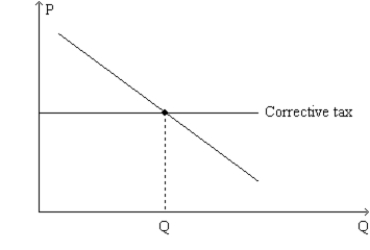 -Refer to Figure 10-18. What is the appropriate label for the downward-sloping line on the graph?
 (Multiple Choice)
4.9/5 (84)
(84) Suppose the government levies a corrective tax on firms that pollute in order to limit the quantity of pollution. Under this policy, does the demand curve for pollution rights determine the quantity of pollution, or does it determine the price of pollution?
(Essay)
4.8/5 (80)
(80) Which of the following is a problem that keeps people from privately solving externality problems?
(Multiple Choice)
4.9/5 (86)
(86) Figure 10-19  -Refer to Figure 10-19. Note that the lines labeled "Demand" and "Social Value"are parallel. Also, the slopes of the lines on the graph reflect the following facts: (1) Private value and social value decrease by $1.00 with each additional unit of the good that is consumed, and (2) private cost increases by $1.40 with each additional unit of the good that is produced. Thus, when the 74th unit of the good is produced and consumed, social well-being
 (Multiple Choice)
4.7/5 (74)
(74) A negative externality arises when a person engages in an activity that has
(Multiple Choice)
4.7/5 (81)
(81) Figure 10-5  -Refer to Figure 10-5. Which of the following statements is correct?
 (Multiple Choice)
4.9/5 (82)
(82) The patent system gives firms greater incentive to engage in research and other activities that advance technology.
(True/False)
4.9/5 (77)
(77) Figure 10-17 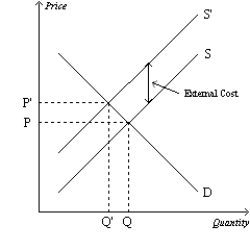 -Refer to Figure 10-17. How large would a corrective tax need to be to move this market from the equilibrium outcome to the socially-optimal outcome?
 (Multiple Choice)
4.9/5 (87)
(87) The impact of one person's actions on the well-being of a bystander is called
(Multiple Choice)
4.8/5 (89)
(89) Which of the following policies is the government most inclined to use when faced with a positive externality?
(Multiple Choice)
4.8/5 (71)
(71) Table 10-4
-Refer to Table 10-4. Taking into account private and external costs, total surplus in the market equilibrium amounts to
-Refer to Table 10-4. Taking into account private and external costs, total surplus in the market equilibrium amounts to (Multiple Choice)
4.8/5 (93)
(93) Table 10-6
The following table shows the total costs for each of four firms (A, B, C, and D) to eliminate units of pollution from their production processes. For example, for Firm A to eliminate one unit of pollution, it would cost $46, and for Firm A to eliminate two units of pollution, it would cost a total of $103.
 -Refer to Table 10-6. Suppose there is presently no pollution fee, and the government wishes to eliminate exactly 8 units of pollution. Which of the following fees per unit of pollution would achieve that goal?
 (Multiple Choice)
4.7/5 (84)
(84) 
Filters
- Essay(0)
- Multiple Choice(0)
- Short Answer(0)
- True False(0)
- Matching(0)