



 Chat with AI
Exam 10: Externalities

Exam 1: Ten Principles of Economics439 Questions
Exam 2: Thinking Like an Economist617 Questions
Exam 3: Interdependence and the Gains From Trade527 Questions
Exam 4: The Market Forces of Supply and Demand698 Questions
Exam 5: Elasticity and Its Application595 Questions
Exam 6: Supply, Demand, and Government Policies644 Questions
Exam 7: Consumers, Producers, and the Efficiency of Markets549 Questions
Exam 8: Application: The Costs of Taxation511 Questions
Exam 9: Application: International Trade493 Questions
Exam 10: Externalities524 Questions
Exam 11: Public Goods and Common Resources433 Questions
Exam 12: The Design of the Tax System551 Questions
Exam 13: The Costs of Production420 Questions
Exam 14: Firms in Competitive Markets543 Questions
Exam 15: Monopoly637 Questions
Exam 16: Monopolistic Competition587 Questions
Exam 17: Oligopoly496 Questions
Exam 18: The Markets for the Factors of Production564 Questions
Exam 19: Earnings and Discrimination490 Questions
Exam 20: Income Inequality and Poverty457 Questions
Exam 21: The Theory of Consumer Choice440 Questions
Exam 22: Frontiers of Microeconomics441 Questions
Select questions type


Which of the following suggests that private markets can be effective in dealing with externalities?
(Multiple Choice)
4.7/5  (81)
(81) Corrective taxes enhance efficiency, but the cost to administer them exceeds the revenue they raise for the government.
(True/False)
4.8/5 (79)
(79) According to the Coase Theorem, individuals can always work out a mutually beneficial agreement to solve the problems of externalities even when high transaction costs are involved.
(True/False)
4.9/5 (95)
(95) When a policy succeeds in giving buyers and sellers in a market an incentive to take into account the external effects of their actions, the policy is said to
(Multiple Choice)
4.8/5 (83)
(83) Suppose that coal producers create a negative externality equal to $5 per ton of coal. What is the relationship between the equilibrium quantity of coal and the socially optimal quantity of coal?
(Multiple Choice)
4.9/5 (76)
(76) Figure 10-4  -Refer to Figure 10-4. If this market is currently producing at Q4, then total economic well-being would be maximized if output
 (Multiple Choice)
4.8/5 (82)
(82) Wally owns a dog whose barking annoys Wally's neighbor, Corrine. Suppose that the benefit of owning the dog is worth $700 to Wally and that Corrine bears a cost of $500 from the barking. Assuming Wally has the legal right to keep the dog, a possible private solution to this problem is that
(Multiple Choice)
4.9/5 (85)
(85) Scenario 10-2
The demand curve for restored historic buildings slopes downward and the supply curve for restored historic buildings slopes upward. The production of the 50th restored historic building entails the following:
-a private cost of $800,000;
-a private value of $650,000;
-a social value of $800,000.
-Refer to Scenario 10-2. Is there an external cost associated with the restoration of the 50th historic building, or is there an external benefit? What is the amount of that external cost or external benefit?
(Essay)
4.8/5 (69)
(69) Table 10-4
 -Refer to Table 10-4. The social cost of the 2nd unit of output that is produced is
 (Multiple Choice)
4.8/5 (83)
(83) Despite the appealing logic of the Coase theorem, private actors often fail to resolve on their own the problems caused by externalities.
(True/False)
4.8/5 (75)
(75) Figure 10-9
 -Refer to Figure 10-9, Panel (c). The market equilibrium quantity is
 (Multiple Choice)
4.9/5 (65)
(65) Assume that your roommate is very messy. According to campus policy, you have a right to live in an uncluttered apartment. Suppose she gets an $80 benefit from being messy but imposes a $60 cost on you. The Coase theorem would suggest that an efficient solution would be for your roommate to
(Multiple Choice)
4.9/5 (85)
(85) Refer to Figure 10-12. An alternative label for the quantity  would be
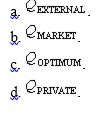
would be
(Multiple Choice)
4.8/5 (82)
(82) Figure 10-2. The graph depicts the market for plastic.  -Refer to Figure 10-2. Suppose that the production of plastic creates a social cost which is depicted in the graph above. Without any government regulation, how much plastic will be produced?
 (Multiple Choice)
4.8/5 (81)
(81) University researchers create a positive externality because what they discover in their research labs can easily be learned by others who haven't contributed to the research costs. What could the federal government do to equate the equilibrium quantity of university research and the socially optimal quantity of university research produced?
(Multiple Choice)
4.8/5 (79)
(79) When Monique drives to work every morning, she drives on a congested highway. What Monique does not realize is that when she enters the highway each morning she increases the travel time of all other drivers on the highway. In this case, the external cost of Monique's highway trip
(Multiple Choice)
4.8/5 (62)
(62) 
Filters
- Essay(0)
- Multiple Choice(0)
- Short Answer(0)
- True False(0)
- Matching(0)