



 Chat with AI
Exam 7: Consumers, Producers, and the Efficiency of Markets

Exam 1: Ten Principles of Economics439 Questions
Exam 2: Thinking Like an Economist617 Questions
Exam 3: Interdependence and the Gains From Trade527 Questions
Exam 4: The Market Forces of Supply and Demand698 Questions
Exam 5: Elasticity and Its Application595 Questions
Exam 6: Supply, Demand, and Government Policies644 Questions
Exam 7: Consumers, Producers, and the Efficiency of Markets549 Questions
Exam 8: Application: The Costs of Taxation511 Questions
Exam 9: Application: International Trade493 Questions
Exam 10: Externalities524 Questions
Exam 11: Public Goods and Common Resources433 Questions
Exam 12: The Design of the Tax System551 Questions
Exam 13: The Costs of Production420 Questions
Exam 14: Firms in Competitive Markets543 Questions
Exam 15: Monopoly637 Questions
Exam 16: Monopolistic Competition587 Questions
Exam 17: Oligopoly496 Questions
Exam 18: The Markets for the Factors of Production564 Questions
Exam 19: Earnings and Discrimination490 Questions
Exam 20: Income Inequality and Poverty457 Questions
Exam 21: The Theory of Consumer Choice440 Questions
Exam 22: Frontiers of Microeconomics441 Questions
Select questions type


Consumer surplus can be measured as the area between the demand curve and the equilibrium price.
(True/False)
4.8/5  (61)
(61) Which of the following is true when the price of a good or service rises?
(Multiple Choice)
4.9/5 (77)
(77) Figure 7-21  -Refer to Figure 7-21. When the price is P1, area B represents
 (Multiple Choice)
4.8/5 (83)
(83) Table 7-13
The numbers reveal the opportunity costs of providing 10 piano lessons of equal quality.
 -Refer to Table 7-13. You wish to purchase 10 piano lessons, so you take bids from each of the sellers. The bids are required to be rounded to the nearest dollar. You will not accept a bid below a seller's cost because you are concerned that the seller will not provide all 10 lessons. Your parents have given you $450 to spend on piano lessons. You believe that the sellers with higher opportunity costs offer higher quality lessons. You want the highest quality lessons that you can afford, but you can spend any remaining money on dinner with friends. From whom will you take lessons, and how much money will you spend?
 (Multiple Choice)
4.9/5 (70)
(70) Figure 7-24  -Refer to Figure 7-24. If the government imposes a price ceiling at $12, then producer surplus is
 (Multiple Choice)
4.7/5 (93)
(93) Answer each of the following questions about supply and producer surplus.
a. What is producer surplus, and how is it measured?
b. What is the relationship between the cost to sellers and the supply curve?
c. Other things equal, what happens to producer surplus when the price of a good rises?
Illustrate your answer on a supply curve.
(Essay)
5.0/5 (94)
(94) Table 7-5
For each of three potential buyers of oranges, the table displays the willingness to pay for the first three oranges of the day. Assume Allison, Bob, and Charisse are the only three buyers of oranges, and only three oranges can be supplied per day.
 -Refer to Table 7-5. If the market price of an orange increases from $0.70 to $1.40, then consumer surplus
 (Multiple Choice)
4.8/5 (89)
(89) Figure 7-23  -Refer to Figure 7-23. The efficient price-quantity combination is
 (Multiple Choice)
4.9/5 (75)
(75) The equilibrium of supply and demand in a market maximizes the total benefits to buyers and sellers of participating in that market.
(True/False)
4.8/5 (86)
(86) Table 7-12
The only four producers in a market have the following costs:
 -Refer to Table 7-12. If the sellers bid against each other for the right to sell the good to a consumer, then the good will sell for
 (Multiple Choice)
4.9/5 (90)
(90) Bob purchases a book for $6, and his consumer surplus is $2. How much is Bob willing to pay for the book?
(Multiple Choice)
4.9/5 (80)
(80) Figure 7-24
-Refer to Figure 7-24. If 4 units of the good are produced and sold, then
-Refer to Figure 7-24. If 4 units of the good are produced and sold, then (Multiple Choice)
4.9/5 (88)
(88) Figure 7-4  -Refer to Figure 7-4. Which area represents the increase in consumer surplus when the price falls from P1 to P2?
 (Multiple Choice)
4.9/5 (81)
(81) If the price a consumer pays for a product is equal to a consumer's willingness to pay, then the consumer surplus relevant to that purchase is
(Multiple Choice)
4.9/5 (87)
(87) Figure 7-21
-Refer to Figure 7-21. When the price is P1, area A represents
-Refer to Figure 7-21. When the price is P1, area A represents (Multiple Choice)
5.0/5 (84)
(84) Table 7-4
The numbers in Table 7-1 reveal the maximum willingness to pay for a ticket to a Chicago Cubs vs. St. Louis Cardinal's baseball game at Wrigley Field.
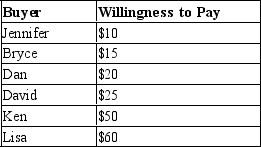 -Refer to Table 7-4. If you have a ticket that you sell to the group in an auction, who will buy the ticket?
 (Multiple Choice)
4.9/5 (87)
(87) Alex is willing to pay $10, and Bella is willing to pay $8, for 1 pound of ribeye steak. When the price of ribeye steak increases from $9 to $11,
(Multiple Choice)
4.8/5 (85)
(85) 
Filters
- Essay(0)
- Multiple Choice(0)
- Short Answer(0)
- True False(0)
- Matching(0)