



 Chat with AI
Exam 7: Consumers, Producers, and the Efficiency of Markets

Exam 1: Ten Principles of Economics439 Questions
Exam 2: Thinking Like an Economist617 Questions
Exam 3: Interdependence and the Gains From Trade527 Questions
Exam 4: The Market Forces of Supply and Demand698 Questions
Exam 5: Elasticity and Its Application595 Questions
Exam 6: Supply, Demand, and Government Policies644 Questions
Exam 7: Consumers, Producers, and the Efficiency of Markets549 Questions
Exam 8: Application: The Costs of Taxation511 Questions
Exam 9: Application: International Trade493 Questions
Exam 10: Externalities524 Questions
Exam 11: Public Goods and Common Resources433 Questions
Exam 12: The Design of the Tax System551 Questions
Exam 13: The Costs of Production420 Questions
Exam 14: Firms in Competitive Markets543 Questions
Exam 15: Monopoly637 Questions
Exam 16: Monopolistic Competition587 Questions
Exam 17: Oligopoly496 Questions
Exam 18: The Markets for the Factors of Production564 Questions
Exam 19: Earnings and Discrimination490 Questions
Exam 20: Income Inequality and Poverty457 Questions
Exam 21: The Theory of Consumer Choice440 Questions
Exam 22: Frontiers of Microeconomics441 Questions
Select questions type


Figure 7-34  -Refer to Figure 7-34. Suppose there is initially a price floor set at $10 in this market. If the government removed the price floor, by how much would total producer surplus change, assuming the producers with the lowest cost were the ones supplying the market when the price floor was in place?
 (Essay)
4.9/5  (72)
(72) Even though participants in the economy are motivated by self-interest, the "invisible hand" of the marketplace guides this self-interest into promoting general economic well-being.
(True/False)
4.8/5 (77)
(77) Table 7-6
For each of three potential buyers of apples, the table displays the willingness to pay for the first three apples of the day. Assume Xavier, Yadier, and Zavi are the only three buyers of apples, and only three apples can be supplied per day.
 -Refer to Table 7-6. If the market price of an apple is $1.40, then consumer surplus amounts to
 (Multiple Choice)
4.9/5 (86)
(86) Figure 7-22  -Refer to Figure 7-22. At the equilibrium price, total surplus is
 (Multiple Choice)
4.7/5 (84)
(84) Which of the following statements is not correct about a market in equilibrium?
(Multiple Choice)
4.8/5 (89)
(89) Table 7-4
The numbers in Table 7-1 reveal the maximum willingness to pay for a ticket to a Chicago Cubs vs. St. Louis Cardinal's baseball game at Wrigley Field.
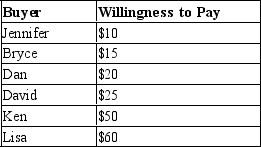 -Refer to Table 7-4. If you have a ticket that you sell to the group in an auction, what will be the selling price?
 (Multiple Choice)
4.8/5 (84)
(84) Figure 7-15  -Refer to Figure 7-15. When the price is P1, producer surplus is
 (Multiple Choice)
4.9/5 (81)
(81) Figure 7-20  -Refer to Figure 7-20. Total surplus can be measured as the area
 (Multiple Choice)
4.8/5 (80)
(80) A seller is willing to sell a product only if the seller receives a price that is at least as great as the
(Multiple Choice)
4.8/5 (85)
(85) You are offered a free ticket to see the Chicago Cubs play the Chicago White Sox at Wrigley Field. Assume the ticket has no resale value. Willie Nelson is performing on the same night, and his concert is your next-best alternative activity. Tickets to see Willie Nelson cost $40. On any given day, you would be willing to pay up to $50 to see and hear Willie Nelson perform. Assume there are no other costs of seeing either event. Based on this information, at a minimum, how much would you have to value seeing the Cubs play the White Sox to accept the ticket and go to the game?
(Multiple Choice)
4.8/5 (87)
(87) Figure 7-20
-Refer to Figure 7-20. For quantities less than M, the value to the marginal buyer is
-Refer to Figure 7-20. For quantities less than M, the value to the marginal buyer is (Multiple Choice)
4.9/5 (78)
(78) Table 7-12
The only four producers in a market have the following costs:
 -Refer to Table 7-12. If Evan, Selena, Angie, and Kris sell the good, and the resulting producer surplus is $700, then the price must have been
 (Multiple Choice)
4.8/5 (79)
(79) Allen tutors in his spare time for extra income. Buyers of his service are willing to pay $40 per hour for as many hours Allen is willing to tutor. On a particular day, he is willing to tutor the first hour for $10, the second hour for $18, the third hour for $28, and the fourth hour for $40. Assume Allen is rational in deciding how many hours to tutor. His producer surplus is
(Multiple Choice)
4.7/5 (65)
(65) Table 7-15
 -Refer to Table 7-15. You and your best friend want to hire a professional photographer to take pictures of your two families. The table shows the costs of the four potential sellers in the local photography market. You and your friend take bids from the sellers. Who offers the two winning bids, and what do they offer to charge for the photography sessions?
 (Multiple Choice)
4.8/5 (73)
(73) Abraham drinks Mountain Dew. He can buy as many cans of Mountain Dew as he wishes at a price of $0.55 per can. On a particular day, he is willing to pay $0.95 for the first can, $0.80 for the second can, $0.60 for the third can, and $0.40 for the fourth can. Assume Abraham is rational in deciding how many cans to buy. His consumer surplus is
(Multiple Choice)
4.7/5 (67)
(67) Suppose the demand for peaches decreases. What will happen to producer surplus in the market for peaches?
(Multiple Choice)
4.9/5 (67)
(67) The area below the price and above the supply curve measures the producer surplus in a market.
(True/False)
4.9/5 (76)
(76) Figure 7-11  -Refer to Figure 7-11. If the supply curve is S and the demand curve shifts from D to D', what is the increase in producer surplus to existing producers?
 (Multiple Choice)
4.9/5 (78)
(78) 
Filters
- Essay(0)
- Multiple Choice(0)
- Short Answer(0)
- True False(0)
- Matching(0)