



 Chat with AI
Exam 7: Consumers, Producers, and the Efficiency of Markets

Exam 1: Ten Principles of Economics439 Questions
Exam 2: Thinking Like an Economist617 Questions
Exam 3: Interdependence and the Gains From Trade527 Questions
Exam 4: The Market Forces of Supply and Demand698 Questions
Exam 5: Elasticity and Its Application595 Questions
Exam 6: Supply, Demand, and Government Policies644 Questions
Exam 7: Consumers, Producers, and the Efficiency of Markets549 Questions
Exam 8: Application: The Costs of Taxation511 Questions
Exam 9: Application: International Trade493 Questions
Exam 10: Externalities524 Questions
Exam 11: Public Goods and Common Resources433 Questions
Exam 12: The Design of the Tax System551 Questions
Exam 13: The Costs of Production420 Questions
Exam 14: Firms in Competitive Markets543 Questions
Exam 15: Monopoly637 Questions
Exam 16: Monopolistic Competition587 Questions
Exam 17: Oligopoly496 Questions
Exam 18: The Markets for the Factors of Production564 Questions
Exam 19: Earnings and Discrimination490 Questions
Exam 20: Income Inequality and Poverty457 Questions
Exam 21: The Theory of Consumer Choice440 Questions
Exam 22: Frontiers of Microeconomics441 Questions
Select questions type


At any quantity, the price given by the supply curve shows the cost of the lowest-cost seller.
(True/False)
5.0/5  (79)
(79) Figure 7-33  -Refer to Figure 7-33. Suppose demand shifts such that consumers wish to purchase 12 fewer units at every price.
How much is total surplus in this market at the new equilibrium price?
-Refer to Figure 7-33. Suppose demand shifts such that consumers wish to purchase 12 fewer units at every price.
How much is total surplus in this market at the new equilibrium price? (Essay)
4.9/5 (82)
(82) Consumer surplus is a good measure of economic welfare if policymakers want to
(Multiple Choice)
4.8/5 (69)
(69) Table 7-1
 -Refer to Table 7-1. If the price of the product is $130, then who would be willing to purchase the product?
 (Multiple Choice)
4.9/5 (79)
(79) Figure 7-33
-Refer to Figure 7-33. Suppose demand shifts such that consumers wish to purchase 12 fewer units at every price.
How much is total producer surplus in this market at the new equilibrium price?
-Refer to Figure 7-33. Suppose demand shifts such that consumers wish to purchase 12 fewer units at every price.
How much is total producer surplus in this market at the new equilibrium price? (Essay)
4.8/5 (85)
(85) What happens to consumer surplus in the iPod market if iPods are normal goods and buyers of iPods experience an increase in income?
(Multiple Choice)
4.9/5 (72)
(72) Tammy loves donuts. The table shown reflects the value Tammy places on each donut she eats:
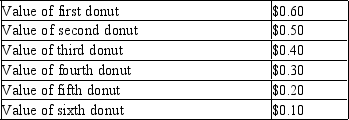 a. Use this information to construct Tammy's demand curve for donuts.
b. If the price of donuts is $0.20, how many donuts will Tammy buy?
c. Show Tammy's consumer surplus on your graph. How much consumer surplus would she have at a price of $0.20?
d. If the price of donuts rose to $0.40, how many donuts would she purchase now? What would happen to Tammy's consumer surplus? Show this change on your graph.
a. Use this information to construct Tammy's demand curve for donuts.
b. If the price of donuts is $0.20, how many donuts will Tammy buy?
c. Show Tammy's consumer surplus on your graph. How much consumer surplus would she have at a price of $0.20?
d. If the price of donuts rose to $0.40, how many donuts would she purchase now? What would happen to Tammy's consumer surplus? Show this change on your graph. (Essay)
5.0/5 (87)
(87) Which of the following events would increase producer surplus?
(Multiple Choice)
4.9/5 (80)
(80) Suppose the market demand curve for a good passes through the point (quantity demanded = 100, price = $25). If there are five buyers in the market, then
(Multiple Choice)
4.8/5 (89)
(89) Suppose that Firms A and B each produce high-resolution computer monitors, but Firm A can do so at a lower cost. Cassie and David each want to purchase a high-resolution computer monitor, but David is willing to pay more than Cassie. If Firm B produces a monitor that David buys, then the market outcome illustrates which of the following principles? (i) Free markets allocate the supply of goods to the buyers who value them most highly, as measured by their willingness to pay.
(ii) Free markets allocate the demand for goods to the sellers who can produce them at the least cost.
(Multiple Choice)
4.9/5 (68)
(68) Figure 7-12  -Refer to Figure 7-12. If the equilibrium price rises from $200 to $350, what is the producer surplus to new producers
 (Multiple Choice)
4.8/5 (78)
(78) Ray buys a new tractor for $118,000. He receives consumer surplus of $13,000 on his purchase. Ray's willingness to pay is
(Multiple Choice)
4.8/5 (88)
(88) Figure 7-12
-Refer to Figure 7-12. If the equilibrium price is $200, what is the producer surplus?
-Refer to Figure 7-12. If the equilibrium price is $200, what is the producer surplus? (Multiple Choice)
5.0/5 (87)
(87) Figure 7-34  -Refer to Figure 7-34. Suppose there is initially a price floor set at $10 in this market. If the government removed the price floor, by how much would total consumer surplus increase for those consumers who were purchasing the good when the price floor was in place?
 (Essay)
4.7/5 (83)
(83) Donald produces nails at a cost of $200 per ton. If he sells the nails for $350 per ton, his producer surplus per ton is
(Multiple Choice)
4.8/5 (84)
(84) If the United States legally allowed for a market in transplant organs, it is estimated that one kidney would sell for at least $100,000.
(True/False)
4.7/5 (69)
(69) 
Filters
- Essay(0)
- Multiple Choice(0)
- Short Answer(0)
- True False(0)
- Matching(0)