



 Chat with AI
Exam 7: Consumers, Producers, and the Efficiency of Markets

Exam 1: Ten Principles of Economics439 Questions
Exam 2: Thinking Like an Economist617 Questions
Exam 3: Interdependence and the Gains From Trade527 Questions
Exam 4: The Market Forces of Supply and Demand698 Questions
Exam 5: Elasticity and Its Application595 Questions
Exam 6: Supply, Demand, and Government Policies644 Questions
Exam 7: Consumers, Producers, and the Efficiency of Markets549 Questions
Exam 8: Application: The Costs of Taxation511 Questions
Exam 9: Application: International Trade493 Questions
Exam 10: Externalities524 Questions
Exam 11: Public Goods and Common Resources433 Questions
Exam 12: The Design of the Tax System551 Questions
Exam 13: The Costs of Production420 Questions
Exam 14: Firms in Competitive Markets543 Questions
Exam 15: Monopoly637 Questions
Exam 16: Monopolistic Competition587 Questions
Exam 17: Oligopoly496 Questions
Exam 18: The Markets for the Factors of Production564 Questions
Exam 19: Earnings and Discrimination490 Questions
Exam 20: Income Inequality and Poverty457 Questions
Exam 21: The Theory of Consumer Choice440 Questions
Exam 22: Frontiers of Microeconomics441 Questions
Select questions type


Which of the following will cause an increase in producer surplus?
(Multiple Choice)
4.9/5  (77)
(77) Table 7-7
 -Refer to Table 7-7. You have two essentially identical extra tickets to the Midwest Regional Sweet 16 game in the men's NCAA basketball tournament. The table shows the willingness to pay of the four potential buyers in the market for a ticket to the game. You hold an auction to sell the two tickets. Who makes the winning bids, and what do they offer to pay for the tickets?
 (Multiple Choice)
4.9/5 (74)
(74) Table 7-5
For each of three potential buyers of oranges, the table displays the willingness to pay for the first three oranges of the day. Assume Allison, Bob, and Charisse are the only three buyers of oranges, and only three oranges can be supplied per day.
 -Refer to Table 7-5. Who experiences the largest loss of consumer surplus when the price of an orange increases from $0.70 to $1.40?
 (Multiple Choice)
4.9/5 (82)
(82) If the United States changed its laws to allow for the legal sale of a kidney, which of the following is least likely to occur?
(Multiple Choice)
4.8/5 (68)
(68) Figure 7-23  -Refer to Figure 7-23. At equilibrium, consumer surplus is represented by the area
 (Multiple Choice)
4.7/5 (80)
(80) In order to conclude that markets are efficient, we assume that they are perfectly competitive.
(True/False)
4.7/5 (69)
(69) Figure 7-16  -Refer to Figure 7-16. Suppose the price of the good is $400. Then, on the first unit of the good that is sold, producer surplus amounts to
 (Multiple Choice)
5.0/5 (61)
(61) If the government allowed a free market for transplant organs such as kidneys to exist, the
(Multiple Choice)
4.9/5 (78)
(78) Denise values a stainless steel dishwasher for her new house at $500, but she succeeds in buying one for $350. Denise's consumer surplus is
(Multiple Choice)
4.8/5 (92)
(92) If the United States changed its laws to allow for the legal sale of a kidney, which of the following is likely to occur?
(Multiple Choice)
4.9/5 (83)
(83) Let P represent price; let QS represent quantity supplied; and assume the equation of the supply curve is
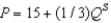 If 90 units of the good are produced and sold, then producer surplus amounts to $1,350.
 (True/False)
4.9/5 (83)
(83) If a market is allowed to move freely to its equilibrium price and quantity, then an increase in supply will
(Multiple Choice)
4.8/5 (87)
(87) Figure 7-4  -Refer to Figure 7-4. When the price falls from P1 to P2, which area represents the increase in consumer surplus to existing buyers?
 (Multiple Choice)
4.9/5 (74)
(74)  -Refer to Figure 7-15. Area B represents
Table 7-7
-Refer to Table 7-7. You have two essentially identical extra tickets to the Midwest Regional Sweet 16 game in the men's NCAA basketball tournament. The table shows the willingness to pay of the four potential buyers in the market for a ticket to the game. You hold an auction to sell the two tickets. Michael and Earvin each offer to pay $360 for a ticket, and you sell them the two tickets. What is the total consumer surplus in the market?
-Refer to Table 7-7. You have two essentially identical extra tickets to the Midwest Regional Sweet 16 game in the men's NCAA basketball tournament. The table shows the willingness to pay of the four potential buyers in the market for a ticket to the game. You hold an auction to sell the two tickets. Michael and Earvin each offer to pay $360 for a ticket, and you sell them the two tickets. What is the total consumer surplus in the market? (Multiple Choice)
4.9/5 (77)
(77) Figure 7-24  -Refer to Figure 7-24. If the government imposes a price floor at $18, then consumer surplus is
 (Multiple Choice)
4.8/5 (78)
(78) Figure 7-4
-Refer to Figure 7-4. Which area represents consumer surplus at a price of P1?
-Refer to Figure 7-4. Which area represents consumer surplus at a price of P1? (Multiple Choice)
4.8/5 (80)
(80) Suppose there is an early freeze in California that reduces the size of the lemon crop. What happens to consumer surplus in the market for lemons?
(Multiple Choice)
4.8/5 (68)
(68) Figure 7-20  -Refer to Figure 7-20. For quantities greater than M, the value to the marginal buyer is
 (Multiple Choice)
4.8/5 (73)
(73) 
Filters
- Essay(0)
- Multiple Choice(0)
- Short Answer(0)
- True False(0)
- Matching(0)