



 Chat with AI
Exam 7: Consumers, Producers, and the Efficiency of Markets

Exam 1: Ten Principles of Economics439 Questions
Exam 2: Thinking Like an Economist617 Questions
Exam 3: Interdependence and the Gains From Trade527 Questions
Exam 4: The Market Forces of Supply and Demand698 Questions
Exam 5: Elasticity and Its Application595 Questions
Exam 6: Supply, Demand, and Government Policies644 Questions
Exam 7: Consumers, Producers, and the Efficiency of Markets549 Questions
Exam 8: Application: The Costs of Taxation511 Questions
Exam 9: Application: International Trade493 Questions
Exam 10: Externalities524 Questions
Exam 11: Public Goods and Common Resources433 Questions
Exam 12: The Design of the Tax System551 Questions
Exam 13: The Costs of Production420 Questions
Exam 14: Firms in Competitive Markets543 Questions
Exam 15: Monopoly637 Questions
Exam 16: Monopolistic Competition587 Questions
Exam 17: Oligopoly496 Questions
Exam 18: The Markets for the Factors of Production564 Questions
Exam 19: Earnings and Discrimination490 Questions
Exam 20: Income Inequality and Poverty457 Questions
Exam 21: The Theory of Consumer Choice440 Questions
Exam 22: Frontiers of Microeconomics441 Questions
Select questions type


Table 7-9
During the last two days, Chad purchased a latte from two different stores. The table below shows Chad's willingness to pay on each day and his consumer surplus from each purchase.
 -Refer to Table 7-9. The price that Chad paid for a latte on the second day is
 (Multiple Choice)
4.9/5  (71)
(71) Henry is willing to pay 45 cents, and Janine is willing to pay 55 cents, for 1 pound of bananas. When the price of bananas falls from 50 cents a pound to 40 cents a pound,
(Multiple Choice)
4.7/5 (90)
(90) Figure 7-30  -Refer to Figure 7-30. If the market equilibrium price falls from $120 to $80, how much is the increase in consumer surplus to the consumers who were initially in the market at the $120 price?
 (Essay)
4.8/5 (76)
(76) Figure 7-17  -Refer to Figure 7-17. If the demand curve is D and the supply curve shifts left from S to S', what is the change in producer surplus when comparing the new equilibrium with the original equilibrium?
 (Multiple Choice)
4.9/5 (82)
(82) Figure 7-23  -Refer to Figure 7-23. The equilibrium price is
 (Multiple Choice)
4.9/5 (79)
(79) Figure 7-2 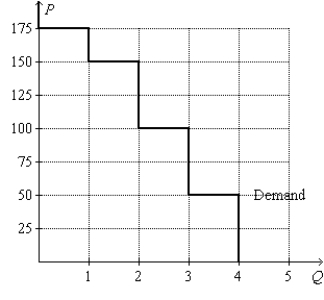 -Refer to Figure 7-2. If the price of the good is $100, then consumer surplus amounts to
 (Multiple Choice)
4.8/5 (84)
(84) When demand increases so that market price increases, producer surplus increases because (1) producer surplus received by existing sellers increases, and (2) new sellers enter the market.
(True/False)
4.9/5 (81)
(81) Figure 7-24  -Refer to Figure 7-24. If 10 units of the good are produced and sold, then
 (Multiple Choice)
4.9/5 (84)
(84) George produces cupcakes. His production cost is $10 per dozen. He sells the cupcakes for $16 per dozen. His producer surplus per dozen cupcakes is
(Multiple Choice)
5.0/5 (68)
(68) The French expression used by free-market advocates, which literally translates as "allow them to do," is
(Multiple Choice)
4.9/5 (63)
(63) Figure 7-27  -Refer to Figure 7-27. Sellers whose costs are less than the equilibrium price are represented by which line segment?
 (Multiple Choice)
4.8/5 (79)
(79) Table 7-13
The numbers reveal the opportunity costs of providing 10 piano lessons of equal quality.
 -Refer to Table 7-13. The equilibrium market price for 10 piano lessons is $400. What is the total producer surplus in the market?
 (Multiple Choice)
4.8/5 (85)
(85) Chuck would be willing to pay $20 to attend a dog show, but he buys a ticket for $15. Chuck values the dog show at
(Multiple Choice)
4.9/5 (73)
(73) The maximum price that a buyer will pay for a good is called
(Multiple Choice)
5.0/5 (87)
(87) Figure 7-17
-Refer to Figure 7-17. Suppose the market starts out in equilibrium with demand curve D and supply curve S. Next, suppose demand shifts left so as to decrease the quantity demanded by 20 units at every price. What is the change in producer surplus as a result of this demand shift?
-Refer to Figure 7-17. Suppose the market starts out in equilibrium with demand curve D and supply curve S. Next, suppose demand shifts left so as to decrease the quantity demanded by 20 units at every price. What is the change in producer surplus as a result of this demand shift? (Multiple Choice)
4.8/5 (86)
(86) Figure 7-19  -Refer to Figure 7-19. If the government imposes a price floor of $55 in this market, then total surplus will be
 (Multiple Choice)
4.9/5 (87)
(87) Corn chips and potato chips are substitutes. Good weather that sharply increases the corn harvest would
(Multiple Choice)
4.8/5 (77)
(77) Kristi sells purses. Her cost is $35 per purse. On a certain day, she sells 12 purses, and her producer surplus for that day amounts to $180. Kristi sold each purse for
(Multiple Choice)
4.8/5 (79)
(79) 
Filters
- Essay(0)
- Multiple Choice(0)
- Short Answer(0)
- True False(0)
- Matching(0)