



 Chat with AI
Exam 7: Consumers, Producers, and the Efficiency of Markets

Exam 1: Ten Principles of Economics439 Questions
Exam 2: Thinking Like an Economist617 Questions
Exam 3: Interdependence and the Gains From Trade527 Questions
Exam 4: The Market Forces of Supply and Demand698 Questions
Exam 5: Elasticity and Its Application595 Questions
Exam 6: Supply, Demand, and Government Policies644 Questions
Exam 7: Consumers, Producers, and the Efficiency of Markets549 Questions
Exam 8: Application: The Costs of Taxation511 Questions
Exam 9: Application: International Trade493 Questions
Exam 10: Externalities524 Questions
Exam 11: Public Goods and Common Resources433 Questions
Exam 12: The Design of the Tax System551 Questions
Exam 13: The Costs of Production420 Questions
Exam 14: Firms in Competitive Markets543 Questions
Exam 15: Monopoly637 Questions
Exam 16: Monopolistic Competition587 Questions
Exam 17: Oligopoly496 Questions
Exam 18: The Markets for the Factors of Production564 Questions
Exam 19: Earnings and Discrimination490 Questions
Exam 20: Income Inequality and Poverty457 Questions
Exam 21: The Theory of Consumer Choice440 Questions
Exam 22: Frontiers of Microeconomics441 Questions
Select questions type


Bill created a new software program he is willing to sell for $300. He sells his first copy and enjoys a producer surplus of $250. What is the price paid for the software?
(Multiple Choice)
4.9/5  (90)
(90) All else equal, an increase in supply will cause an increase in consumer surplus.
(True/False)
4.8/5 (86)
(86) If a market is in equilibrium, then it is impossible for a social planner to raise economic welfare by increasing or decreasing the quantity of the good.
(True/False)
4.8/5 (77)
(77) The area below the demand curve and above the supply curve measures the producer surplus in a market.
(True/False)
4.8/5 (66)
(66) Figure 7-8 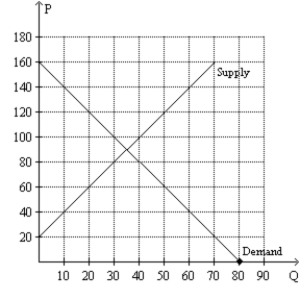 -Refer to Figure 7-8. At the equilibrium price, consumer surplus is
 (Multiple Choice)
4.8/5 (87)
(87) Suppose that Firms A and B each produce high-resolution computer monitors, but Firm A can do so at a lower cost. Cassie and David each want to purchase a high-resolution computer monitor, but David is willing to pay more than Cassie. If Firm A produces a monitor that Cassie buys but David does not, then the market outcome illustrates which of the following principles?
(i) Free markets allocate the supply of goods to the buyers who value them most highly, as measured by their willingness to pay.
(ii) Free markets allocate the demand for goods to the sellers who can produce them at the least cost.
(Multiple Choice)
4.9/5 (78)
(78) Josh is willing to pay $500 for a set of tire, but he is able to pay $300 at the local tire store. His consumer surplus is
(Multiple Choice)
4.8/5 (88)
(88) Laissez-faire is a French expression which literally means
(Multiple Choice)
4.8/5 (79)
(79) Efficiency refers to whether a market outcome is fair, while equality refers to whether the maximum amount of output was produced from a given number of inputs.
(True/False)
4.7/5 (70)
(70) Figure 7-21  -Refer to Figure 7-21. When the price is P1, area C represents
 (Multiple Choice)
5.0/5 (68)
(68) Suppose Larry, Moe, and Curly are bidding in an auction for a mint-condition video of Charlie Chaplin's first movie. Each has in mind a maximum amount that he will bid. This maximum is called
(Multiple Choice)
4.9/5 (69)
(69) Let P represent price; let QS represent quantity supplied; and assume the equation of the supply curve is
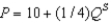 If 80 units of the good are produced and sold, then producer surplus amounts to $1,200.
 (True/False)
4.8/5 (83)
(83) Figure 7-34  -Refer to Figure 7-34. Suppose there is initially a price ceiling set at $4 in this market. If the government removed the price ceiling, by how much would total producer surplus change?
 (Essay)
4.9/5 (77)
(77) Denise values a stainless steel dishwasher for her new house at $500. The actual price of the dishwasher is $650. Denise
(Multiple Choice)
4.7/5 (80)
(80) Table 7-12
The only four producers in a market have the following costs:
 -Refer to Table 7-12. If the sellers bid against each other for the right to sell the good to a consumer, then the producer surplus will be
 (Multiple Choice)
4.9/5 (76)
(76) Figure 7-31  -Refer to Figure 7-31. If the market equilibrium price rises from $25 to $35, how much is the increase in producer surplus to the producers supplying units at the initial $25 price?
 (Essay)
4.9/5 (78)
(78) Table 7-11
The following table represents the costs of five possible sellers.
 -Refer to Table 7-11. If the price is $1,l50, who would be willing to supply the product?
 (Multiple Choice)
4.8/5 (78)
(78) 
Filters
- Essay(0)
- Multiple Choice(0)
- Short Answer(0)
- True False(0)
- Matching(0)