



 Chat with AI
Exam 7: Consumers, Producers, and the Efficiency of Markets

Exam 1: Ten Principles of Economics439 Questions
Exam 2: Thinking Like an Economist617 Questions
Exam 3: Interdependence and the Gains From Trade527 Questions
Exam 4: The Market Forces of Supply and Demand698 Questions
Exam 5: Elasticity and Its Application595 Questions
Exam 6: Supply, Demand, and Government Policies644 Questions
Exam 7: Consumers, Producers, and the Efficiency of Markets549 Questions
Exam 8: Application: The Costs of Taxation511 Questions
Exam 9: Application: International Trade493 Questions
Exam 10: Externalities524 Questions
Exam 11: Public Goods and Common Resources433 Questions
Exam 12: The Design of the Tax System551 Questions
Exam 13: The Costs of Production420 Questions
Exam 14: Firms in Competitive Markets543 Questions
Exam 15: Monopoly637 Questions
Exam 16: Monopolistic Competition587 Questions
Exam 17: Oligopoly496 Questions
Exam 18: The Markets for the Factors of Production564 Questions
Exam 19: Earnings and Discrimination490 Questions
Exam 20: Income Inequality and Poverty457 Questions
Exam 21: The Theory of Consumer Choice440 Questions
Exam 22: Frontiers of Microeconomics441 Questions
Select questions type


Which of the Ten Principles of Economics does welfare economics explain more fully?
(Multiple Choice)
4.7/5  (73)
(73) Table 7-16
The following table represents the costs of five possible sellers.
Seller Cost ($)
 -Refer to Table 7-16. Suppose each of the five sellers can supply at most one unit of the good. At which of the following prices would the market quantity supplied be exactly three units?
 (Multiple Choice)
4.9/5 (68)
(68) Table 7-16
The following table represents the costs of five possible sellers.
Seller Cost ($)
-Refer to Table 7-16. If each producer has one unit available for sale, and if the market equilibrium price is $80 per unit, how much is the total producer surplus in this market?
-Refer to Table 7-16. If each producer has one unit available for sale, and if the market equilibrium price is $80 per unit, how much is the total producer surplus in this market? (Multiple Choice)
4.8/5 (77)
(77) Figure 7-16  -Refer to Figure 7-16. If the price of the good is $500, then producer surplus amounts to
 (Multiple Choice)
4.8/5 (78)
(78) Chad is willing to pay $5.00 to get his first cup of morning latté; he is willing to pay $4.50 for a second cup. He buys his first cup from a vendor selling latté for $3.75 per cup. He returns to that vendor later in the morning to find that the vendor has increased her price to $3.90 per cup. Chad buys a second cup. Which of the following statements is correct?
(Multiple Choice)
4.8/5 (89)
(89) Oil is used to produce gasoline. If the price of oil increases, consumer surplus in the gasoline market
(Multiple Choice)
4.9/5 (78)
(78) At Nick's Bakery, the cost to make homemade chocolate cake is $4 per cake. As a result of selling five cakes, Nick experiences a producer surplus in the amount of $17.50. Nick must be selling his cakes for
(Multiple Choice)
4.8/5 (72)
(72) Figure 7-19  -Refer to Figure 7-19. At the equilibrium price, producer surplus is
 (Multiple Choice)
4.9/5 (97)
(97) Table 7-7
 -Refer to Table 7-7. You have four essentially identical extra tickets to the Midwest Regional Sweet 16 game in the men's NCAA basketball tournament. The table shows the willingness to pay of the four potential buyers in the market for a ticket to the game. You offer to sell the tickets for $325. How many tickets do you sell, and what is the total consumer surplus in the market?
 (Multiple Choice)
4.8/5 (89)
(89) A result of welfare economics is that the equilibrium price of a product is considered to be the best price because it
(Multiple Choice)
4.9/5 (83)
(83) Figure 7-9  -Refer to Figure 7-9. If the price of the good is $14, then producer surplus is
 (Multiple Choice)
4.8/5 (73)
(73) Table 7-17
 -Refer to Table 7-17. Both the demand curve and the supply curve are straight lines. At equilibrium, total surplus is
 (Multiple Choice)
4.9/5 (82)
(82) Which of the following is not true when the price of a good or service falls?
(Multiple Choice)
4.9/5 (77)
(77) Figure 7-28 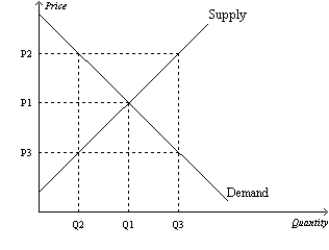 -Refer to Figure 7-28. At the quantity Q2, the marginal value to buyers
 (Multiple Choice)
4.9/5 (86)
(86) Figure 7-23  -Refer to Figure 7-23. At equilibrium, total surplus is represented by the area
 (Multiple Choice)
4.7/5 (75)
(75) When policymakers are considering a particular action, they can use consumer surplus as a(n)
(Multiple Choice)
5.0/5 (71)
(71) Dawn's bridal boutique is having a sale on evening dresses. The increase in consumer surplus comes from the benefit of the lower prices to
(Multiple Choice)
4.8/5 (75)
(75) Figure 7-3  -Refer to Figure 7-3. When the price is P1, consumer surplus is
 (Multiple Choice)
4.8/5 (82)
(82) Table 7-13
The numbers reveal the opportunity costs of providing 10 piano lessons of equal quality.
 -Refer to Table 7-13. The equilibrium market price for 10 piano lessons is $300. What is the total producer surplus in the market?

-Refer to Table 7-13. The equilibrium market price for 10 piano lessons is $300. What is the total producer surplus in the market? (Multiple Choice)
4.9/5 (71)
(71) 
Filters
- Essay(0)
- Multiple Choice(0)
- Short Answer(0)
- True False(0)
- Matching(0)