



 Chat with AI
Exam 7: Consumers, Producers, and the Efficiency of Markets

Exam 1: Ten Principles of Economics439 Questions
Exam 2: Thinking Like an Economist617 Questions
Exam 3: Interdependence and the Gains From Trade527 Questions
Exam 4: The Market Forces of Supply and Demand698 Questions
Exam 5: Elasticity and Its Application595 Questions
Exam 6: Supply, Demand, and Government Policies644 Questions
Exam 7: Consumers, Producers, and the Efficiency of Markets549 Questions
Exam 8: Application: The Costs of Taxation511 Questions
Exam 9: Application: International Trade493 Questions
Exam 10: Externalities524 Questions
Exam 11: Public Goods and Common Resources433 Questions
Exam 12: The Design of the Tax System551 Questions
Exam 13: The Costs of Production420 Questions
Exam 14: Firms in Competitive Markets543 Questions
Exam 15: Monopoly637 Questions
Exam 16: Monopolistic Competition587 Questions
Exam 17: Oligopoly496 Questions
Exam 18: The Markets for the Factors of Production564 Questions
Exam 19: Earnings and Discrimination490 Questions
Exam 20: Income Inequality and Poverty457 Questions
Exam 21: The Theory of Consumer Choice440 Questions
Exam 22: Frontiers of Microeconomics441 Questions
Select questions type


Figure 7-22  -Refer to Figure 7-22. If 110 units of the good are bought and sold, then
 (Multiple Choice)
4.7/5  (83)
(83) Unless markets are perfectly competitive, they may fail to maximize the total benefits to buyers and sellers.
(True/False)
4.8/5 (79)
(79) A simultaneous increase in both the demand for MP3 players and the supply of MP3 players would imply that
(Multiple Choice)
4.9/5 (68)
(68) Figure 7-5 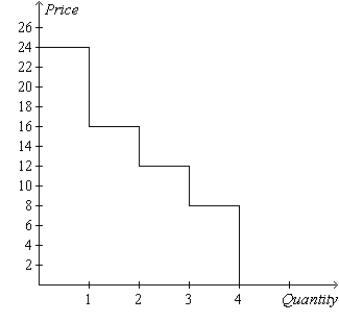 -Refer to Figure 7-5. If the price of the good is $6, then consumer surplus is
 (Multiple Choice)
4.9/5 (74)
(74) Jeff decides that he would pay as much as $3,000 for a new laptop computer. He buys the computer and realizes consumer surplus of $700. How much did Jeff pay for his computer?
(Multiple Choice)
4.9/5 (70)
(70) Figure 7-16  -Refer to Figure 7-16. If the price of the good is $600, then producer surplus amounts to
 (Multiple Choice)
4.8/5 (80)
(80) On a graph, the area below a demand curve and above the price measures
(Multiple Choice)
4.8/5 (84)
(84) Figure 7-34  -Refer to Figure 7-34. Suppose there is initially a price floor set at $10 in this market. If the government removed the price floor, by how much would total consumer surplus increase for those consumers who enter the market after the price floor is removed?
 (Essay)
4.8/5 (89)
(89) Figure 7-33  -Refer to Figure 7-33. How much is total consumer surplus in this market at the equilibrium price?
 (Essay)
4.9/5 (84)
(84) Figure 7-27  -Refer to Figure 7-27. Buyers who value this good more than the equilibrium price are represented by which line segment?
 (Multiple Choice)
4.9/5 (81)
(81) All else equal, an increase in demand will always increase consumer surplus.
(True/False)
4.9/5 (76)
(76) Justin builds fences for a living. Justin's outofpocket expenses (for wood, paint, etc.) plus the value that he places
(Multiple Choice)
4.9/5 (84)
(84) The Surgeon General announces that eating apples promotes healthy teeth. As a result, the equilibrium price of apples
(Multiple Choice)
5.0/5 (74)
(74) Figure 7-15  -Refer to Figure 7-15. When the price falls from P2 to P1, producer surplus
 (Multiple Choice)
4.9/5 (76)
(76) Connie can clean windows in large office buildings at a cost of $1 per window. The market price for window- cleaning services is $3 per window. If Connie cleans 100 windows, her producer surplus is $100.
(True/False)
4.9/5 (88)
(88) Table 7-17
 -Refer to Table 7-17. Both the demand curve and the supply curve are straight lines. If 6 units are bought and sold, then total surplus is
 (Multiple Choice)
4.7/5 (93)
(93) Figure 7-3  -Refer to Figure 7-3. When the price rises from P1 to P2, consumer surplus
 (Multiple Choice)
5.0/5 (88)
(88) Figure 7-21  -Refer to Figure 7-21. Which area represents producer surplus when the price is P1?
 (Multiple Choice)
4.8/5 (80)
(80) Table 7-3
The only four consumers in a market have the following willingness to pay for a good:
 -Refer to Table 7-3. If the market price for the good is $20, who will purchase the good?
 (Multiple Choice)
4.8/5 (79)
(79) 
Filters
- Essay(0)
- Multiple Choice(0)
- Short Answer(0)
- True False(0)
- Matching(0)