



 Chat with AI
Exam 7: Consumers, Producers, and the Efficiency of Markets

Exam 1: Ten Principles of Economics439 Questions
Exam 2: Thinking Like an Economist617 Questions
Exam 3: Interdependence and the Gains From Trade527 Questions
Exam 4: The Market Forces of Supply and Demand698 Questions
Exam 5: Elasticity and Its Application595 Questions
Exam 6: Supply, Demand, and Government Policies644 Questions
Exam 7: Consumers, Producers, and the Efficiency of Markets549 Questions
Exam 8: Application: The Costs of Taxation511 Questions
Exam 9: Application: International Trade493 Questions
Exam 10: Externalities524 Questions
Exam 11: Public Goods and Common Resources433 Questions
Exam 12: The Design of the Tax System551 Questions
Exam 13: The Costs of Production420 Questions
Exam 14: Firms in Competitive Markets543 Questions
Exam 15: Monopoly637 Questions
Exam 16: Monopolistic Competition587 Questions
Exam 17: Oligopoly496 Questions
Exam 18: The Markets for the Factors of Production564 Questions
Exam 19: Earnings and Discrimination490 Questions
Exam 20: Income Inequality and Poverty457 Questions
Exam 21: The Theory of Consumer Choice440 Questions
Exam 22: Frontiers of Microeconomics441 Questions
Select questions type


Table 7-5
For each of three potential buyers of oranges, the table displays the willingness to pay for the first three oranges of the day. Assume Allison, Bob, and Charisse are the only three buyers of oranges, and only three oranges can be supplied per day.
 -Refer to Table 7-5. If the market price of an orange is $0.65, then consumer surplus amounts to
 (Multiple Choice)
5.0/5  (78)
(78) ABC Company incurs a cost of 50 cents to produce a dozen eggs, while XYZ Company incurs a cost of 70 cents to produce a dozen eggs. Which of the following price increases would cause both companies to experience an increase in producer surplus?
(Multiple Choice)
4.7/5 (69)
(69) Figure 7-16  -Refer to Figure 7-16. Sellers will be unwilling to sell more than
 (Multiple Choice)
5.0/5 (78)
(78) Table 7-17
 -Refer to Table 7-17. Both the demand curve and the supply curve are straight lines. If the price is $4 but only 6 units are bought and sold, producer surplus will be
 (Multiple Choice)
4.9/5 (91)
(91) If Rosa is willing to pay $450 for hockey tickets and has consumer surplus of $175, the price of the tickets is $625.
(True/False)
4.8/5 (86)
(86) Figure 7-29 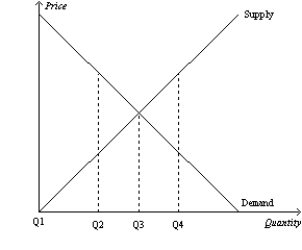 -Refer to Figure 7-29. Which of the following statements is correct?
 (Multiple Choice)
4.8/5 (80)
(80) Suppose that the market price for pizzas increases. The increase in producer surplus comes from the benefit of the higher prices to
(Multiple Choice)
4.9/5 (84)
(84) Celine buys a new MP3 player for $90. She receives consumer surplus of $15 on her purchase if her willingness to pay is
(Multiple Choice)
4.7/5 (80)
(80) Figure 7-12  -Refer to Figure 7-12. If the equilibrium price rises from $200 to $350, what is the additional producer surplus to initial producers?
 (Multiple Choice)
4.9/5 (85)
(85) Table 7-3
The only four consumers in a market have the following willingness to pay for a good:
 -Refer to Table 7-3. If the price is $20, then consumer surplus in the market is
 (Multiple Choice)
4.9/5 (78)
(78) Table 7-11
The following table represents the costs of five possible sellers.
 -Refer to Table 7-11. Suppose each of the five sellers can supply at most one unit of the good. The market quantity supplied is exactly 4 if the price is
 (Multiple Choice)
4.8/5 (80)
(80) The study of how the allocation of resources affects economic well-being is called
(Multiple Choice)
4.9/5 (69)
(69) Caroline sharpens knives in her spare time for extra income. Buyers of her service are willing to pay $2.95 per knife for as many knives as Caroline is willing to sharpen. On a particular day, she is willing to sharpen the first knife for $2.00, the second knife for $2.25, the third knife for $2.75, and the fourth knife for $3.50. Assume Caroline is rational in deciding how many knives to sharpen. Her producer surplus is
(Multiple Choice)
4.9/5 (76)
(76) Figure 7-16
-Refer to Figure 7-16. If the price of the good is $300, then producer surplus amounts to
-Refer to Figure 7-16. If the price of the good is $300, then producer surplus amounts to (Multiple Choice)
4.8/5 (69)
(69) Joel has a 1966 Mustang, which he sells to Susie, an avid car collector. Susie is pleased since she paid $8,000 for the car but would have been willing to pay $11,000 for the car. Susie's consumer surplus is $2,000.
(True/False)
4.7/5 (75)
(75) Producer surplus measures the benefit to sellers from receiving a price above their costs.
(True/False)
4.9/5 (90)
(90) Each seller of a product is willing to sell as long as the price he or she can receive is greater than the opportunity cost of producing the product.
(True/False)
4.9/5 (81)
(81) 
Filters
- Essay(0)
- Multiple Choice(0)
- Short Answer(0)
- True False(0)
- Matching(0)