



 Chat with AI
Exam 30: Nervous and Sensory Systems

Exam 1: The Nature of Science and the Characteristics of Life80 Questions
Exam 2: The Chemistry of Life93 Questions
Exam 3: Cell Structure and Internal Compartments89 Questions
Exam 4: Cell Membranes, Transport, and Communication89 Questions
Exam 5: Energy, Metabolism, and Enzymes85 Questions
Exam 6: Photosynthesis and Cellular Respiration89 Questions
Exam 7: Cell Division84 Questions
Exam 8: Cancer and Human Health86 Questions
Exam 9: Patterns of Inheritance86 Questions
Exam 10: Chromosomes and Human Genetics77 Questions
Exam 11: DNA and Genes83 Questions
Exam 12: From Gene to Protein88 Questions
Exam 13: DNA Technology96 Questions
Exam 14: How Evolution Works72 Questions
Exam 15: The Origin of Species76 Questions
Exam 16: The Evolution of Biodiversity102 Questions
Exam 17: Biological Diversity, Bacteria, and Archaea80 Questions
Exam 18: Protista, Plantae, and Fungi83 Questions
Exam 19: Animalia80 Questions
Exam 20: The Biosphere88 Questions
Exam 21: Growth of Populations70 Questions
Exam 22: Animal Behavior82 Questions
Exam 23: Ecological Communities105 Questions
Exam 24: Ecosystems74 Questions
Exam 25: Global Change73 Questions
Exam 26: Internal Organization and Homeostasis75 Questions
Exam 27: Nutrition and Digestion81 Questions
Exam 28: Circulation and Gas Exchange77 Questions
Exam 29: Animal Hormones79 Questions
Exam 30: Nervous and Sensory Systems76 Questions
Exam 31: Skeletons,Muscles,and Movement77 Questions
Exam 32: The Immune System80 Questions
Exam 33: Reproduction and Development86 Questions
Exam 34: Plant Structure, Nutrition, and Transport80 Questions
Exam 35: Plant Growth and Reproduction81 Questions
Select questions type


As a whole,the nervous system converts stimuli into ________ input-action potentials that convey information about stimuli.
(Short Answer)
4.8/5  (95)
(95) The brain has important interactions with the endocrine system.Which part of the brain directly stimulates the release of hormones from the pituitary gland?
(Multiple Choice)
4.8/5 (81)
(81) The figure below illustrates the organ of Corti,a part of the cochlea in the human inner ear.
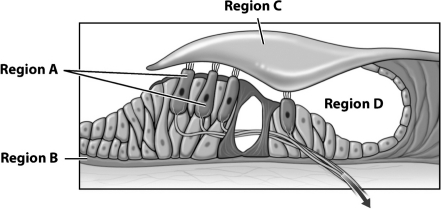 What labeled region of this figure of the organ of Corti is directly stimulated to vibrate in response to the air movements caused by sound?
 (Multiple Choice)
4.8/5 (72)
(72) When the difference in charge across a neuron's cell membrane decreases,the cell is depolarizing.
(True/False)
4.8/5 (67)
(67) Examine the figure below.
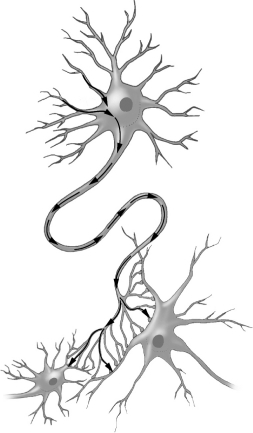 The path of the arrows in this figure indicates the movement of ________ through a neuron.
 (Short Answer)
5.0/5 (72)
(72) A signal-sending neuron releases a ________,a molecule that carries the signal across the synapse between nerve cells.
(Short Answer)
4.8/5 (94)
(94) Air pressure between the middle and outer ear is equalized by the
(Multiple Choice)
5.0/5 (94)
(94) A person who,as a result of a mutation,could NOT produce one of the pigment molecules found in cones
(Multiple Choice)
4.7/5 (75)
(75) The ________ nervous system ferries signals to and from the central nervous system.
(Short Answer)
4.8/5 (93)
(93) The cerebral cortex of the human brain is much more highly and intricately folded than the same region in other animals.Why might this be the case?
(Multiple Choice)
4.9/5 (81)
(81) One interneuron can send signals to the peripheral nervous system and the brain at the same time.
(True/False)
4.8/5 (71)
(71) Researchers have suggested a fifth taste in humans known as umami and attribute the taste to the compound glutamate.Which of the following would support the belief that umami is a real taste?
(Multiple Choice)
4.7/5 (79)
(79) Where would you expect to see an absence of neurotransmitters?
(Multiple Choice)
4.9/5 (87)
(87) The human skin has numerous sensory receptors that take in information about our environment,and these receptors are concentrated in areas where detailed information on touch is needed.Which of the following body areas is likely to have the smallest number of sensory receptors?
(Multiple Choice)
4.9/5 (65)
(65) The center of the human retina has a region called the ________ where cones are most densely packed.
(Short Answer)
4.8/5 (79)
(79) The cerebrum has four major lobes: the parietal lobe,the frontal lobe,the temporal lobe,and the ________ lobe.
(Short Answer)
4.9/5 (72)
(72) The position of our body is reported by mechanoreceptors called ________.
(Short Answer)
4.8/5 (71)
(71) 
Filters
- Essay(0)
- Multiple Choice(0)
- Short Answer(0)
- True False(0)
- Matching(0)