



 Chat with AI
Exam 10: Chromosomes and Human Genetics

Exam 1: The Nature of Science and the Characteristics of Life80 Questions
Exam 2: The Chemistry of Life93 Questions
Exam 3: Cell Structure and Internal Compartments89 Questions
Exam 4: Cell Membranes, Transport, and Communication89 Questions
Exam 5: Energy, Metabolism, and Enzymes85 Questions
Exam 6: Photosynthesis and Cellular Respiration89 Questions
Exam 7: Cell Division84 Questions
Exam 8: Cancer and Human Health86 Questions
Exam 9: Patterns of Inheritance86 Questions
Exam 10: Chromosomes and Human Genetics77 Questions
Exam 11: DNA and Genes83 Questions
Exam 12: From Gene to Protein88 Questions
Exam 13: DNA Technology96 Questions
Exam 14: How Evolution Works72 Questions
Exam 15: The Origin of Species76 Questions
Exam 16: The Evolution of Biodiversity102 Questions
Exam 17: Biological Diversity, Bacteria, and Archaea80 Questions
Exam 18: Protista, Plantae, and Fungi83 Questions
Exam 19: Animalia80 Questions
Exam 20: The Biosphere88 Questions
Exam 21: Growth of Populations70 Questions
Exam 22: Animal Behavior82 Questions
Exam 23: Ecological Communities105 Questions
Exam 24: Ecosystems74 Questions
Exam 25: Global Change73 Questions
Exam 26: Internal Organization and Homeostasis75 Questions
Exam 27: Nutrition and Digestion81 Questions
Exam 28: Circulation and Gas Exchange77 Questions
Exam 29: Animal Hormones79 Questions
Exam 30: Nervous and Sensory Systems76 Questions
Exam 31: Skeletons,Muscles,and Movement77 Questions
Exam 32: The Immune System80 Questions
Exam 33: Reproduction and Development86 Questions
Exam 34: Plant Structure, Nutrition, and Transport80 Questions
Exam 35: Plant Growth and Reproduction81 Questions
Select questions type


The "actual results" in the experiment depicted in the following figure differ significantly from the "expected results" predicted by Mendel's laws because the gene for body color and the gene for wing length
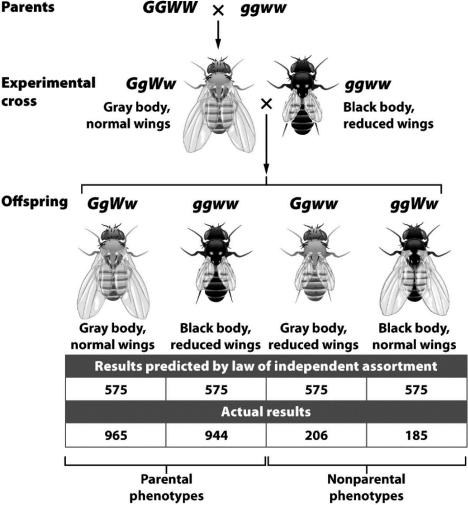
(Multiple Choice)
4.8/5  (84)
(84) Why are X-linked recessive genetic disorders more commonly seen in males?
(Multiple Choice)
4.7/5 (80)
(80) Which of the following decreases the probable variation between individuals?
(Multiple Choice)
4.8/5 (93)
(93) The tendency to develop diseases,such as cancer and heart disease,is
(Multiple Choice)
4.8/5 (69)
(69) This chromosomal disorder known as Cri du chat syndrome is the result of missing a part of chromosome 5,an example of chromosome
(Multiple Choice)
4.9/5 (74)
(74) Among children with parents who are both carriers of Tay-Sachs,an autosomal recessive disorder,chances are that
(Multiple Choice)
4.9/5 (83)
(83) Translocation occurs when homologous chromosomes exchange equal pieces of DNA.
(True/False)
4.9/5 (70)
(70) Genes that are located on opposite ends of the same chromosome are
(Multiple Choice)
4.8/5 (74)
(74) If a recessive allele causes a fatal disease that kills the affected individual before he or she can reproduce,why doesn't that allele quickly become extinct in the population?
(Multiple Choice)
4.8/5 (90)
(90) A man is a carrier for a recessive disease allele.A woman is not a carrier and does not have the disease.The couple has four children and
(Multiple Choice)
4.9/5 (80)
(80) If DNA testing reveals that you carry alleles for a particular genetic disorder,you will definitely get that disorder at some point in the future.
(True/False)
5.0/5 (74)
(74) A specific gene can be found in several possible places on a given chromosome.
(True/False)
4.9/5 (82)
(82) Down syndrome results from trisomy of chromosome 21.Which of the following is NOT an example of how this may have happened?
(Multiple Choice)
4.8/5 (88)
(88) The following diagram demonstrates what happens during a change in chromosomal structure known as a deletion.

(True/False)
4.7/5 (89)
(89) Chromosomes that are NOT involved in determining gender are known as
(Multiple Choice)
4.8/5 (75)
(75) This pedigree diagrams an X-linked gene.The individual indicated by the question mark is ________ for the gene.
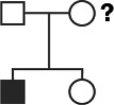
(Multiple Choice)
4.8/5 (94)
(94) 
Filters
- Essay(0)
- Multiple Choice(0)
- Short Answer(0)
- True False(0)
- Matching(0)