



 Chat with AI
Exam 15: Monopoly

Exam 1: Ten Lessons From Economics149 Questions
Exam 2: Thinking Like an Economist147 Questions
Exam 3: Interdependence and the Gains From Trade153 Questions
Exam 4: The Market Forces of Supply and Demand222 Questions
Exam 5: Elasticity and Its Application181 Questions
Exam 6: Supply, Demand and Government Policies148 Questions
Exam 7: Consumers, Producers and the Efficiency of Markets177 Questions
Exam 8: Application: The Costs of Taxation141 Questions
Exam 9: Application: International Trade161 Questions
Exam 10: Externalities199 Questions
Exam 11: Public Goods and Common Resources182 Questions
Exam 12: The Design of the Tax System154 Questions
Exam 13: The Costs of Production191 Questions
Exam 14: Firms in Competitive Markets200 Questions
Exam 15: Monopoly214 Questions
Exam 16: Business Strategy184 Questions
Exam 17: Competition Policy104 Questions
Exam 18: Monopolistic Competition214 Questions
Exam 19: The Markets for the Factors of Production215 Questions
Exam 20: Earnings, Unions and Discrimination206 Questions
Exam 21: Income Inequity and Poverty111 Questions
Exam 22: The Theory of Consumer Choice161 Questions
Exam 23: Frontiers of Microeconomics120 Questions
Exam 24: Measuring a Nations Income51 Questions
Exam 25: Measuring the Cost of Living52 Questions
Exam 26: Production and Growth62 Questions
Exam 27: Saving, Investment and the Financial System62 Questions
Exam 28: The Natural Rate of Unemployment59 Questions
Exam 29: The Monetary System66 Questions
Exam 30: Inflation: Its Causes and Costs74 Questions
Exam 31: Open-Economy Macroeconomics: Basic Concepts68 Questions
Exam 32: A Macroeconomic Theory of the Open Economy64 Questions
Exam 33: Aggregate Demand and Aggregate Supply82 Questions
Exam 34: The Influence of Monetary and Fiscal Policy on Aggregate Demand73 Questions
Exam 35: The Short-Run Trade-Off Between Inflation and Unemployment58 Questions
Exam 36: Five Debates Over Macroeconomic Policy38 Questions
Select questions type


A competitive firm is a price maker and a monopoly firm is a price taker.
(True/False)
4.7/5  (72)
(72) What is the monopolist's profit under the following conditions? The profit-maximising price charged for goods produced is $16. The intersection of the marginal-revenue and marginal-cost curves occurs where output is 10 units and marginal cost is $8.
(Multiple Choice)
4.7/5 (95)
(95) Black Box Pay TV is able to purchase an exclusive right to sell a premium movie channel (PMC) in its market area. Black Box pays $150 000 a year for the exclusive marketing rights to PMC. Since Black Box has already installed satellite dishes to all of the homes in its market area, the marginal cost of PMC to subscribers is zero. The manager of Black Box needs to know what price to charge for the PMC service in order to maximise her profit. Before setting the price, she hires an economist to estimate the demand for the PMC service. The economist discovers that there are two types of subscribers who value premium movie channels. First are the 4000 diehard TV viewers who will pay as much as $150 a year for the new PMC premium channel. Second, the PMC channel will appeal to about 20 000 occasional TV viewers who will pay as much as $20 a year for a subscription to PMC.
-Refer to the information provided. If Black Box Pay TV is unable to price discriminate, what price will it choose to maximise its profit and what is the amount of the profit?
(Multiple Choice)
4.8/5 (74)
(74) A fundamental source of monopoly market power arises from:
(Multiple Choice)
4.8/5 (72)
(72) When a firm's average-total-cost curve continually declines, the firm is:
(Multiple Choice)
4.8/5 (74)
(74) For a monopolist, profit is determined by which of the following equations?
(Multiple Choice)
4.8/5 (69)
(69) When a monopolist increases the number of units it sells, there are two effects on revenue: the output effect and the price effect.
(True/False)
4.8/5 (74)
(74) Black Box Pay TV is able to purchase an exclusive right to sell a premium movie channel (PMC) in its market area. Black Box pays $150 000 a year for the exclusive marketing rights to PMC. Since Black Box has already installed satellite dishes to all of the homes in its market area, the marginal cost of PMC to subscribers is zero. The manager of Black Box needs to know what price to charge for the PMC service in order to maximise her profit. Before setting the price, she hires an economist to estimate the demand for the PMC service. The economist discovers that there are two types of subscribers who value premium movie channels. First are the 4000 diehard TV viewers who will pay as much as $150 a year for the new PMC premium channel. Second, the PMC channel will appeal to about 20 000 occasional TV viewers who will pay as much as $20 a year for a subscription to PMC.
-According to the information provided, what is the deadweight loss associated with the non-discriminating pricing policy compared to the price-discriminating policy?
(Multiple Choice)
4.9/5 (67)
(67) Encouraging firms to invest in research and development and individuals to engage in creative endeavours such as writing novels is one justification for:
(Multiple Choice)
4.9/5 (77)
(77) The amount that producers receive for a good minus their costs of producing it equals producer:
(Multiple Choice)
4.8/5 (85)
(85) An unregulated monopoly is likely to have its marginal cost set:
(Multiple Choice)
4.8/5 (84)
(84) Graph 15-6
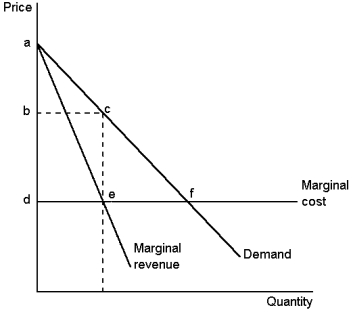 This graph depicts the demand, marginal-revenue and marginal-cost curves of a profit-maximising monopolist. Use the graph to answer the following question(s).
-Refer to Graph 15-6. What is the deadweight loss equal to when the monopolist does NOT price discriminate?
This graph depicts the demand, marginal-revenue and marginal-cost curves of a profit-maximising monopolist. Use the graph to answer the following question(s).
-Refer to Graph 15-6. What is the deadweight loss equal to when the monopolist does NOT price discriminate? (Multiple Choice)
4.8/5 (73)
(73) What is the monopolist's profit under the following conditions? The profit-maximising price charged for goods produced is $24. The intersection of the marginal-revenue and marginal-cost curves occurs where output is 15 units and marginal cost is $12.
(Multiple Choice)
4.7/5 (80)
(80) To price discriminate and raise profits, publishers release hardback books first and paperback books later. Diehard fans are willing to pay more than less enthusiastic readers to read the book first.
(True/False)
4.9/5 (71)
(71) Airlines often separate their customers into business travellers and personal travellers by giving a discount to those travellers who stay over a Saturday night.
(True/False)
4.9/5 (77)
(77) A profit-maximising monopolist chooses the output level where marginal revenue equals marginal cost and chooses the corresponding price off the marginal-revenue curve.
(True/False)
4.9/5 (84)
(84) 
Filters
- Essay(0)
- Multiple Choice(0)
- Short Answer(0)
- True False(0)
- Matching(0)