



 Chat with AI
Exam 6: Supply, Demand and Government Policies

Exam 1: Ten Lessons From Economics149 Questions
Exam 2: Thinking Like an Economist147 Questions
Exam 3: Interdependence and the Gains From Trade153 Questions
Exam 4: The Market Forces of Supply and Demand222 Questions
Exam 5: Elasticity and Its Application181 Questions
Exam 6: Supply, Demand and Government Policies148 Questions
Exam 7: Consumers, Producers and the Efficiency of Markets177 Questions
Exam 8: Application: The Costs of Taxation141 Questions
Exam 9: Application: International Trade161 Questions
Exam 10: Externalities199 Questions
Exam 11: Public Goods and Common Resources182 Questions
Exam 12: The Design of the Tax System154 Questions
Exam 13: The Costs of Production191 Questions
Exam 14: Firms in Competitive Markets200 Questions
Exam 15: Monopoly214 Questions
Exam 16: Business Strategy184 Questions
Exam 17: Competition Policy104 Questions
Exam 18: Monopolistic Competition214 Questions
Exam 19: The Markets for the Factors of Production215 Questions
Exam 20: Earnings, Unions and Discrimination206 Questions
Exam 21: Income Inequity and Poverty111 Questions
Exam 22: The Theory of Consumer Choice161 Questions
Exam 23: Frontiers of Microeconomics120 Questions
Exam 24: Measuring a Nations Income51 Questions
Exam 25: Measuring the Cost of Living52 Questions
Exam 26: Production and Growth62 Questions
Exam 27: Saving, Investment and the Financial System62 Questions
Exam 28: The Natural Rate of Unemployment59 Questions
Exam 29: The Monetary System66 Questions
Exam 30: Inflation: Its Causes and Costs74 Questions
Exam 31: Open-Economy Macroeconomics: Basic Concepts68 Questions
Exam 32: A Macroeconomic Theory of the Open Economy64 Questions
Exam 33: Aggregate Demand and Aggregate Supply82 Questions
Exam 34: The Influence of Monetary and Fiscal Policy on Aggregate Demand73 Questions
Exam 35: The Short-Run Trade-Off Between Inflation and Unemployment58 Questions
Exam 36: Five Debates Over Macroeconomic Policy38 Questions
Select questions type


Graph 6-9
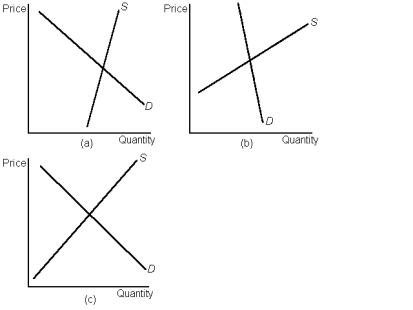 -Refer to Graph 6-9. In which market will the tax be most equally divided between the buyer and the seller?
Free
(Multiple Choice)
5.0/5  (68)
(68) Correct Answer: Verified
C
Graph 6-1
 -In Graph 6-1, a price ceiling that is not binding is shown in:
Free
(Multiple Choice)
4.9/5 (82)
(82) Correct Answer:Verified
VerifiedA
Graph 6-9
-Refer to Graph 6-9. In which market will the majority of a tax be paid by the seller?
-Refer to Graph 6-9. In which market will the majority of a tax be paid by the seller?Free
(Multiple Choice)
4.9/5 (75)
(75) Correct Answer:Verified
VerifiedA
A tax on sellers shifts the supply curve upward by exactly the size of the tax.
(True/False)
4.8/5 (97)
(97) The minimum wage has its greatest adverse impact on the market for:
(Multiple Choice)
4.8/5 (73)
(73) Graph 6-6
 -According to Graph 6-6, in panel b, at the actual price there will be:
 (Multiple Choice)
4.7/5 (83)
(83) Graph 6-7
 -According to Graph 6-7, the price sellers receive after the tax is imposed is:
 (Multiple Choice)
4.8/5 (64)
(64) Graph 6-8
 -According to Graph 6-8, the price sellers receive after the tax is imposed is:
 (Multiple Choice)
4.8/5 (71)
(71) Australia has a higher tax on luxury cars compared to other cars. Is this an effective way to raise revenue for the government from the rich?
(Essay)
4.8/5 (88)
(88) Who pays the majority of a tax levied on a product depends on whether the tax is placed on the buyer or the seller.
(True/False)
4.9/5 (81)
(81) Domestic producers of natural gas would welcome being a signatory to the world price regime if it is set above the equilibrium, as they can export the surplus.
(True/False)
4.9/5 (77)
(77) Graph 6-7
-According to Graph 6-7, the amount of the tax that sellers would pay would be:
-According to Graph 6-7, the amount of the tax that sellers would pay would be: (Multiple Choice)
4.8/5 (86)
(86) If a price ceiling is a not a binding constraint, then the:
(Multiple Choice)
4.9/5 (81)
(81) Graph 6-10
 -In Graph 6-10, the equilibrium price before the tax is:
 (Multiple Choice)
4.9/5 (81)
(81) Graph 6-10
-In Graph 6-10, the per-unit burden of the tax on buyers is:
-In Graph 6-10, the per-unit burden of the tax on buyers is: (Multiple Choice)
4.9/5 (75)
(75) 
Filters
- Essay(0)
- Multiple Choice(0)
- Short Answer(0)
- True False(0)
- Matching(0)