



 Chat with AI
Exam 6: Supply, Demand and Government Policies

Exam 1: Ten Lessons From Economics149 Questions
Exam 2: Thinking Like an Economist147 Questions
Exam 3: Interdependence and the Gains From Trade153 Questions
Exam 4: The Market Forces of Supply and Demand222 Questions
Exam 5: Elasticity and Its Application181 Questions
Exam 6: Supply, Demand and Government Policies148 Questions
Exam 7: Consumers, Producers and the Efficiency of Markets177 Questions
Exam 8: Application: The Costs of Taxation141 Questions
Exam 9: Application: International Trade161 Questions
Exam 10: Externalities199 Questions
Exam 11: Public Goods and Common Resources182 Questions
Exam 12: The Design of the Tax System154 Questions
Exam 13: The Costs of Production191 Questions
Exam 14: Firms in Competitive Markets200 Questions
Exam 15: Monopoly214 Questions
Exam 16: Business Strategy184 Questions
Exam 17: Competition Policy104 Questions
Exam 18: Monopolistic Competition214 Questions
Exam 19: The Markets for the Factors of Production215 Questions
Exam 20: Earnings, Unions and Discrimination206 Questions
Exam 21: Income Inequity and Poverty111 Questions
Exam 22: The Theory of Consumer Choice161 Questions
Exam 23: Frontiers of Microeconomics120 Questions
Exam 24: Measuring a Nations Income51 Questions
Exam 25: Measuring the Cost of Living52 Questions
Exam 26: Production and Growth62 Questions
Exam 27: Saving, Investment and the Financial System62 Questions
Exam 28: The Natural Rate of Unemployment59 Questions
Exam 29: The Monetary System66 Questions
Exam 30: Inflation: Its Causes and Costs74 Questions
Exam 31: Open-Economy Macroeconomics: Basic Concepts68 Questions
Exam 32: A Macroeconomic Theory of the Open Economy64 Questions
Exam 33: Aggregate Demand and Aggregate Supply82 Questions
Exam 34: The Influence of Monetary and Fiscal Policy on Aggregate Demand73 Questions
Exam 35: The Short-Run Trade-Off Between Inflation and Unemployment58 Questions
Exam 36: Five Debates Over Macroeconomic Policy38 Questions
Select questions type


Which of the following is NOT a function of prices in a market system?
(Multiple Choice)
4.9/5  (84)
(84) A coffee-producing country requires all its growers to sell to a single, government-owned marketing board. This marketing board sells the coffee on behalf of the growers into the world market. Suppose the marketing board puts a price ceiling of $3.00 on the coffee it buys from its growers while the market equilibrium price is $5.00. What effect will this have on coffee production in this country? Quantity is given in kg.
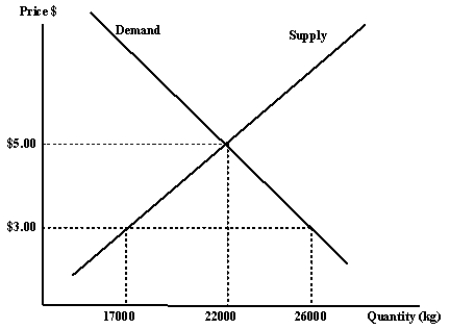
(Essay)
4.9/5 (88)
(88) When analysing the economic effects of government policies:
(Multiple Choice)
4.9/5 (68)
(68) If the demand for coffee and the supply of coffee are both elastic then:
(Multiple Choice)
4.8/5 (95)
(95) New Zealand is considering a higher tax on RTD (alcopops) to try and stop young people binge drinking. Is this an effective way to raise revenue for the government from the consumers?
(Essay)
4.9/5 (83)
(83) Graph 6-3
 -According to Graph 6-3, which panel(s) best represent(s) a binding rent control in the short run?
 (Multiple Choice)
5.0/5 (84)
(84) Graph 6-10
 -In Graph 6-10, the price that will be paid after the tax is:
 (Multiple Choice)
4.9/5 (91)
(91) If a price ceiling is non-binding, it will have no effect on the market.
(True/False)
5.0/5 (76)
(76) Graph 6-8
 -According to Graph 6-8, the amount of the tax imposed in this market is:
 (Multiple Choice)
4.8/5 (69)
(69) Graph 6-8
-According to Graph 6-8, the price buyers will pay after the tax is imposed is:
-According to Graph 6-8, the price buyers will pay after the tax is imposed is: (Multiple Choice)
4.7/5 (73)
(73) When OPEC raised the price of crude oil in the 1970s, this caused the:
(Multiple Choice)
4.7/5 (79)
(79) If prices are prevented from rationing a product because of a binding price ceiling, how is the scarce product rationed among potential buyers?
(Essay)
4.9/5 (83)
(83) Graph 6-2
 -According to Graph 6-2, a binding price ceiling would exist at a price of:
 (Multiple Choice)
4.9/5 (79)
(79) Which of the following is the most correct statement about price controls?
(Multiple Choice)
4.8/5 (72)
(72) The consequences of economic policies are often predicted or intended by their advocates.
(True/False)
4.9/5 (79)
(79) Graph 6-7
 -According to Graph 6-7, the price buyers will pay after the tax is imposed is:
 (Multiple Choice)
4.8/5 (94)
(94) 
Filters
- Essay(0)
- Multiple Choice(0)
- Short Answer(0)
- True False(0)
- Matching(0)