



 Chat with AI
Exam 16: Business Strategy

Exam 1: Ten Lessons From Economics149 Questions
Exam 2: Thinking Like an Economist147 Questions
Exam 3: Interdependence and the Gains From Trade153 Questions
Exam 4: The Market Forces of Supply and Demand222 Questions
Exam 5: Elasticity and Its Application181 Questions
Exam 6: Supply, Demand and Government Policies148 Questions
Exam 7: Consumers, Producers and the Efficiency of Markets177 Questions
Exam 8: Application: The Costs of Taxation141 Questions
Exam 9: Application: International Trade161 Questions
Exam 10: Externalities199 Questions
Exam 11: Public Goods and Common Resources182 Questions
Exam 12: The Design of the Tax System154 Questions
Exam 13: The Costs of Production191 Questions
Exam 14: Firms in Competitive Markets200 Questions
Exam 15: Monopoly214 Questions
Exam 16: Business Strategy184 Questions
Exam 17: Competition Policy104 Questions
Exam 18: Monopolistic Competition214 Questions
Exam 19: The Markets for the Factors of Production215 Questions
Exam 20: Earnings, Unions and Discrimination206 Questions
Exam 21: Income Inequity and Poverty111 Questions
Exam 22: The Theory of Consumer Choice161 Questions
Exam 23: Frontiers of Microeconomics120 Questions
Exam 24: Measuring a Nations Income51 Questions
Exam 25: Measuring the Cost of Living52 Questions
Exam 26: Production and Growth62 Questions
Exam 27: Saving, Investment and the Financial System62 Questions
Exam 28: The Natural Rate of Unemployment59 Questions
Exam 29: The Monetary System66 Questions
Exam 30: Inflation: Its Causes and Costs74 Questions
Exam 31: Open-Economy Macroeconomics: Basic Concepts68 Questions
Exam 32: A Macroeconomic Theory of the Open Economy64 Questions
Exam 33: Aggregate Demand and Aggregate Supply82 Questions
Exam 34: The Influence of Monetary and Fiscal Policy on Aggregate Demand73 Questions
Exam 35: The Short-Run Trade-Off Between Inflation and Unemployment58 Questions
Exam 36: Five Debates Over Macroeconomic Policy38 Questions
Select questions type


The standard price for monopoly firms is a price that:

Free
(Multiple Choice)
4.8/5  (85)
(85) Correct Answer: Verified
A
An important characteristic of an oligopoly market structure is that:
Free
(Multiple Choice)
4.9/5 (67)
(67) Correct Answer:Verified
VerifiedC
Oligopolies can end up looking like competitive firms if the number of firms is large and they do not cooperate.
Free
(True/False)
4.9/5 (83)
(83) Correct Answer:Verified
VerifiedTrue
Assuming that oligopolists do not have the opportunity to collude, once they have reached the Nash equilibrium, it:
(Multiple Choice)
4.7/5 (83)
(83) Table 16-2
In the following duopoly game, the two firms can either set the price of their product high or low. If one firm's price is lower than the other, most of the market will buy from them. This will increase the low-price firm's profit at the expense of the other firm. The game is represented in the table below.
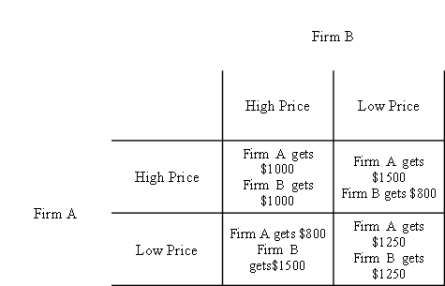 -Refer to Table 16-2. What is the profit firm B will earn if it plays its dominant strategy:
 (Multiple Choice)
4.9/5 (67)
(67) Which of the following statements are true of the prisoners' dilemma? (i) cooperation between the prisoners is difficult to maintain
(ii) rational self-interest leads neither party to confess
(iii) cooperation between the prisoners is individually irrational
(Multiple Choice)
4.8/5 (75)
(75) It is individually irrational for players to cooperate in the prisoner's dilemma game because cooperation is not the dominant strategy.
(True/False)
5.0/5 (86)
(86) The general term for market structures that fall somewhere in between monopoly and perfect competition is:
(Multiple Choice)
4.8/5 (88)
(88) Even when allowed to collude, firms in an oligopoly will choose to cheat on their agreements with the rest of the cartel. Why?
(Essay)
4.8/5 (95)
(95) Binding agreements concerning production levels between oligopolists can lead the involved firms to:
(Multiple Choice)
4.9/5 (77)
(77) Table 16-1
The table below shows the total demand for viewing a rare penguin species at a local reserve. Ecotour companies have to build discreet viewing hides for tourists to view the penguins. Each ecotour company has to pay a fixed fee of $10 000 for the right to build on the reserve. Assume that hides can be supplied to tourists at zero marginal cost. Tickets are sold to tourists to use the viewing hides.
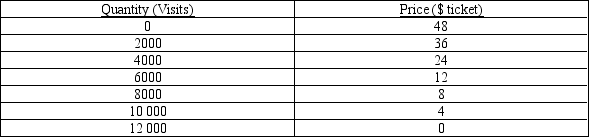 Any firm can change tickets by steps of 1000 only. Prices for missing quantities are the exact midpoint between two adjacent prices.
-Refer to Table 16-1. If there is only one ecotourist company in this market, what ticket-price would it charge for its hides to maximise its profit?
Any firm can change tickets by steps of 1000 only. Prices for missing quantities are the exact midpoint between two adjacent prices.
-Refer to Table 16-1. If there is only one ecotourist company in this market, what ticket-price would it charge for its hides to maximise its profit? (Multiple Choice)
4.8/5 (93)
(93) An agreement among firms over production and price is called:
(Multiple Choice)
4.8/5 (86)
(86) If both countries agree on a certain level of arms in an arms race game, social welfare will decrease if both countries keep their end of the bargain.
(True/False)
4.8/5 (78)
(78) Consider two cigarette companies, PM Inc. and Brown Inc. If neither company advertises, the two companies split the market. If they both advertise, they again split the market, but profits are lower, since each company must bear the cost of advertising. Yet, if one company advertises while the other does not, the one that advertises attracts customers from the other.
-Refer to the information provided. In 1971, the federal government passed a law that banned cigarette advertising on television. If cigarette companies are profit maximisers, it is likely that:
(Multiple Choice)
4.8/5 (86)
(86) Table 16-1
The table below shows the total demand for viewing a rare penguin species at a local reserve. Ecotour companies have to build discreet viewing hides for tourists to view the penguins. Each ecotour company has to pay a fixed fee of $10 000 for the right to build on the reserve. Assume that hides can be supplied to tourists at zero marginal cost. Tickets are sold to tourists to use the viewing hides.
Any firm can change tickets by steps of 1000 only. Prices for missing quantities are the exact midpoint between two adjacent prices.
-Refer to Table 16-1. Assume that there are two profit-maximising ecotourist companies operating in this market. Further assume that they are not able to collude on price and quantity of the tickets they sell. How many tickets will be by each firms when this market reaches a Nash equilibrium?
Any firm can change tickets by steps of 1000 only. Prices for missing quantities are the exact midpoint between two adjacent prices.
-Refer to Table 16-1. Assume that there are two profit-maximising ecotourist companies operating in this market. Further assume that they are not able to collude on price and quantity of the tickets they sell. How many tickets will be by each firms when this market reaches a Nash equilibrium? (Multiple Choice)
4.9/5 (87)
(87) The arms race is similar to which of the following economic scenarios?
(Multiple Choice)
4.8/5 (90)
(90) 
Filters
- Essay(0)
- Multiple Choice(0)
- Short Answer(0)
- True False(0)
- Matching(0)