



 Chat with AI
Exam 16: Business Strategy

Exam 1: Ten Lessons From Economics149 Questions
Exam 2: Thinking Like an Economist147 Questions
Exam 3: Interdependence and the Gains From Trade153 Questions
Exam 4: The Market Forces of Supply and Demand222 Questions
Exam 5: Elasticity and Its Application181 Questions
Exam 6: Supply, Demand and Government Policies148 Questions
Exam 7: Consumers, Producers and the Efficiency of Markets177 Questions
Exam 8: Application: The Costs of Taxation141 Questions
Exam 9: Application: International Trade161 Questions
Exam 10: Externalities199 Questions
Exam 11: Public Goods and Common Resources182 Questions
Exam 12: The Design of the Tax System154 Questions
Exam 13: The Costs of Production191 Questions
Exam 14: Firms in Competitive Markets200 Questions
Exam 15: Monopoly214 Questions
Exam 16: Business Strategy184 Questions
Exam 17: Competition Policy104 Questions
Exam 18: Monopolistic Competition214 Questions
Exam 19: The Markets for the Factors of Production215 Questions
Exam 20: Earnings, Unions and Discrimination206 Questions
Exam 21: Income Inequity and Poverty111 Questions
Exam 22: The Theory of Consumer Choice161 Questions
Exam 23: Frontiers of Microeconomics120 Questions
Exam 24: Measuring a Nations Income51 Questions
Exam 25: Measuring the Cost of Living52 Questions
Exam 26: Production and Growth62 Questions
Exam 27: Saving, Investment and the Financial System62 Questions
Exam 28: The Natural Rate of Unemployment59 Questions
Exam 29: The Monetary System66 Questions
Exam 30: Inflation: Its Causes and Costs74 Questions
Exam 31: Open-Economy Macroeconomics: Basic Concepts68 Questions
Exam 32: A Macroeconomic Theory of the Open Economy64 Questions
Exam 33: Aggregate Demand and Aggregate Supply82 Questions
Exam 34: The Influence of Monetary and Fiscal Policy on Aggregate Demand73 Questions
Exam 35: The Short-Run Trade-Off Between Inflation and Unemployment58 Questions
Exam 36: Five Debates Over Macroeconomic Policy38 Questions
Select questions type


When prisoners' dilemma games are repeated over and over, sometimes the threat of penalty causes both parties to cooperate.
(True/False)
4.9/5  (76)
(76) To increase their profits further, members of a cartel have an incentive to:
(Multiple Choice)
4.7/5 (89)
(89) Because each oligopolist cares about its profit rather than the collective profit of all the oligopolists together:
(Multiple Choice)
4.7/5 (83)
(83) The best way for oligopolists to increase their profits is to:
(Multiple Choice)
4.7/5 (82)
(82) Assume that the countries of Irun and Urun are the only two producers of crude oil. Further assume that both countries have entered into an agreement to maintain certain production levels in order to maximise profits. The world market for oil is represented by a downward-sloping demand curve.
-According to the information provided, the fact that both countries have colluded to earn higher profit shows their desire to keep production levels:
(Multiple Choice)
4.9/5 (87)
(87) In Berserkistan, two political parties vie for control of the country. Each political party, when it is not in power, has a tendency to call general strikes to influence the policy of the ruling party. Evaluate this strategy in the context of a multiple-period game. Is it possible, in this situation, that a multiple-period game reduces, rather than enhances, social wellbeing? What would have to happen in this game in order to improve social welfare if a tit-for-tat strategy is used?
(Essay)
4.7/5 (86)
(86) Table 16-7
Consider two countries, Eudora and the Inhabit, that are engaged in an arms race. The question each country must face is whether to build new weapons or to disarm existing weapons. Each country prefers to have more arms than the other because a large arsenal gives it more influence in world affairs. But each country also prefers to live in a world safe from the other country's weapons. The table shows the possible outcomes for each decision combination.
 -Refer to Table 16-7. If both countries get together and agree on a certain level of arms, what will happen to social welfare, assuming that both countries keep their end of the bargain?
 (Multiple Choice)
4.8/5 (82)
(82) Assume that the countries of Irun and Urun are the only two producers of crude oil. Further assume that both countries have entered into an agreement to maintain certain production levels in order to maximise profits. The world market for oil is represented by a downward-sloping demand curve.
-According to the information provided, as long as production levels are less than the Nash equilibrium, both Irun and Urun have the individual incentive to:
(Multiple Choice)
4.7/5 (88)
(88) Oligopolies would like to act like a monopoly but self-interest often drives them closer to competition.
(True/False)
4.9/5 (63)
(63) Firms in industries that have competitors but, at the same time, do not face so much competition that they are price takers, are operating in either a(n):
(Multiple Choice)
4.8/5 (80)
(80) When an oligopoly market is in Nash equilibrium, firms will not act as profit maximisers.
(True/False)
4.9/5 (72)
(72) Table 16-1
The table below shows the total demand for viewing a rare penguin species at a local reserve. Ecotour companies have to build discreet viewing hides for tourists to view the penguins. Each ecotour company has to pay a fixed fee of $10 000 for the right to build on the reserve. Assume that hides can be supplied to tourists at zero marginal cost. Tickets are sold to tourists to use the viewing hides.
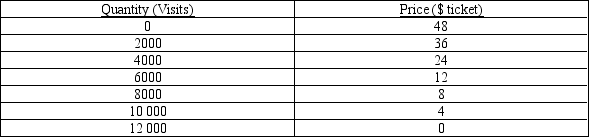 Any firm can change tickets by steps of 1000 only. Prices for missing quantities are the exact midpoint between two adjacent prices.
-Refer to Table 16-1. Assume that there are two profit-maximising ecotourist companies operating in this market. Further assume that they are able to collude on the price of the tickets they sell. As part of their collusive agreement, they decide to take an equal share of the market. How much profit will each company make?
Any firm can change tickets by steps of 1000 only. Prices for missing quantities are the exact midpoint between two adjacent prices.
-Refer to Table 16-1. Assume that there are two profit-maximising ecotourist companies operating in this market. Further assume that they are able to collude on the price of the tickets they sell. As part of their collusive agreement, they decide to take an equal share of the market. How much profit will each company make? (Multiple Choice)
4.9/5 (75)
(75) Imagine that two oil companies, Big Petro Inc. and Gargantuan Gas, own adjacent oil fields. Under the fields is a common pool of oil worth $24 million. Drilling a well to recover oil costs $2 million per well. If each company drills one well, each will get half of the oil and earn a $10 million profit ($12 million in revenue - $2 million in costs). If a company has X per cent of the total wells, then it will collect X per cent of the total revenue.
-According to the information provided, Gargantuan Gas's dominant strategy would lead to what sort of well-drilling behaviour?
(Multiple Choice)
5.0/5 (79)
(79) When strategic interactions are important to pricing and production decisions, a firm will:
(Multiple Choice)
4.9/5 (71)
(71) The typical firm in the Australian economy has some degree of market power, but cannot be considered a monopoly firm.
(True/False)
4.9/5 (86)
(86) Larger cartels have a greater probability of reaching the monopoly outcome than do smaller cartels.
(True/False)
4.9/5 (88)
(88) Table 16-8
Two discount superstores (Ultimate Saver and SuperDuper Saver) in a growing urban area are interested in expanding their market share. Both are interested in expanding the size of their stores and parking lots to accommodate potential growth in their customer base. The following game depicts the strategic outcomes that result from the game. Growth-related profits of the two discount superstores under two scenarios are shown in the table:
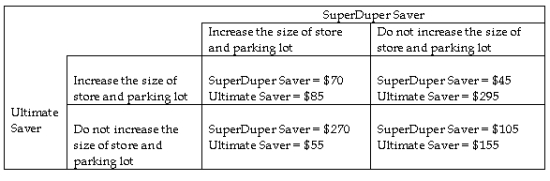 a. What are growth related profits for Ultimate Saver if both stores follow a dominant strategy?
b. What are growth related profits for SuperDuper Saver if both stores follow a dominant strategy?
c. If the owners of Ultimate Saver and SuperDuper Saver meet for a friendly game of golf one afternoon and happen to discuss a strategy to optimise their growth-related profits, what strategy should they agree to? How would they enforce this agreement? If the collusive agreement was enforceable, how would the wellbeing of society be impacted by the agreement?
a. What are growth related profits for Ultimate Saver if both stores follow a dominant strategy?
b. What are growth related profits for SuperDuper Saver if both stores follow a dominant strategy?
c. If the owners of Ultimate Saver and SuperDuper Saver meet for a friendly game of golf one afternoon and happen to discuss a strategy to optimise their growth-related profits, what strategy should they agree to? How would they enforce this agreement? If the collusive agreement was enforceable, how would the wellbeing of society be impacted by the agreement? (Essay)
4.7/5 (59)
(59) Table 16-5
Two discount superstores (Ultimate Saver and SuperDuper Saver) in a growing urban area are interested in expanding their market share. Both are interested in expanding the size of their stores and parking lots to accommodate potential growth in their customer base. The following table depicts the strategic outcomes that result from the game. Growth-related profits of the two discount superstores under two scenarios are shown.
 -Refer to Table 16-5. If both stores follow a dominant strategy, Ultimate Saver's growth related profits will be:
 (Multiple Choice)
4.8/5 (83)
(83) If all the oligopolists in a market collude to form a cartel, total profit for the cartel is less than that of a monopolist.
(True/False)
4.8/5 (77)
(77) 
Filters
- Essay(0)
- Multiple Choice(0)
- Short Answer(0)
- True False(0)
- Matching(0)