



 Chat with AI
Exam 21: Income Inequity and Poverty

Exam 1: Ten Lessons From Economics149 Questions
Exam 2: Thinking Like an Economist147 Questions
Exam 3: Interdependence and the Gains From Trade153 Questions
Exam 4: The Market Forces of Supply and Demand222 Questions
Exam 5: Elasticity and Its Application181 Questions
Exam 6: Supply, Demand and Government Policies148 Questions
Exam 7: Consumers, Producers and the Efficiency of Markets177 Questions
Exam 8: Application: The Costs of Taxation141 Questions
Exam 9: Application: International Trade161 Questions
Exam 10: Externalities199 Questions
Exam 11: Public Goods and Common Resources182 Questions
Exam 12: The Design of the Tax System154 Questions
Exam 13: The Costs of Production191 Questions
Exam 14: Firms in Competitive Markets200 Questions
Exam 15: Monopoly214 Questions
Exam 16: Business Strategy184 Questions
Exam 17: Competition Policy104 Questions
Exam 18: Monopolistic Competition214 Questions
Exam 19: The Markets for the Factors of Production215 Questions
Exam 20: Earnings, Unions and Discrimination206 Questions
Exam 21: Income Inequity and Poverty111 Questions
Exam 22: The Theory of Consumer Choice161 Questions
Exam 23: Frontiers of Microeconomics120 Questions
Exam 24: Measuring a Nations Income51 Questions
Exam 25: Measuring the Cost of Living52 Questions
Exam 26: Production and Growth62 Questions
Exam 27: Saving, Investment and the Financial System62 Questions
Exam 28: The Natural Rate of Unemployment59 Questions
Exam 29: The Monetary System66 Questions
Exam 30: Inflation: Its Causes and Costs74 Questions
Exam 31: Open-Economy Macroeconomics: Basic Concepts68 Questions
Exam 32: A Macroeconomic Theory of the Open Economy64 Questions
Exam 33: Aggregate Demand and Aggregate Supply82 Questions
Exam 34: The Influence of Monetary and Fiscal Policy on Aggregate Demand73 Questions
Exam 35: The Short-Run Trade-Off Between Inflation and Unemployment58 Questions
Exam 36: Five Debates Over Macroeconomic Policy38 Questions
Select questions type


According to the maximin criterion, income can be transferred from the rich to the poor as long as it: (i) enhances the welfare of workers
(ii) promotes an egalitarian distribution of income
(iii) raises the wellbeing of the least fortunate

Free
(Multiple Choice)
4.9/5  (68)
(68) Correct Answer: Verified
D
Robert Nozick criticises Rawls' concept of justice by using an example of:
Free
(Multiple Choice)
4.9/5 (71)
(71) Correct Answer:Verified
VerifiedC
The income distribution in a society is:
Free
(Multiple Choice)
4.8/5 (93)
(93) Correct Answer:Verified
VerifiedD
Economists refer to the regular pattern of income variation over a person's lifetime as the:
(Multiple Choice)
5.0/5 (86)
(86) For each figure below, describe whether it could reflect a possible distribution of income and if so, what is implied about the equality of income depicted.

(Essay)
4.8/5 (81)
(81) When the government taxes income as part of a redistribution program:
(Multiple Choice)
4.9/5 (86)
(86) Graph 21-1
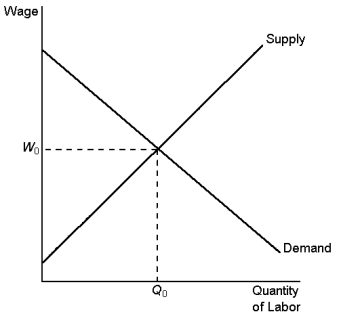 -Refer to Graph 21-1. Advocates of minimum wage legislation would suggest that an effective minimum wage would be set at a level:
 (Multiple Choice)
4.9/5 (62)
(62) Suppose the government proposes a negative income tax that calculates taxes owed according to the formula TAXES OWED = (1/3 * INCOME) - 10 000. A family that earns an income of $60 000 will:
(Multiple Choice)
4.9/5 (99)
(99) Which of the following is a cause of movement of individuals among income classes? (i) hard work
(ii) laziness
(iii) chance
(Multiple Choice)
4.9/5 (83)
(83) Graph 21-1
-Refer to Graph 21-1. According to the graph, if the government imposes a minimum wage below Wo, it is likely to:
-Refer to Graph 21-1. According to the graph, if the government imposes a minimum wage below Wo, it is likely to: (Multiple Choice)
4.8/5 (66)
(66) Suppose the government proposes a negative income tax that calculates taxes owed according to the formula TAXES OWED = (1/3 * INCOME) - 10 000. A family that earns an income of $30 000 will:
(Multiple Choice)
4.8/5 (73)
(73) Trends over time support the view that the decline of the two-parent family is largely the effect of the welfare system.
(True/False)
4.9/5 (87)
(87) Brian earns more than Lynne. A benevolent legislator has proposed taxing Bill in order to supplement Lynne's income. A libertarian would view this proposal as:
(Multiple Choice)
4.9/5 (73)
(73) Explain what is meant by 'in-kind transfer' programs. Briefly outline the pros and cons associated with an in-kind transfer program.
(Essay)
4.9/5 (72)
(72) 
Filters
- Essay(0)
- Multiple Choice(0)
- Short Answer(0)
- True False(0)
- Matching(0)