



 Chat with AI
Exam 21: Income Inequity and Poverty

Exam 1: Ten Lessons From Economics149 Questions
Exam 2: Thinking Like an Economist147 Questions
Exam 3: Interdependence and the Gains From Trade153 Questions
Exam 4: The Market Forces of Supply and Demand222 Questions
Exam 5: Elasticity and Its Application181 Questions
Exam 6: Supply, Demand and Government Policies148 Questions
Exam 7: Consumers, Producers and the Efficiency of Markets177 Questions
Exam 8: Application: The Costs of Taxation141 Questions
Exam 9: Application: International Trade161 Questions
Exam 10: Externalities199 Questions
Exam 11: Public Goods and Common Resources182 Questions
Exam 12: The Design of the Tax System154 Questions
Exam 13: The Costs of Production191 Questions
Exam 14: Firms in Competitive Markets200 Questions
Exam 15: Monopoly214 Questions
Exam 16: Business Strategy184 Questions
Exam 17: Competition Policy104 Questions
Exam 18: Monopolistic Competition214 Questions
Exam 19: The Markets for the Factors of Production215 Questions
Exam 20: Earnings, Unions and Discrimination206 Questions
Exam 21: Income Inequity and Poverty111 Questions
Exam 22: The Theory of Consumer Choice161 Questions
Exam 23: Frontiers of Microeconomics120 Questions
Exam 24: Measuring a Nations Income51 Questions
Exam 25: Measuring the Cost of Living52 Questions
Exam 26: Production and Growth62 Questions
Exam 27: Saving, Investment and the Financial System62 Questions
Exam 28: The Natural Rate of Unemployment59 Questions
Exam 29: The Monetary System66 Questions
Exam 30: Inflation: Its Causes and Costs74 Questions
Exam 31: Open-Economy Macroeconomics: Basic Concepts68 Questions
Exam 32: A Macroeconomic Theory of the Open Economy64 Questions
Exam 33: Aggregate Demand and Aggregate Supply82 Questions
Exam 34: The Influence of Monetary and Fiscal Policy on Aggregate Demand73 Questions
Exam 35: The Short-Run Trade-Off Between Inflation and Unemployment58 Questions
Exam 36: Five Debates Over Macroeconomic Policy38 Questions
Select questions type


Outline the possible work disincentives created by anti-poverty programs. Is there a way to solve this problem without causing other forms of inefficiency to arise? Explain your answer.
(Essay)
4.9/5  (67)
(67) According to utilitarians, the government should continue to redistribute income until everyone in society has exactly the same income.
(True/False)
4.8/5 (76)
(76) For most government programs that are designed to help the poor:
(Multiple Choice)
4.7/5 (86)
(86) Using demand-supply analysis, show why some economists argue that an effective minimum wage will result in higher unemployment among those groups of workers affected by the minimum wage.
(Essay)
4.9/5 (72)
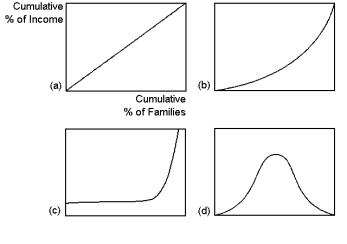
(72) Using the graph drawn above, what could occur if:
i) a government that advocates a flat tax rate to the income distribution.
ii) a government advocates a proportional tax where there are more tax brackets.
(Essay)
4.9/5 (88)
(88) Although economic growth has raised the income of the typical family, the increase in inequality has prevented the poorest families from sharing in this greater economic prosperity.
(True/False)
4.9/5 (77)
(77) Opponents of legislation that proposes to limit the time a family can receive welfare benefits are most likely to argue that time limits are undesirable because:
(Multiple Choice)
4.9/5 (76)
(76) Amy currently earns $80 000 a year, while John earns $30 000 a year. Suppose that both of their incomes are subject to diminishing marginal utility. From a utilitarian perspective taking a dollar from Amy and giving it to John will:
(Multiple Choice)
4.8/5 (83)
(83) What is meant by a perfectly equal distribution of income? Use a graph to depict such a situation.
(Essay)
4.9/5 (76)
(76) The maximin criterion holds that public policies should aim to minimise the well-being of the most-fortunate person in society.
(True/False)
5.0/5 (92)
(92) 
Filters
- Essay(0)
- Multiple Choice(0)
- Short Answer(0)
- True False(0)
- Matching(0)