



 Chat with AI
Exam 8: Application: The Costs of Taxation

Exam 1: Ten Lessons From Economics149 Questions
Exam 2: Thinking Like an Economist147 Questions
Exam 3: Interdependence and the Gains From Trade153 Questions
Exam 4: The Market Forces of Supply and Demand222 Questions
Exam 5: Elasticity and Its Application181 Questions
Exam 6: Supply, Demand and Government Policies148 Questions
Exam 7: Consumers, Producers and the Efficiency of Markets177 Questions
Exam 8: Application: The Costs of Taxation141 Questions
Exam 9: Application: International Trade161 Questions
Exam 10: Externalities199 Questions
Exam 11: Public Goods and Common Resources182 Questions
Exam 12: The Design of the Tax System154 Questions
Exam 13: The Costs of Production191 Questions
Exam 14: Firms in Competitive Markets200 Questions
Exam 15: Monopoly214 Questions
Exam 16: Business Strategy184 Questions
Exam 17: Competition Policy104 Questions
Exam 18: Monopolistic Competition214 Questions
Exam 19: The Markets for the Factors of Production215 Questions
Exam 20: Earnings, Unions and Discrimination206 Questions
Exam 21: Income Inequity and Poverty111 Questions
Exam 22: The Theory of Consumer Choice161 Questions
Exam 23: Frontiers of Microeconomics120 Questions
Exam 24: Measuring a Nations Income51 Questions
Exam 25: Measuring the Cost of Living52 Questions
Exam 26: Production and Growth62 Questions
Exam 27: Saving, Investment and the Financial System62 Questions
Exam 28: The Natural Rate of Unemployment59 Questions
Exam 29: The Monetary System66 Questions
Exam 30: Inflation: Its Causes and Costs74 Questions
Exam 31: Open-Economy Macroeconomics: Basic Concepts68 Questions
Exam 32: A Macroeconomic Theory of the Open Economy64 Questions
Exam 33: Aggregate Demand and Aggregate Supply82 Questions
Exam 34: The Influence of Monetary and Fiscal Policy on Aggregate Demand73 Questions
Exam 35: The Short-Run Trade-Off Between Inflation and Unemployment58 Questions
Exam 36: Five Debates Over Macroeconomic Policy38 Questions
Select questions type


Graph 8-3
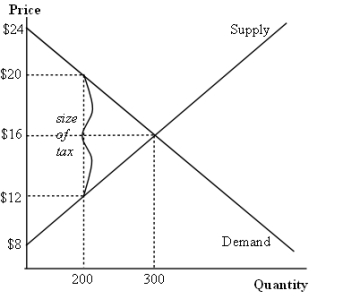 -According to Graph 8-3, producer surplus before the tax equals:
Free
(Multiple Choice)
4.8/5  (91)
(91) Correct Answer: Verified
A
The Laffer curve indicates that income tax collections:
Free
(Multiple Choice)
4.7/5 (71)
(71) Correct Answer:Verified
VerifiedD
Graph 8-3
-According to Graph 8-3, the price sellers receive after the tax is:
-According to Graph 8-3, the price sellers receive after the tax is:Free
(Multiple Choice)
4.8/5 (80)
(80) Correct Answer:Verified
VerifiedB
Suppose that instead of a supply-demand diagram, you are given the following information:
Qs = 90 + P
Qd = 300 - 2P
From this information, compute the equilibrium price (P) and quantity (Q).
Now suppose that a tax (T) is placed on buyers so that
Qd = 300 - 2(P + T).
If T = 12, solve for the new equilibrium price and quantity. (Note: P is the price received by sellers and P + T is the price paid by buyers.) Compare these answers for equilibrium price and quantity with your first answers. What does this show you?
(Essay)
4.7/5 (80)
(80) Taxes cause deadweight losses because they prevent buyers and sellers from realising some of the gains from trade.
(True/False)
4.8/5 (80)
(80) Tax cuts and deregulation may cause output in an economy to increase by each of the following, except:
(Multiple Choice)
4.8/5 (85)
(85) Although tax revenue eventually begins to fall as tax rates increase, the revenue will always be greater than zero, no matter how large the tax is.
(True/False)
4.8/5 (80)
(80) Suppose Australia puts the same tax on cycads harvested in the wild and ornamental ferns sold in nurseries. Cycads are a very slow growing plant that is subject to a small, regular harvest in the wild, often by Aborigines. Assume that the tax is the same for both plants and that the elasticity of demand is the same for both plants. What would be the difference in the tax burden for these cycads and ferns and why?
(Essay)
4.9/5 (75)
(75) Graph 8-1
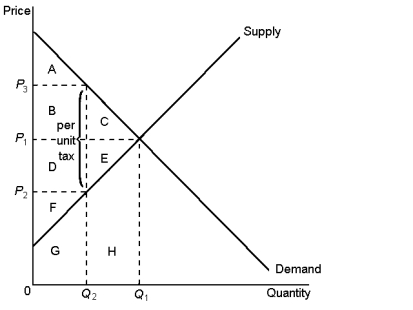 -According to Graph 8-1, producer surplus before the tax is represented by area:
 (Multiple Choice)
4.8/5 (69)
(69) The more inelastic the supply and demand curves in a market, the more taxes in that market distort behaviour, and the more likely it is that a tax cut will raise tax revenue.
(True/False)
4.7/5 (88)
(88) Graph 8-1
-According to Graph 8-1, the price buyers pay after the tax is:
-According to Graph 8-1, the price buyers pay after the tax is: (Multiple Choice)
4.9/5 (83)
(83) Graph 8-1
-According to Graph 8-1, the total surplus (consumer, producer, and government) with the tax is represented by area:
-According to Graph 8-1, the total surplus (consumer, producer, and government) with the tax is represented by area: (Multiple Choice)
4.8/5 (76)
(76) A major political problem with collecting taxes to finance government spending is that:
(Multiple Choice)
4.8/5 (89)
(89) Graph 8-1
-According to Graph 8-1, the loss in total welfare resulting from the levying of the tax is represented by area:
-According to Graph 8-1, the loss in total welfare resulting from the levying of the tax is represented by area: (Multiple Choice)
4.8/5 (75)
(75) When the government imposes taxes on buyers and sellers of a good, society loses some of the benefits of market efficiency.
(True/False)
4.9/5 (76)
(76) A tax on luxuries will create a smaller deadweight loss than will the same tax on necessities, ceteris paribus.
(True/False)
4.9/5 (73)
(73) Assume that a tax is levied on a good and the government uses the funds to build statues of former prime ministers. In this case there would be:
(Multiple Choice)
4.9/5 (86)
(86) The higher a country's tax rates, the more likely that country will be:
(Multiple Choice)
4.8/5 (74)
(74) 
Filters
- Essay(0)
- Multiple Choice(0)
- Short Answer(0)
- True False(0)
- Matching(0)