



 Chat with AI
Exam 8: Application: The Costs of Taxation

Exam 1: Ten Lessons From Economics149 Questions
Exam 2: Thinking Like an Economist147 Questions
Exam 3: Interdependence and the Gains From Trade153 Questions
Exam 4: The Market Forces of Supply and Demand222 Questions
Exam 5: Elasticity and Its Application181 Questions
Exam 6: Supply, Demand and Government Policies148 Questions
Exam 7: Consumers, Producers and the Efficiency of Markets177 Questions
Exam 8: Application: The Costs of Taxation141 Questions
Exam 9: Application: International Trade161 Questions
Exam 10: Externalities199 Questions
Exam 11: Public Goods and Common Resources182 Questions
Exam 12: The Design of the Tax System154 Questions
Exam 13: The Costs of Production191 Questions
Exam 14: Firms in Competitive Markets200 Questions
Exam 15: Monopoly214 Questions
Exam 16: Business Strategy184 Questions
Exam 17: Competition Policy104 Questions
Exam 18: Monopolistic Competition214 Questions
Exam 19: The Markets for the Factors of Production215 Questions
Exam 20: Earnings, Unions and Discrimination206 Questions
Exam 21: Income Inequity and Poverty111 Questions
Exam 22: The Theory of Consumer Choice161 Questions
Exam 23: Frontiers of Microeconomics120 Questions
Exam 24: Measuring a Nations Income51 Questions
Exam 25: Measuring the Cost of Living52 Questions
Exam 26: Production and Growth62 Questions
Exam 27: Saving, Investment and the Financial System62 Questions
Exam 28: The Natural Rate of Unemployment59 Questions
Exam 29: The Monetary System66 Questions
Exam 30: Inflation: Its Causes and Costs74 Questions
Exam 31: Open-Economy Macroeconomics: Basic Concepts68 Questions
Exam 32: A Macroeconomic Theory of the Open Economy64 Questions
Exam 33: Aggregate Demand and Aggregate Supply82 Questions
Exam 34: The Influence of Monetary and Fiscal Policy on Aggregate Demand73 Questions
Exam 35: The Short-Run Trade-Off Between Inflation and Unemployment58 Questions
Exam 36: Five Debates Over Macroeconomic Policy38 Questions
Select questions type


Economists disagree on whether labour taxes have a small or a large deadweight loss.
(True/False)
4.9/5  (79)
(79) Draw a supply-demand diagram for chocolate. On the diagram, show the equilibrium before and after the imposition of a tax. Now identify areas corresponding to each of the following:
a. consumer surplus before the tax
b. producer surplus before the tax
c. total surplus before the tax
d. consumer surplus after the tax
e. producer surplus after the tax
f. total surplus after the tax
g. tax revenue
h. deadweight loss
(Essay)
4.8/5 (87)
(87) The deadweight loss of a tax is the reduction in total surplus in excess of the tax revenue collected that results from the tax.
(True/False)
4.9/5 (78)
(78) If the government tripled the taxes on new cameras, the deadweight loss from the camera tax would:
(Multiple Choice)
4.8/5 (80)
(80) Illustrate on three demand-supply graphs how the size of a tax (small, medium and large) can alter total revenue and deadweight loss.
(Essay)
4.9/5 (77)
(77) Other things being equal, as the size of a tax varies, the deadweight loss from the tax varies according to the square root of the size of the tax.
(True/False)
4.8/5 (74)
(74) Graph 8-3
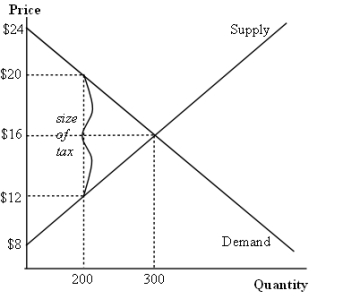 -According to Graph 8-3, the price buyers pay after the tax is:
 (Multiple Choice)
4.7/5 (73)
(73) Graph 8-3
-According to Graph 8-3, after the tax is levied, producer surplus is:
-According to Graph 8-3, after the tax is levied, producer surplus is: (Multiple Choice)
4.8/5 (93)
(93) Graph 8-1
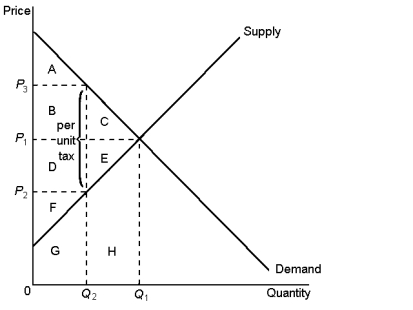 -According to Graph 8-1, the tax caused a reduction in consumer surplus, it is represented by area:
 (Multiple Choice)
4.9/5 (70)
(70) Assume that Jane cleans Joe's house weekly for $80. Joe would be willing to pay as much as $100 weekly to have his house cleaned. Jane's opportunity cost is $70.
-According to the information provided, if Jane cleans Joe's house, the consumer surplus is:
(Multiple Choice)
4.8/5 (75)
(75) Graph 8-1
-According to Graph 8-1, the benefits to the government (total tax revenue) is represented by area:
-According to Graph 8-1, the benefits to the government (total tax revenue) is represented by area: (Multiple Choice)
4.9/5 (75)
(75) Assume that Jane cleans Joe's house weekly for $80. Joe would be willing to pay as much as $100 weekly to have his house cleaned. Jane's opportunity cost is $70.
-According to the information provided, assume that Joe is required to pay a tax of $40 when he hires someone to clean his house. Which of the following is true?
(Multiple Choice)
5.0/5 (86)
(86) Graph 8-3
-According to Graph 8-3, the equilibrium market price before the tax is imposed is:
-According to Graph 8-3, the equilibrium market price before the tax is imposed is: (Multiple Choice)
4.7/5 (85)
(85) Phil offers to do Don's housework for $20 per week. Don's opportunity cost of doing housework is $30 per week, and Phil's opportunity cost of doing housework is $10 per week.
-According to the information provided, what will be Don's gain in consumer surplus as a result of the proposed transaction?
(Multiple Choice)
4.7/5 (82)
(82) Economists generally agree that the most important tax in the Australian economy is the tax on:
(Multiple Choice)
4.9/5 (77)
(77) The deadweight loss of a tax rises even more rapidly than the size of the tax.
(True/False)
4.9/5 (69)
(69) The underground economy refers to the extractive mining and petroleum industries.
(True/False)
4.7/5 (62)
(62) 
Filters
- Essay(0)
- Multiple Choice(0)
- Short Answer(0)
- True False(0)
- Matching(0)