



 Chat with AI
Exam 9: Application: International Trade

Exam 1: Ten Lessons From Economics149 Questions
Exam 2: Thinking Like an Economist147 Questions
Exam 3: Interdependence and the Gains From Trade153 Questions
Exam 4: The Market Forces of Supply and Demand222 Questions
Exam 5: Elasticity and Its Application181 Questions
Exam 6: Supply, Demand and Government Policies148 Questions
Exam 7: Consumers, Producers and the Efficiency of Markets177 Questions
Exam 8: Application: The Costs of Taxation141 Questions
Exam 9: Application: International Trade161 Questions
Exam 10: Externalities199 Questions
Exam 11: Public Goods and Common Resources182 Questions
Exam 12: The Design of the Tax System154 Questions
Exam 13: The Costs of Production191 Questions
Exam 14: Firms in Competitive Markets200 Questions
Exam 15: Monopoly214 Questions
Exam 16: Business Strategy184 Questions
Exam 17: Competition Policy104 Questions
Exam 18: Monopolistic Competition214 Questions
Exam 19: The Markets for the Factors of Production215 Questions
Exam 20: Earnings, Unions and Discrimination206 Questions
Exam 21: Income Inequity and Poverty111 Questions
Exam 22: The Theory of Consumer Choice161 Questions
Exam 23: Frontiers of Microeconomics120 Questions
Exam 24: Measuring a Nations Income51 Questions
Exam 25: Measuring the Cost of Living52 Questions
Exam 26: Production and Growth62 Questions
Exam 27: Saving, Investment and the Financial System62 Questions
Exam 28: The Natural Rate of Unemployment59 Questions
Exam 29: The Monetary System66 Questions
Exam 30: Inflation: Its Causes and Costs74 Questions
Exam 31: Open-Economy Macroeconomics: Basic Concepts68 Questions
Exam 32: A Macroeconomic Theory of the Open Economy64 Questions
Exam 33: Aggregate Demand and Aggregate Supply82 Questions
Exam 34: The Influence of Monetary and Fiscal Policy on Aggregate Demand73 Questions
Exam 35: The Short-Run Trade-Off Between Inflation and Unemployment58 Questions
Exam 36: Five Debates Over Macroeconomic Policy38 Questions
Select questions type


A tariff decreases the quantity of imports.

Free
(True/False)
4.9/5  (78)
(78) Correct Answer: Verified
True
When Ford and General Motors import automobile parts from Mexico at prices below those they must pay in the US:
Free
(Multiple Choice)
4.9/5 (80)
(80) Correct Answer:Verified
VerifiedD
Since losers from international trade are always compensated for their losses, international trade increases the size of the economic pie and the size of the pieces such that everyone is better off.
Free
(True/False)
4.9/5 (79)
(79) Correct Answer:Verified
VerifiedFalse
If Australia imports toys from other countries, Australian producers of toys are better off as a result of trade, but Australian consumers of toys are worse off.
(True/False)
4.8/5 (77)
(77) Suppose that Australia has a comparative advantage over the New Zealand in providing financial services and New Zealand has a comparative advantage over Australia in producing milk products. By reducing trade barriers, CER allowed both Australia and New Zealand to export more of the products in which it enjoys a comparative advantage. Do all people in both countries benefit from this free trade agreement? Explain.
(Essay)
4.7/5 (71)
(71) Graph 9-8
 -According to Graph 9-8, producer surplus before trade would be:
 (Multiple Choice)
4.8/5 (73)
(73) If Peru exports coffee to the rest of the world, Peruvian consumers of coffee are worse off as a result of trade, but Peruvian producers of coffee are better off.
(True/False)
4.8/5 (93)
(93) If free trade means that domestic jobs might be lost because of foreign competition, then economists agree that free trade must be restricted.
(True/False)
5.0/5 (83)
(83) Graph 9-9
 -Which of the following is an argument for restricting trade?
 (Multiple Choice)
4.7/5 (79)
(79) Graph 9-5
This graph refers to the market for oil in Spain.
 -According to Graph 9-5, the quantity of oil imported into Spain is:
 (Multiple Choice)
4.8/5 (83)
(83) In principle, trade can make everyone better off, since the gains to the winners exceed the losses to the losers.
(True/False)
4.9/5 (69)
(69) Graph 9-6
This graph refers to the market for oil in Spain.
 -According to Graph 9-6, producer surplus in Spain before trade would be:
 (Multiple Choice)
4.8/5 (73)
(73) Graph 9-8
-According to Graph 9-8, consumer surplus after trade would be:
-According to Graph 9-8, consumer surplus after trade would be: (Multiple Choice)
4.9/5 (74)
(74) In 1983, New Zealand had 16 car assembly plants. These plants were protected from international competition by very high tariffs. These tariffs were later removed. Assuming that New Zealand is a price taker in the automobile market, explain the welfare changes that occurred after the tariffs were removed. Identify the winners and losers of the policy.
(Essay)
4.7/5 (80)
(80) Import quotas and tariffs both cause the quantity of imports to fall.
(True/False)
4.9/5 (78)
(78) Graph 9-1
This graph refers to the market for beef in Japan.
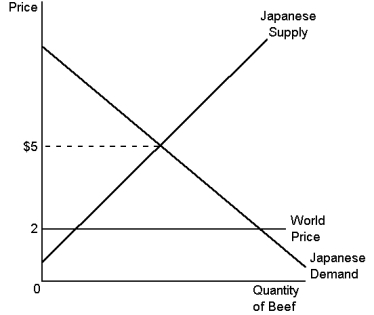 -According to Graph 9-1, if trade in beef is allowed, Japanese beef:
 (Multiple Choice)
4.8/5 (55)
(55) Graph 9-7
 -According to Graph 9-7, the price and domestic quantity demanded after trade would be:
 (Multiple Choice)
5.0/5 (76)
(76) Graph 9-8
-According to Graph 9-8, how many units of this product would be imported after trade?
-According to Graph 9-8, how many units of this product would be imported after trade? (Multiple Choice)
4.7/5 (82)
(82) 
Filters
- Essay(0)
- Multiple Choice(0)
- Short Answer(0)
- True False(0)
- Matching(0)