



 Chat with AI
Exam 9: Application: International Trade

Exam 1: Ten Lessons From Economics149 Questions
Exam 2: Thinking Like an Economist147 Questions
Exam 3: Interdependence and the Gains From Trade153 Questions
Exam 4: The Market Forces of Supply and Demand222 Questions
Exam 5: Elasticity and Its Application181 Questions
Exam 6: Supply, Demand and Government Policies148 Questions
Exam 7: Consumers, Producers and the Efficiency of Markets177 Questions
Exam 8: Application: The Costs of Taxation141 Questions
Exam 9: Application: International Trade161 Questions
Exam 10: Externalities199 Questions
Exam 11: Public Goods and Common Resources182 Questions
Exam 12: The Design of the Tax System154 Questions
Exam 13: The Costs of Production191 Questions
Exam 14: Firms in Competitive Markets200 Questions
Exam 15: Monopoly214 Questions
Exam 16: Business Strategy184 Questions
Exam 17: Competition Policy104 Questions
Exam 18: Monopolistic Competition214 Questions
Exam 19: The Markets for the Factors of Production215 Questions
Exam 20: Earnings, Unions and Discrimination206 Questions
Exam 21: Income Inequity and Poverty111 Questions
Exam 22: The Theory of Consumer Choice161 Questions
Exam 23: Frontiers of Microeconomics120 Questions
Exam 24: Measuring a Nations Income51 Questions
Exam 25: Measuring the Cost of Living52 Questions
Exam 26: Production and Growth62 Questions
Exam 27: Saving, Investment and the Financial System62 Questions
Exam 28: The Natural Rate of Unemployment59 Questions
Exam 29: The Monetary System66 Questions
Exam 30: Inflation: Its Causes and Costs74 Questions
Exam 31: Open-Economy Macroeconomics: Basic Concepts68 Questions
Exam 32: A Macroeconomic Theory of the Open Economy64 Questions
Exam 33: Aggregate Demand and Aggregate Supply82 Questions
Exam 34: The Influence of Monetary and Fiscal Policy on Aggregate Demand73 Questions
Exam 35: The Short-Run Trade-Off Between Inflation and Unemployment58 Questions
Exam 36: Five Debates Over Macroeconomic Policy38 Questions
Select questions type


Graph 9-2
This graph refers to the market for saddles in Argentina.
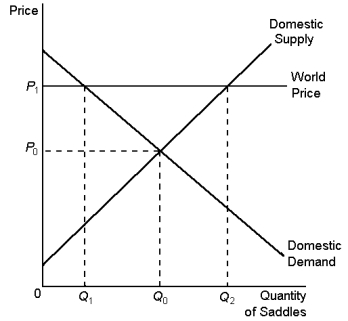 -According to Graph 9-2, the price and quantity demanded of saddles in Argentina after trade would be:
 (Multiple Choice)
5.0/5  (89)
(89) Graph 9-7
 -According to Graph 9-7, how many units of this product would be exported after trade is allowed?
 (Multiple Choice)
4.7/5 (73)
(73) If a tariff is placed on clocks, the price of both domestic and imported clocks will rise by the amount of the tariff.
(True/False)
4.9/5 (66)
(66) The main justification for imposing restrictions on free international trade is:
(Multiple Choice)
4.8/5 (73)
(73) Graph 9-8
 -According to Graph 9-8, producer surplus after trade would be:
 (Multiple Choice)
5.0/5 (83)
(83) An import quota increases domestic producer surplus and the surplus of import licence holders, reduces domestic consumer surplus, and creates deadweight loss.
(True/False)
4.8/5 (82)
(82) Suppose that Tonga, a small country, imports apples at the world price of $4 per kilogram. If Tonga imposes a tariff of $1 per kilogram on imported apples, the price of apples in Tonga will increase, but by less than $1, ceteris paribus.
(True/False)
4.7/5 (86)
(86) When a country allows trade and becomes an importer of a good, which of the following is NOT true?
(Multiple Choice)
4.8/5 (84)
(84) Graph 9-7
-According to Graph 9-7, consumer surplus before trade would be:
-According to Graph 9-7, consumer surplus before trade would be: (Multiple Choice)
4.9/5 (87)
(87) Graph 9-7
-According to Graph 9-7, producer surplus before trade would be:
-According to Graph 9-7, producer surplus before trade would be: (Multiple Choice)
4.9/5 (73)
(73) If the domestic price of a good is low relative to the world price, the country has a comparative advantage in producing that good.
(True/False)
4.8/5 (72)
(72) If a country allows trade and the domestic price of a good is lower than the world price:
(Multiple Choice)
5.0/5 (65)
(65) Graph 9-5
This graph refers to the market for oil in Spain.
 -According to Graph 9-5, the price of oil and the quantity demanded in Spain after trade would be:
 (Multiple Choice)
4.9/5 (90)
(90) Economists contend that imposing trade restrictions in order to protect industries for national security reasons is never justified.
(True/False)
4.8/5 (84)
(84) When goods that are produced in China are sold to Australia, the goods are:
(Multiple Choice)
4.9/5 (82)
(82) Graph 9-4
This graph refers to the market for kiwifruit in New Zealand.
 -According to Graph 9-4, producer surplus in New Zealand before trade is:
 (Multiple Choice)
4.9/5 (82)
(82) When a government imposes a tariff on a product, the domestic price will equal the world price.
(True/False)
4.8/5 (72)
(72) A multilateral approach to free trade has the potential to increase the gains from trade more than a unilateral approach does, because the multilateral approach can reduce trade restrictions abroad as well as at home.
(True/False)
4.8/5 (81)
(81) 
Filters
- Essay(0)
- Multiple Choice(0)
- Short Answer(0)
- True False(0)
- Matching(0)