



 Chat with AI
Exam 9: Application: International Trade

Exam 1: Ten Lessons From Economics149 Questions
Exam 2: Thinking Like an Economist147 Questions
Exam 3: Interdependence and the Gains From Trade153 Questions
Exam 4: The Market Forces of Supply and Demand222 Questions
Exam 5: Elasticity and Its Application181 Questions
Exam 6: Supply, Demand and Government Policies148 Questions
Exam 7: Consumers, Producers and the Efficiency of Markets177 Questions
Exam 8: Application: The Costs of Taxation141 Questions
Exam 9: Application: International Trade161 Questions
Exam 10: Externalities199 Questions
Exam 11: Public Goods and Common Resources182 Questions
Exam 12: The Design of the Tax System154 Questions
Exam 13: The Costs of Production191 Questions
Exam 14: Firms in Competitive Markets200 Questions
Exam 15: Monopoly214 Questions
Exam 16: Business Strategy184 Questions
Exam 17: Competition Policy104 Questions
Exam 18: Monopolistic Competition214 Questions
Exam 19: The Markets for the Factors of Production215 Questions
Exam 20: Earnings, Unions and Discrimination206 Questions
Exam 21: Income Inequity and Poverty111 Questions
Exam 22: The Theory of Consumer Choice161 Questions
Exam 23: Frontiers of Microeconomics120 Questions
Exam 24: Measuring a Nations Income51 Questions
Exam 25: Measuring the Cost of Living52 Questions
Exam 26: Production and Growth62 Questions
Exam 27: Saving, Investment and the Financial System62 Questions
Exam 28: The Natural Rate of Unemployment59 Questions
Exam 29: The Monetary System66 Questions
Exam 30: Inflation: Its Causes and Costs74 Questions
Exam 31: Open-Economy Macroeconomics: Basic Concepts68 Questions
Exam 32: A Macroeconomic Theory of the Open Economy64 Questions
Exam 33: Aggregate Demand and Aggregate Supply82 Questions
Exam 34: The Influence of Monetary and Fiscal Policy on Aggregate Demand73 Questions
Exam 35: The Short-Run Trade-Off Between Inflation and Unemployment58 Questions
Exam 36: Five Debates Over Macroeconomic Policy38 Questions
Select questions type


Graph 9-9
 -In Graph 9-9, consumer surplus after the tariff would be:
 (Multiple Choice)
4.9/5  (66)
(66) Graph 9-4
This graph refers to the market for kiwifruit in New Zealand.
 -According to Graph 9-4, consumer surplus in New Zealand before trade the trade in kiwifruit is:
 (Multiple Choice)
4.9/5 (77)
(77) Suppose the before-trade domestic price of natural gas in Australia is $15 per kg. The world price of natural gas is $30 per kg. Australia is a price-taker in the natural gas market.
-According to this statement, if trade in natural gas is allowed, the price of natural gas in Australia will be:
(Multiple Choice)
4.8/5 (87)
(87) Use the following information to answer the following questions.
The before-trade price of logs in New Zealand is $100 per cubic metre. The world price of logs is $200 per cubic metre. New Zealand is a price taker in the world log market.
-Suppose Australia has a free-trade treaty with the United States. As a result, Australia increases its exports of kangaroo to the USA. Which of the following statements is NOT true?
(Multiple Choice)
4.9/5 (69)
(69) Graph 9-6
This graph refers to the market for oil in Spain.
 -According to Graph 9-6, consumer surplus in Spain before trade would be:
 (Multiple Choice)
4.8/5 (88)
(88) Graph 9-12
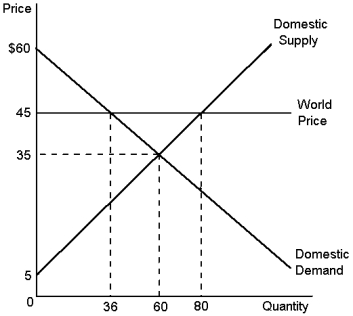 -Using Graph 9-12, answer the following questions about chairs.
a. What is the equilibrium price of chairs before trade?
b. What is the equilibrium quantity of chairs before trade?
c. What is the price of chairs after trade is allowed?
d. What is the quantity of chairs exported?
e. What is the amount of consumer surplus before trade?
f. What is the amount of consumer surplus after trade?
g. What is the amount of producer surplus before trade?
h. What is the amount of producer surplus after trade?
i. What is the change in total surplus because of trade?
-Using Graph 9-12, answer the following questions about chairs.
a. What is the equilibrium price of chairs before trade?
b. What is the equilibrium quantity of chairs before trade?
c. What is the price of chairs after trade is allowed?
d. What is the quantity of chairs exported?
e. What is the amount of consumer surplus before trade?
f. What is the amount of consumer surplus after trade?
g. What is the amount of producer surplus before trade?
h. What is the amount of producer surplus after trade?
i. What is the change in total surplus because of trade? (Short Answer)
4.7/5 (84)
(84) While tariffs raise the domestic price of a good, a quota has no effect on the domestic price of a good.
(True/False)
4.9/5 (69)
(69) Suppose that Australia and China do not trade with each other. If they then allow trade and Australia becomes an exporter of mineral products to China, which group or groups in each country are better off, and which are worse off?
(Essay)
4.8/5 (83)
(83) Graph 9-1
This graph refers to the market for beef in Japan.
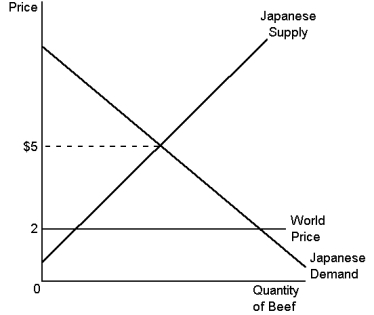 -According to Graph 9-1, if trade in beef is allowed, the price of beef in Japan will be:
 (Multiple Choice)
4.9/5 (70)
(70) Graph 9-9
-In Graph 9-9, the domestic price and quantity demanded after the tariff would be:
-In Graph 9-9, the domestic price and quantity demanded after the tariff would be: (Multiple Choice)
4.8/5 (74)
(74) Suppose the before-trade domestic price of natural gas in Australia is $15 per kg. The world price of natural gas is $30 per kg. Australia is a price-taker in the natural gas market.
-According to this statement, if trade in natural gas is allowed:
(Multiple Choice)
4.8/5 (88)
(88) Define the two approaches a nation can take to achieve free trade. Does one approach have an advantage over the other?
(Essay)
4.8/5 (100)
(100) Graph 9-9
-Which of the following is NOT an argument for restricting trade?
-Which of the following is NOT an argument for restricting trade? (Multiple Choice)
4.9/5 (83)
(83) Suppose that Australia and China do not trade with each other. If they then allow trade and Australia becomes an importer of clothing from China, which group or groups in each country are better off and which are worse off?
(Essay)
5.0/5 (66)
(66) The decrease in total surplus that results from a tariff or quota is called the gains from trade.
(True/False)
4.9/5 (85)
(85) Graph 9-4
This graph refers to the market for kiwifruit in New Zealand.
-According to Graph 9-4, the change in total surplus in New Zealand because of the trade in kiwifruit is:
-According to Graph 9-4, the change in total surplus in New Zealand because of the trade in kiwifruit is: (Multiple Choice)
4.9/5 (81)
(81) Graph 9-9
-In Graph 9-9, the free-trade price and quantity demanded would be:
-In Graph 9-9, the free-trade price and quantity demanded would be: (Multiple Choice)
4.8/5 (77)
(77) 
Filters
- Essay(0)
- Multiple Choice(0)
- Short Answer(0)
- True False(0)
- Matching(0)