



 Chat with AI
Exam 9: Application: International Trade

Exam 1: Ten Lessons From Economics149 Questions
Exam 2: Thinking Like an Economist147 Questions
Exam 3: Interdependence and the Gains From Trade153 Questions
Exam 4: The Market Forces of Supply and Demand222 Questions
Exam 5: Elasticity and Its Application181 Questions
Exam 6: Supply, Demand and Government Policies148 Questions
Exam 7: Consumers, Producers and the Efficiency of Markets177 Questions
Exam 8: Application: The Costs of Taxation141 Questions
Exam 9: Application: International Trade161 Questions
Exam 10: Externalities199 Questions
Exam 11: Public Goods and Common Resources182 Questions
Exam 12: The Design of the Tax System154 Questions
Exam 13: The Costs of Production191 Questions
Exam 14: Firms in Competitive Markets200 Questions
Exam 15: Monopoly214 Questions
Exam 16: Business Strategy184 Questions
Exam 17: Competition Policy104 Questions
Exam 18: Monopolistic Competition214 Questions
Exam 19: The Markets for the Factors of Production215 Questions
Exam 20: Earnings, Unions and Discrimination206 Questions
Exam 21: Income Inequity and Poverty111 Questions
Exam 22: The Theory of Consumer Choice161 Questions
Exam 23: Frontiers of Microeconomics120 Questions
Exam 24: Measuring a Nations Income51 Questions
Exam 25: Measuring the Cost of Living52 Questions
Exam 26: Production and Growth62 Questions
Exam 27: Saving, Investment and the Financial System62 Questions
Exam 28: The Natural Rate of Unemployment59 Questions
Exam 29: The Monetary System66 Questions
Exam 30: Inflation: Its Causes and Costs74 Questions
Exam 31: Open-Economy Macroeconomics: Basic Concepts68 Questions
Exam 32: A Macroeconomic Theory of the Open Economy64 Questions
Exam 33: Aggregate Demand and Aggregate Supply82 Questions
Exam 34: The Influence of Monetary and Fiscal Policy on Aggregate Demand73 Questions
Exam 35: The Short-Run Trade-Off Between Inflation and Unemployment58 Questions
Exam 36: Five Debates Over Macroeconomic Policy38 Questions
Select questions type


Tariffs and import quotas have the following differing outcomes:
(Multiple Choice)
4.9/5  (91)
(91) Graph 9-9
 -In Graph 9-9, producer surplus with free trade would be:
 (Multiple Choice)
5.0/5 (64)
(64) When resources devoted to lobbying are included in the analysis of restrictions to international trade:
(Multiple Choice)
5.0/5 (79)
(79) The Closer Economic Relations agreement between New Zealand and Australia is designed to ensure both Australia and New Zealand can exercise their own comparative advantage.
(True/False)
4.7/5 (90)
(90) Graph 9-7
 -According to Graph 9-7, equilibrium price and quantity before trade would be:
 (Multiple Choice)
4.8/5 (73)
(73) Graph 9-8
 -According to Graph 9-8, domestic production and domestic consumption after trade would be:
 (Multiple Choice)
4.9/5 (59)
(59) Suppose that you are advising Russian policy makers on trade issues, and the issue of protection for the Russian vodka industry comes up. You argue in favour of free trade but the policymakers are convinced that some protection is needed. They are leaning in favour of an import quota. What will you tell them about the relative effects of import quotas and equivalent tariffs on the wellbeing of Russian vodka producers, Russian vodka consumers and the Russian government budget?
(Essay)
4.8/5 (83)
(83) The before-trade domestic price of honey in Australia is $6 per gallon. The world price of honey is $5 per gallon. Australia is a price taker in the honey market. Given this information, answer the following questions.
a. Will Australia import or export honey?
b. What will the price of honey be in Australia if free trade is allowed?
c. Who will benefit from free trade in this case?
d. Who will lose from free trade?
(Essay)
4.9/5 (89)
(89) Suppose the before-trade domestic price of natural gas in Australia is $15 per kg. The world price of natural gas is $30 per kg. Australia is a price-taker in the natural gas market.
-According to this statement, if trade in natural gas is allowed, the price of natural gas in Australia:
(Multiple Choice)
4.9/5 (74)
(74) Graph 9-8
-According to Graph 9-8, equilibrium price and quantity before trade would be:
-According to Graph 9-8, equilibrium price and quantity before trade would be: (Multiple Choice)
4.8/5 (84)
(84) One of the important outcomes of international trade is that countries specialise in the output of things they are best at.
(True/False)
4.9/5 (82)
(82) Graph 9-9
-In Graph 9-9, as a result of the tariff, government tariff revenue would be:
-In Graph 9-9, as a result of the tariff, government tariff revenue would be: (Multiple Choice)
4.8/5 (81)
(81) A country is deemed to have a comparative advantage in a product if:
(Multiple Choice)
4.9/5 (83)
(83) If Japan subsidised the production of rice and then exported the rice to Australia at artificially low prices, then the Australian economy would be worse off.
(True/False)
4.8/5 (66)
(66) If a small country imposes a tariff on an imported good, domestic sellers will gain producer surplus, the government will gain tariff revenue and domestic consumers will gain consumer surplus.
(True/False)
4.8/5 (81)
(81) Suppose that a country that has been isolated from the rest of the world decides to open its borders to international trade. The country produces chickens and soccer balls. On what basis can the country decide which good to import and which good to export?
(Essay)
4.9/5 (92)
(92) Graph 9-15
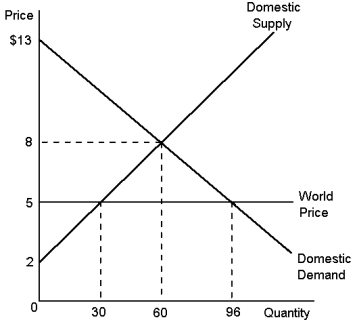 -Using Graph 9-15, assume that the government imposes an import quota of 20 hammers. Answer the following questions, given this information.
a. What is the equilibrium price and quantity of hammers after the quota is imposed?
b. What is the quantity of hammers imported before the quota?
c. What is the quantity of hammers imported after the quota?
d. What is the amount of consumer surplus before the quota?
e. What is the amount of consumer surplus after the quota?
f. What is the amount of producer surplus before the quota?
g. What is the amount of producer surplus after the quota?
h. What would be the amount of deadweight loss due to the quota?
-Using Graph 9-15, assume that the government imposes an import quota of 20 hammers. Answer the following questions, given this information.
a. What is the equilibrium price and quantity of hammers after the quota is imposed?
b. What is the quantity of hammers imported before the quota?
c. What is the quantity of hammers imported after the quota?
d. What is the amount of consumer surplus before the quota?
e. What is the amount of consumer surplus after the quota?
f. What is the amount of producer surplus before the quota?
g. What is the amount of producer surplus after the quota?
h. What would be the amount of deadweight loss due to the quota? (Essay)
4.9/5 (90)
(90) 
Filters
- Essay(0)
- Multiple Choice(0)
- Short Answer(0)
- True False(0)
- Matching(0)