



 Chat with AI
Exam 9: Application: International Trade

Exam 1: Ten Lessons From Economics149 Questions
Exam 2: Thinking Like an Economist147 Questions
Exam 3: Interdependence and the Gains From Trade153 Questions
Exam 4: The Market Forces of Supply and Demand222 Questions
Exam 5: Elasticity and Its Application181 Questions
Exam 6: Supply, Demand and Government Policies148 Questions
Exam 7: Consumers, Producers and the Efficiency of Markets177 Questions
Exam 8: Application: The Costs of Taxation141 Questions
Exam 9: Application: International Trade161 Questions
Exam 10: Externalities199 Questions
Exam 11: Public Goods and Common Resources182 Questions
Exam 12: The Design of the Tax System154 Questions
Exam 13: The Costs of Production191 Questions
Exam 14: Firms in Competitive Markets200 Questions
Exam 15: Monopoly214 Questions
Exam 16: Business Strategy184 Questions
Exam 17: Competition Policy104 Questions
Exam 18: Monopolistic Competition214 Questions
Exam 19: The Markets for the Factors of Production215 Questions
Exam 20: Earnings, Unions and Discrimination206 Questions
Exam 21: Income Inequity and Poverty111 Questions
Exam 22: The Theory of Consumer Choice161 Questions
Exam 23: Frontiers of Microeconomics120 Questions
Exam 24: Measuring a Nations Income51 Questions
Exam 25: Measuring the Cost of Living52 Questions
Exam 26: Production and Growth62 Questions
Exam 27: Saving, Investment and the Financial System62 Questions
Exam 28: The Natural Rate of Unemployment59 Questions
Exam 29: The Monetary System66 Questions
Exam 30: Inflation: Its Causes and Costs74 Questions
Exam 31: Open-Economy Macroeconomics: Basic Concepts68 Questions
Exam 32: A Macroeconomic Theory of the Open Economy64 Questions
Exam 33: Aggregate Demand and Aggregate Supply82 Questions
Exam 34: The Influence of Monetary and Fiscal Policy on Aggregate Demand73 Questions
Exam 35: The Short-Run Trade-Off Between Inflation and Unemployment58 Questions
Exam 36: Five Debates Over Macroeconomic Policy38 Questions
Select questions type


Import quotas increase the domestic price of the product to at least the world price.
(True/False)
4.9/5  (83)
(83) Graph 9-7
 -According to Graph 9-7, domestic production and domestic consumption after trade would be:
 (Multiple Choice)
4.9/5 (92)
(92) Graph 9-6
This graph refers to the market for oil in Spain.
 -According to Graph 9-6, producer surplus plus consumer surplus in Spain after trade would be:
 (Multiple Choice)
4.9/5 (85)
(85) Graph 9-4
This graph refers to the market for kiwifruit in New Zealand.
 -According to Graph 9-4, total surplus in New Zealand after the trade in kiwifruit is:
 (Multiple Choice)
4.8/5 (71)
(71) When a country allows trade and becomes an importer of a good, consumer surplus:
(Multiple Choice)
4.8/5 (85)
(85) A multilateral approach to free trade can sometimes win political support when a unilateral approach cannot.
(True/False)
4.9/5 (88)
(88) Graph 9-4
This graph refers to the market for kiwifruit in New Zealand.
-According to Graph 9-4, total surplus in New Zealand before the trade in kiwifruit is:
-According to Graph 9-4, total surplus in New Zealand before the trade in kiwifruit is: (Multiple Choice)
4.8/5 (66)
(66) Graph 9-9
 -In Graph 9-9, consumer surplus with free trade would be:
 (Multiple Choice)
4.8/5 (93)
(93) Graph 9-7
-According to Graph 9-7, producer surplus after trade would be:
-According to Graph 9-7, producer surplus after trade would be: (Multiple Choice)
4.8/5 (76)
(76) The Closer Economic Relations agreement between New Zealand and Australia is designed to ensure that Australia can exercise its absolute advantage.
(True/False)
4.9/5 (88)
(88) Graph 9-6
This graph refers to the market for oil in Spain.
-According to Graph 9-6, producer surplus in Spain after trade would be:
-According to Graph 9-6, producer surplus in Spain after trade would be: (Multiple Choice)
4.8/5 (74)
(74) Graph 9-3
 -In Graph 9-3, the equilibrium price and quantity after the quota would be:
 (Multiple Choice)
4.8/5 (84)
(84) Graph 9-13
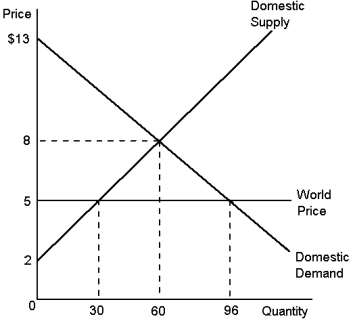 -Using Graph 9-13, answer the following questions about hammers.
a. What is the equilibrium price of hammers before trade?
b. What is the equilibrium quantity of hammers before trade?
c. What is the price of hammers after trade is allowed?
d. What is the quantity of hammers imported?
e. What is the amount of consumer surplus before trade?
f. What is the amount of consumer surplus after trade?
g. What is the amount of producer surplus before trade?
h. What is the amount of producer surplus after trade?
i. What is the change in total surplus because of trade?
-Using Graph 9-13, answer the following questions about hammers.
a. What is the equilibrium price of hammers before trade?
b. What is the equilibrium quantity of hammers before trade?
c. What is the price of hammers after trade is allowed?
d. What is the quantity of hammers imported?
e. What is the amount of consumer surplus before trade?
f. What is the amount of consumer surplus after trade?
g. What is the amount of producer surplus before trade?
h. What is the amount of producer surplus after trade?
i. What is the change in total surplus because of trade? (Short Answer)
4.7/5 (95)
(95) Suppose that China can produce every product at an absolutely lower cost than can Australia. Does it pay for China to trade with Australia? Explain.
(Essay)
4.8/5 (84)
(84) Graph 9-8
 -According to Graph 9-8, consumer surplus before trade would be:
 (Multiple Choice)
4.8/5 (85)
(85) If a country allows trade and the domestic price of a good is higher than the world price:
(Multiple Choice)
4.8/5 (81)
(81) When the free trade treaty CER was signed between New Zealand and Australia, opponents claimed that New Zealand would suffer significant job losses to more efficient Australian producers. Why would you not be surprised to learn that CER did not lift unemployment in either country?
(Essay)
4.9/5 (83)
(83) 
Filters
- Essay(0)
- Multiple Choice(0)
- Short Answer(0)
- True False(0)
- Matching(0)