



 Chat with AI
Exam 8: Application: The Costs of Taxation

Exam 1: Ten Lessons From Economics149 Questions
Exam 2: Thinking Like an Economist147 Questions
Exam 3: Interdependence and the Gains From Trade153 Questions
Exam 4: The Market Forces of Supply and Demand222 Questions
Exam 5: Elasticity and Its Application181 Questions
Exam 6: Supply, Demand and Government Policies148 Questions
Exam 7: Consumers, Producers and the Efficiency of Markets177 Questions
Exam 8: Application: The Costs of Taxation141 Questions
Exam 9: Application: International Trade161 Questions
Exam 10: Externalities199 Questions
Exam 11: Public Goods and Common Resources182 Questions
Exam 12: The Design of the Tax System154 Questions
Exam 13: The Costs of Production191 Questions
Exam 14: Firms in Competitive Markets200 Questions
Exam 15: Monopoly214 Questions
Exam 16: Business Strategy184 Questions
Exam 17: Competition Policy104 Questions
Exam 18: Monopolistic Competition214 Questions
Exam 19: The Markets for the Factors of Production215 Questions
Exam 20: Earnings, Unions and Discrimination206 Questions
Exam 21: Income Inequity and Poverty111 Questions
Exam 22: The Theory of Consumer Choice161 Questions
Exam 23: Frontiers of Microeconomics120 Questions
Exam 24: Measuring a Nations Income51 Questions
Exam 25: Measuring the Cost of Living52 Questions
Exam 26: Production and Growth62 Questions
Exam 27: Saving, Investment and the Financial System62 Questions
Exam 28: The Natural Rate of Unemployment59 Questions
Exam 29: The Monetary System66 Questions
Exam 30: Inflation: Its Causes and Costs74 Questions
Exam 31: Open-Economy Macroeconomics: Basic Concepts68 Questions
Exam 32: A Macroeconomic Theory of the Open Economy64 Questions
Exam 33: Aggregate Demand and Aggregate Supply82 Questions
Exam 34: The Influence of Monetary and Fiscal Policy on Aggregate Demand73 Questions
Exam 35: The Short-Run Trade-Off Between Inflation and Unemployment58 Questions
Exam 36: Five Debates Over Macroeconomic Policy38 Questions
Select questions type


'Assume that the supply of forest products is relatively inelastic and the supply of coffee is relatively elastic'. According to this statement, suppose both forest products and coffee have the same percentage tax applied to them, the fall in quantity supplied of forest products will be:
(Multiple Choice)
4.8/5  (81)
(81) The demand for bread is less elastic than the demand for donuts; hence, ceteris paribus, a tax on bread will create a larger deadweight loss than will the same tax on donuts.
(True/False)
4.7/5 (81)
(81) If a tax did not induce buyers or sellers to change their behaviour, it would not cause a deadweight loss.
(True/False)
4.9/5 (88)
(88) One of the important economic costs of imposing taxes on a market is the deadweight loss.
(True/False)
4.8/5 (74)
(74) When a tax is levied on a good buyers are worse off but not sellers.
(True/False)
4.9/5 (69)
(69) If the size of a tax doubles, the deadweight loss rises by a factor of six.
(True/False)
5.0/5 (81)
(81) Graph 8-3
 -According to Graph 8-3, the amount of deadweight loss in this market resulting from the levying of the tax is:
 (Multiple Choice)
4.7/5 (87)
(87) Using the graph below for cases of microwave popcorn, calculate:
a. equilibrium price.
b. equilibrium quantity.
c. consumer surplus.
d. producer surplus.
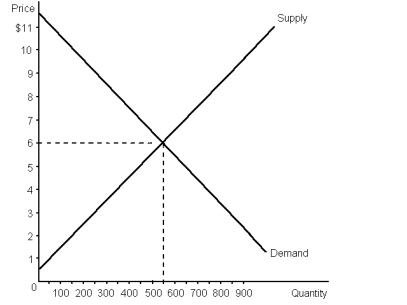 Now suppose that the government imposes a fat tax $2 tax per case on the sellers of microwave popcorn. Show this on the graph and calculate each of the following after the tax is imposed:
e. price paid by buyers
f. price received by sellers
g. consumer surplus
h. producer surplus
i. government revenue
j. deadweight loss
Now suppose that the government imposes a fat tax $2 tax per case on the sellers of microwave popcorn. Show this on the graph and calculate each of the following after the tax is imposed:
e. price paid by buyers
f. price received by sellers
g. consumer surplus
h. producer surplus
i. government revenue
j. deadweight loss (Essay)
5.0/5 (79)
(79) Assume that Jane cleans Joe's house weekly for $80. Joe would be willing to pay as much as $100 weekly to have his house cleaned. Jane's opportunity cost is $70.
-According to the information provided, if Jane cleans Joe's house, the producer surplus is:
(Multiple Choice)
4.8/5 (74)
(74) Suppose the demand curve becomes more elastic, but nothing else changes, this implies that the deadweight loss from a given tax will be smaller.
(True/False)
5.0/5 (86)
(86) One result of a tax on a good is that the equilibrium quantity sold tends to rise.
(True/False)
4.8/5 (86)
(86) Graph 8-2
 This graph shows supply and demand in a free market.
-According to Graph 8-2, when the market is in equilibrium, producer surplus is represented by area:
This graph shows supply and demand in a free market.
-According to Graph 8-2, when the market is in equilibrium, producer surplus is represented by area: (Multiple Choice)
4.9/5 (88)
(88) Because taxes distort incentives, they cause markets to allocate resources inefficiently.
(True/False)
4.9/5 (75)
(75) Supply-side economics can be a winning strategy in many computer games.
(True/False)
4.8/5 (94)
(94) 
Filters
- Essay(0)
- Multiple Choice(0)
- Short Answer(0)
- True False(0)
- Matching(0)