



 Chat with AI
Exam 21: Income Inequity and Poverty

Exam 1: Ten Lessons From Economics149 Questions
Exam 2: Thinking Like an Economist147 Questions
Exam 3: Interdependence and the Gains From Trade153 Questions
Exam 4: The Market Forces of Supply and Demand222 Questions
Exam 5: Elasticity and Its Application181 Questions
Exam 6: Supply, Demand and Government Policies148 Questions
Exam 7: Consumers, Producers and the Efficiency of Markets177 Questions
Exam 8: Application: The Costs of Taxation141 Questions
Exam 9: Application: International Trade161 Questions
Exam 10: Externalities199 Questions
Exam 11: Public Goods and Common Resources182 Questions
Exam 12: The Design of the Tax System154 Questions
Exam 13: The Costs of Production191 Questions
Exam 14: Firms in Competitive Markets200 Questions
Exam 15: Monopoly214 Questions
Exam 16: Business Strategy184 Questions
Exam 17: Competition Policy104 Questions
Exam 18: Monopolistic Competition214 Questions
Exam 19: The Markets for the Factors of Production215 Questions
Exam 20: Earnings, Unions and Discrimination206 Questions
Exam 21: Income Inequity and Poverty111 Questions
Exam 22: The Theory of Consumer Choice161 Questions
Exam 23: Frontiers of Microeconomics120 Questions
Exam 24: Measuring a Nations Income51 Questions
Exam 25: Measuring the Cost of Living52 Questions
Exam 26: Production and Growth62 Questions
Exam 27: Saving, Investment and the Financial System62 Questions
Exam 28: The Natural Rate of Unemployment59 Questions
Exam 29: The Monetary System66 Questions
Exam 30: Inflation: Its Causes and Costs74 Questions
Exam 31: Open-Economy Macroeconomics: Basic Concepts68 Questions
Exam 32: A Macroeconomic Theory of the Open Economy64 Questions
Exam 33: Aggregate Demand and Aggregate Supply82 Questions
Exam 34: The Influence of Monetary and Fiscal Policy on Aggregate Demand73 Questions
Exam 35: The Short-Run Trade-Off Between Inflation and Unemployment58 Questions
Exam 36: Five Debates Over Macroeconomic Policy38 Questions
Select questions type


Because people can borrow and save to smooth out life-cycle changes in income, their standard of living in any year depends more on lifetime income than on that year's income.
(True/False)
4.9/5  (79)
(79) The life cycle effect characterises a lifetime income profile in which income:
(Multiple Choice)
4.8/5 (73)
(73) You are a critic of welfare reforms that impose a time limit on the number of years a person is eligible for welfare benefits. What is the foundation of your critique?
(Essay)
4.9/5 (75)
(75) The concept of diminishing marginal utility is embodied in the utilitarian rationale for:
(Multiple Choice)
4.8/5 (70)
(70) The distortionary effect of government redistribution programs is analogous to filling a well with a leaky bucket.
(True/False)
4.9/5 (98)
(98) Economists who support minimum wage legislation are likely to believe that the: (i) demand for unskilled labour is relatively inelastic
(ii) demand for unskilled labour is relatively elastic
(iii) supply of unskilled labour is relatively elastic
(Multiple Choice)
4.7/5 (75)
(75) As a result of the trade-off between income equality and incentives to work, an optimal redistribution policy:
(Multiple Choice)
4.8/5 (60)
(60) Many people have been critical of statistics that are used to characterise income inequality on the grounds that as long as the average income of the poor is increasing, their position relative to the rich should not matter. Evaluate this critique.
(Essay)
5.0/5 (82)
(82) Which of the following statements about anti-poverty programs are generally true? (i) they generate a very low marginal tax rate on income
(ii) they create disincentives to work
(iii) they discourage saving among recipient groups
(Multiple Choice)
4.8/5 (76)
(76) Whether or not policymakers should try to make our society more egalitarian is largely a matter of:
(Multiple Choice)
4.8/5 (73)
(73) Which of the following statements about minimum-wage laws are true? Minimum wages:
(i) force a market imbalance between the supply and demand for labour
(ii) increase the efficiency of labour markets
(iii) are most effective at alleviating poverty when labour demand is highly elastic
(Multiple Choice)
4.8/5 (68)
(68) Using demand-supply analysis, show how the elasticity of demand of labour determines the magnitude of unemployment when an effective minimum wage is imposed.
(Essay)
4.8/5 (78)
(78) Which of the following is an explanation of why high-income men are increasingly likely to marry high-income women? (i) the women's movement
(ii) the urbanisation of society
(iii) comparable worth legislation
(Multiple Choice)
5.0/5 (84)
(84) Suppose income was equally distributed across all families, then:
(Multiple Choice)
4.9/5 (68)
(68) Table 21-1
 Given Table 21-1, which country has a more equally distributed income? Explain your answer.
 (Essay)
4.9/5 (85)
(85) Political philosophers agree in their views about the role of government in altering the distribution of income.
(True/False)
4.9/5 (76)
(76) Which of the following formulas is most representative of a negative income tax proposal?
(Multiple Choice)
4.8/5 (76)
(76) In gauging the inequality of living standards, annual income is more relevant than permanent income.
(True/False)
4.7/5 (80)
(80) Table 21-2
Total utility derived from various income levels
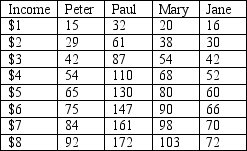 Table 21-2 reflects the levels of total utility received from income for each of four members of a society.
a. Assume that the society has the following income distribution:
Peter - $3
Paul - $7
Mary - $5
Jane - $3
Is it possible for the government to increase total aggregate utility by redistributing income among members of society? Explain your answer.
b. Assume that the government has $19 to allocate among the four members of society. (Assume that no one has any income to start with.) If the government is interested in distributing income in a way that maximises aggregate total utility, how should it distribute the $19 of income?
c. Does Table 21-2 describe a situation characterised by diminishing marginal utility? Explain your answer.
Table 21-2 reflects the levels of total utility received from income for each of four members of a society.
a. Assume that the society has the following income distribution:
Peter - $3
Paul - $7
Mary - $5
Jane - $3
Is it possible for the government to increase total aggregate utility by redistributing income among members of society? Explain your answer.
b. Assume that the government has $19 to allocate among the four members of society. (Assume that no one has any income to start with.) If the government is interested in distributing income in a way that maximises aggregate total utility, how should it distribute the $19 of income?
c. Does Table 21-2 describe a situation characterised by diminishing marginal utility? Explain your answer. (Essay)
4.8/5 (72)
(72) 
Filters
- Essay(0)
- Multiple Choice(0)
- Short Answer(0)
- True False(0)
- Matching(0)