



 Chat with AI
Exam 6: Supply, Demand and Government Policies

Exam 1: Ten Lessons From Economics149 Questions
Exam 2: Thinking Like an Economist147 Questions
Exam 3: Interdependence and the Gains From Trade153 Questions
Exam 4: The Market Forces of Supply and Demand222 Questions
Exam 5: Elasticity and Its Application181 Questions
Exam 6: Supply, Demand and Government Policies148 Questions
Exam 7: Consumers, Producers and the Efficiency of Markets177 Questions
Exam 8: Application: The Costs of Taxation141 Questions
Exam 9: Application: International Trade161 Questions
Exam 10: Externalities199 Questions
Exam 11: Public Goods and Common Resources182 Questions
Exam 12: The Design of the Tax System154 Questions
Exam 13: The Costs of Production191 Questions
Exam 14: Firms in Competitive Markets200 Questions
Exam 15: Monopoly214 Questions
Exam 16: Business Strategy184 Questions
Exam 17: Competition Policy104 Questions
Exam 18: Monopolistic Competition214 Questions
Exam 19: The Markets for the Factors of Production215 Questions
Exam 20: Earnings, Unions and Discrimination206 Questions
Exam 21: Income Inequity and Poverty111 Questions
Exam 22: The Theory of Consumer Choice161 Questions
Exam 23: Frontiers of Microeconomics120 Questions
Exam 24: Measuring a Nations Income51 Questions
Exam 25: Measuring the Cost of Living52 Questions
Exam 26: Production and Growth62 Questions
Exam 27: Saving, Investment and the Financial System62 Questions
Exam 28: The Natural Rate of Unemployment59 Questions
Exam 29: The Monetary System66 Questions
Exam 30: Inflation: Its Causes and Costs74 Questions
Exam 31: Open-Economy Macroeconomics: Basic Concepts68 Questions
Exam 32: A Macroeconomic Theory of the Open Economy64 Questions
Exam 33: Aggregate Demand and Aggregate Supply82 Questions
Exam 34: The Influence of Monetary and Fiscal Policy on Aggregate Demand73 Questions
Exam 35: The Short-Run Trade-Off Between Inflation and Unemployment58 Questions
Exam 36: Five Debates Over Macroeconomic Policy38 Questions
Select questions type


Economists suggest that price controls should not be enacted because they believe that the market price of a good or service is efficient.
(True/False)
4.7/5  (79)
(79) Using a supply-demand diagram, show a labour market with a binding minimum wage. Now use the diagram to show those who are helped by the minimum wage and those who are hurt by the minimum wage.
(Essay)
4.8/5 (90)
(90) Graph 6-2
 -According to Graph 6-2, if the government imposes a binding price ceiling in this market at a price of $5.00, the result will be a:
 (Multiple Choice)
4.9/5 (78)
(78) Price controls are an effective way of allocating resources in an economy. For this reason there is widespread support for price controls among economists.
(True/False)
4.9/5 (67)
(67) Graph 6-8
 -According to Graph 6-8, the amount of the tax that sellers would pay would be:
 (Multiple Choice)
4.8/5 (86)
(86) Suppose that the equilibrium wage rate in an industry is $10 per hour. The government then sets a minimum wage of $12 per hour. The result will be a surplus of labour supply.
(True/False)
4.8/5 (81)
(81) Graph 6-7
 -According to Graph 6-7, the amount of the tax imposed in this market is:
 (Multiple Choice)
4.8/5 (77)
(77) The effect of a tax on a product is always to reduce the total size of its market.
(True/False)
4.8/5 (93)
(93) The incidence of a tax is determined by whether the tax is imposed on the seller or the buyer.
(True/False)
4.7/5 (91)
(91) When analysing government policies, supply and demand are not very useful tools.
(True/False)
4.7/5 (80)
(80) Lawmakers can decide whether the buyer or the seller must send a tax to the government but they cannot legislate the true burden of a tax.
(True/False)
4.7/5 (76)
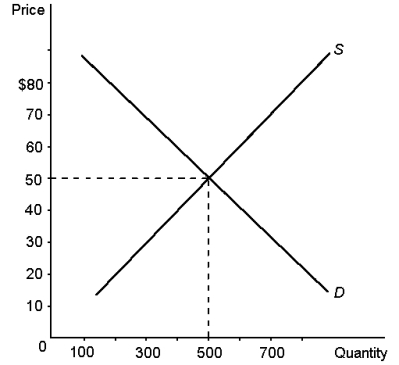
(76) Using the graph below, analyse the effect a $70 price floor would have on the market for tennis shoes. Would this be a binding price floor? Why would policymakers choose to impose a price floor?
(Essay)
4.8/5 (80)
(80) Taxes are employed by policy makers for two reasons. The first is to raise revenue. The second is to adjust market outcomes.
(True/False)
4.7/5 (90)
(90) Which of the following is the most correct statement about tax burdens?
(Multiple Choice)
4.9/5 (77)
(77) If a tax is imposed on a market with inelastic demand and elastic supply, sellers will bear most of the burden of the tax.
(True/False)
4.9/5 (88)
(88) 
Filters
- Essay(0)
- Multiple Choice(0)
- Short Answer(0)
- True False(0)
- Matching(0)