



 Chat with AI
Exam 6: Supply, Demand and Government Policies

Exam 1: Ten Lessons From Economics149 Questions
Exam 2: Thinking Like an Economist147 Questions
Exam 3: Interdependence and the Gains From Trade153 Questions
Exam 4: The Market Forces of Supply and Demand222 Questions
Exam 5: Elasticity and Its Application181 Questions
Exam 6: Supply, Demand and Government Policies148 Questions
Exam 7: Consumers, Producers and the Efficiency of Markets177 Questions
Exam 8: Application: The Costs of Taxation141 Questions
Exam 9: Application: International Trade161 Questions
Exam 10: Externalities199 Questions
Exam 11: Public Goods and Common Resources182 Questions
Exam 12: The Design of the Tax System154 Questions
Exam 13: The Costs of Production191 Questions
Exam 14: Firms in Competitive Markets200 Questions
Exam 15: Monopoly214 Questions
Exam 16: Business Strategy184 Questions
Exam 17: Competition Policy104 Questions
Exam 18: Monopolistic Competition214 Questions
Exam 19: The Markets for the Factors of Production215 Questions
Exam 20: Earnings, Unions and Discrimination206 Questions
Exam 21: Income Inequity and Poverty111 Questions
Exam 22: The Theory of Consumer Choice161 Questions
Exam 23: Frontiers of Microeconomics120 Questions
Exam 24: Measuring a Nations Income51 Questions
Exam 25: Measuring the Cost of Living52 Questions
Exam 26: Production and Growth62 Questions
Exam 27: Saving, Investment and the Financial System62 Questions
Exam 28: The Natural Rate of Unemployment59 Questions
Exam 29: The Monetary System66 Questions
Exam 30: Inflation: Its Causes and Costs74 Questions
Exam 31: Open-Economy Macroeconomics: Basic Concepts68 Questions
Exam 32: A Macroeconomic Theory of the Open Economy64 Questions
Exam 33: Aggregate Demand and Aggregate Supply82 Questions
Exam 34: The Influence of Monetary and Fiscal Policy on Aggregate Demand73 Questions
Exam 35: The Short-Run Trade-Off Between Inflation and Unemployment58 Questions
Exam 36: Five Debates Over Macroeconomic Policy38 Questions
Select questions type


A tax on golf clubs will cause the equilibrium market price of golf clubs to increase and the equilibrium quantity sold to decrease.
(True/False)
4.9/5  (60)
(60) Workers with high levels of skill and experience are not affected by the minimum wage because:
(Multiple Choice)
4.7/5 (74)
(74) A tax on sellers will cause the equilibrium market price to rise but the equilibrium quality sold will fall.
(True/False)
4.8/5 (74)
(74) The minimum wage creates the most benefits for teenage workers as their wages are typically much lower than adult workers.
(True/False)
4.9/5 (77)
(77) Graph 6-6
 -According to Graph 6-6, in panel a, at the actual price there will be:
 (Multiple Choice)
5.0/5 (96)
(96) Some countries in the developing world use price controls on rice to make it easier for poor people to afford. Demonstrate the effect of a binding and non-binding price ceiling on the rice market using supply-demand diagrams.
(Essay)
4.9/5 (77)
(77) Graph 6-8
 -According to Graph 6-8, the equilibrium price in the market before the tax is imposed is:
 (Multiple Choice)
4.9/5 (85)
(85) Rent subsidies and wage subsidies are better than price controls at helping the poor because they have no costs associated with them.
(True/False)
4.7/5 (99)
(99) Does a tax encourage increased market activity? How does a tax affect the amount paid by buyers and the amount received by sellers as a result of a tax on a good?
(Essay)
4.9/5 (78)
(78) If a tax is imposed on a market with elastic demand and inelastic supply, buyers will bear most of the burden of the tax.
(True/False)
4.9/5 (81)
(81) Rich consumers always end up paying most of the tax on luxury goods.
(True/False)
4.8/5 (69)
(69) Graph 6-12
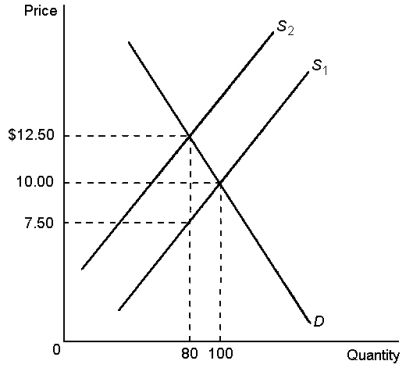 -Using Graph 6-12, answer the following questions.
a. What was the equilibrium price in this market before the tax?
b. What is the amount of the tax?
c. How much of the tax will the buyers pay?
d. How much of the tax will the sellers pay?
e. How much will the buyer pay for the product after the tax is imposed?
f. How much will the seller receive after the tax is imposed?
g. As a result of the tax, what has happened to the level of market activity?
-Using Graph 6-12, answer the following questions.
a. What was the equilibrium price in this market before the tax?
b. What is the amount of the tax?
c. How much of the tax will the buyers pay?
d. How much of the tax will the sellers pay?
e. How much will the buyer pay for the product after the tax is imposed?
f. How much will the seller receive after the tax is imposed?
g. As a result of the tax, what has happened to the level of market activity? (Essay)
4.9/5 (89)
(89) Most labour economists believe that the supply of labour is less elastic than demand. This means:
(Multiple Choice)
4.7/5 (78)
(78) A tax of $0.20 per cup on the sellers of coffee will cause the:
(Multiple Choice)
4.7/5 (73)
(73) 
Filters
- Essay(0)
- Multiple Choice(0)
- Short Answer(0)
- True False(0)
- Matching(0)