



 Chat with AI
Exam 6: Supply, Demand and Government Policies

Exam 1: Ten Lessons From Economics149 Questions
Exam 2: Thinking Like an Economist147 Questions
Exam 3: Interdependence and the Gains From Trade153 Questions
Exam 4: The Market Forces of Supply and Demand222 Questions
Exam 5: Elasticity and Its Application181 Questions
Exam 6: Supply, Demand and Government Policies148 Questions
Exam 7: Consumers, Producers and the Efficiency of Markets177 Questions
Exam 8: Application: The Costs of Taxation141 Questions
Exam 9: Application: International Trade161 Questions
Exam 10: Externalities199 Questions
Exam 11: Public Goods and Common Resources182 Questions
Exam 12: The Design of the Tax System154 Questions
Exam 13: The Costs of Production191 Questions
Exam 14: Firms in Competitive Markets200 Questions
Exam 15: Monopoly214 Questions
Exam 16: Business Strategy184 Questions
Exam 17: Competition Policy104 Questions
Exam 18: Monopolistic Competition214 Questions
Exam 19: The Markets for the Factors of Production215 Questions
Exam 20: Earnings, Unions and Discrimination206 Questions
Exam 21: Income Inequity and Poverty111 Questions
Exam 22: The Theory of Consumer Choice161 Questions
Exam 23: Frontiers of Microeconomics120 Questions
Exam 24: Measuring a Nations Income51 Questions
Exam 25: Measuring the Cost of Living52 Questions
Exam 26: Production and Growth62 Questions
Exam 27: Saving, Investment and the Financial System62 Questions
Exam 28: The Natural Rate of Unemployment59 Questions
Exam 29: The Monetary System66 Questions
Exam 30: Inflation: Its Causes and Costs74 Questions
Exam 31: Open-Economy Macroeconomics: Basic Concepts68 Questions
Exam 32: A Macroeconomic Theory of the Open Economy64 Questions
Exam 33: Aggregate Demand and Aggregate Supply82 Questions
Exam 34: The Influence of Monetary and Fiscal Policy on Aggregate Demand73 Questions
Exam 35: The Short-Run Trade-Off Between Inflation and Unemployment58 Questions
Exam 36: Five Debates Over Macroeconomic Policy38 Questions
Select questions type


Long gas lines after OPEC raised the price of crude oil in world markets were caused by the higher prices of oil and gas.
(True/False)
4.8/5  (81)
(81) Common rationing mechanisms under price ceilings include waiting in long lines and biases of the sellers.
(True/False)
4.7/5 (91)
(91) Graph 6-5
 -According to Graph 6-5, a binding price floor would exist at a price of:
 (Multiple Choice)
4.8/5 (74)
(74) Graph 6-10
 -In Graph 6-10, the per-unit burden of the tax on the sellers is:
 (Multiple Choice)
4.8/5 (74)
(74) If a tax is imposed on the buyer of a product, the tax incidence will fall entirely on the buyer.
(True/False)
4.8/5 (98)
(98) What is the goal of rent control and what do economists think of rent control as a mechanism for achieving the goal?
(Essay)
4.9/5 (63)
(63) Graph 6-3
 -According to Graph 6-3, which panel(s) best represent(s) a binding rent control in the long run?
 (Multiple Choice)
4.8/5 (79)
(79) If the government sets the minimum price a good can be traded at, this is defined as a price floor.
(True/False)
4.9/5 (79)
(79) Graph 6-4
 -According to Graph 6-4, when the supply curve for gasoline shifts from S1 to S2:
 (Multiple Choice)
4.9/5 (63)
(63) Graph 6-11
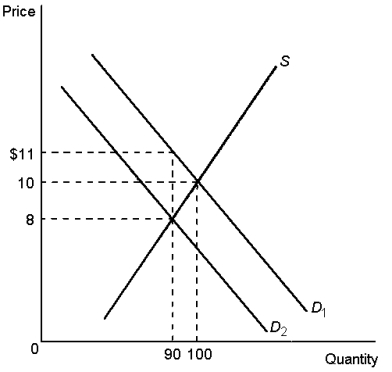 -Using Graph 6-11, answer the following questions.
a. What was the equilibrium price in this market before the tax?
b. What is the amount of the tax?
c. How much of the tax will the buyers pay?
f. How much of the tax will the sellers pay?
e. How much will the buyer pay for the product after the tax is imposed?
f. How much will the seller receive after the tax is imposed?
g. As a result of the tax, what has happened to the level of market activity?
-Using Graph 6-11, answer the following questions.
a. What was the equilibrium price in this market before the tax?
b. What is the amount of the tax?
c. How much of the tax will the buyers pay?
f. How much of the tax will the sellers pay?
e. How much will the buyer pay for the product after the tax is imposed?
f. How much will the seller receive after the tax is imposed?
g. As a result of the tax, what has happened to the level of market activity? (Essay)
4.9/5 (80)
(80) Graph 6-7
 -According to Graph 6-7, the equilibrium price in the market before the tax is imposed is:
 (Multiple Choice)
4.9/5 (83)
(83) A tax on the sellers of coffee will cause the price the buyer pays:
(Multiple Choice)
4.9/5 (81)
(81) Graph 6-5
-According to Graph 6-5, if the government imposes a binding price floor of $6.00 in this market, the result will be a:
-According to Graph 6-5, if the government imposes a binding price floor of $6.00 in this market, the result will be a: (Multiple Choice)
4.9/5 (74)
(74) Most of the burden of a luxury tax falls on the middle-class workers who supply luxury goods, rather than on the rich who buy them.
(True/False)
4.8/5 (84)
(84) Using a demand-supply diagram, show how OPEC's raising of oil prices in the 1970s combined with a government-imposed price ceiling on gasoline created a shortage of gasoline.
(Essay)
4.7/5 (68)
(68) If a tax is imposed on a market, buyers will pay more for their purchases and sellers will receive less for their sales.
(True/False)
4.8/5 (82)
(82) Graph 6-7
-According to Graph 6-7, the amount of the tax that buyers would pay would be:
-According to Graph 6-7, the amount of the tax that buyers would pay would be: (Multiple Choice)
4.8/5 (84)
(84) 
Filters
- Essay(0)
- Multiple Choice(0)
- Short Answer(0)
- True False(0)
- Matching(0)