



 Chat with AI
Exam 15: Monopoly

Exam 1: Ten Lessons From Economics149 Questions
Exam 2: Thinking Like an Economist147 Questions
Exam 3: Interdependence and the Gains From Trade153 Questions
Exam 4: The Market Forces of Supply and Demand222 Questions
Exam 5: Elasticity and Its Application181 Questions
Exam 6: Supply, Demand and Government Policies148 Questions
Exam 7: Consumers, Producers and the Efficiency of Markets177 Questions
Exam 8: Application: The Costs of Taxation141 Questions
Exam 9: Application: International Trade161 Questions
Exam 10: Externalities199 Questions
Exam 11: Public Goods and Common Resources182 Questions
Exam 12: The Design of the Tax System154 Questions
Exam 13: The Costs of Production191 Questions
Exam 14: Firms in Competitive Markets200 Questions
Exam 15: Monopoly214 Questions
Exam 16: Business Strategy184 Questions
Exam 17: Competition Policy104 Questions
Exam 18: Monopolistic Competition214 Questions
Exam 19: The Markets for the Factors of Production215 Questions
Exam 20: Earnings, Unions and Discrimination206 Questions
Exam 21: Income Inequity and Poverty111 Questions
Exam 22: The Theory of Consumer Choice161 Questions
Exam 23: Frontiers of Microeconomics120 Questions
Exam 24: Measuring a Nations Income51 Questions
Exam 25: Measuring the Cost of Living52 Questions
Exam 26: Production and Growth62 Questions
Exam 27: Saving, Investment and the Financial System62 Questions
Exam 28: The Natural Rate of Unemployment59 Questions
Exam 29: The Monetary System66 Questions
Exam 30: Inflation: Its Causes and Costs74 Questions
Exam 31: Open-Economy Macroeconomics: Basic Concepts68 Questions
Exam 32: A Macroeconomic Theory of the Open Economy64 Questions
Exam 33: Aggregate Demand and Aggregate Supply82 Questions
Exam 34: The Influence of Monetary and Fiscal Policy on Aggregate Demand73 Questions
Exam 35: The Short-Run Trade-Off Between Inflation and Unemployment58 Questions
Exam 36: Five Debates Over Macroeconomic Policy38 Questions
Select questions type


Patent and copyright laws are major sources of government created monopolies.
(True/False)
5.0/5  (75)
(75) Graph 15-2
 This graph reflects the cost and revenue structure for a monopoly firm. Use the graph to answer the following question(s).
-Refer to Graph 15-2. The average-total-cost curve for a monopoly firm is depicted by curve:
This graph reflects the cost and revenue structure for a monopoly firm. Use the graph to answer the following question(s).
-Refer to Graph 15-2. The average-total-cost curve for a monopoly firm is depicted by curve: (Multiple Choice)
4.9/5 (77)
(77) If the firm is the only owner of a key resource then this will be a significant barrier to entry.
(True/False)
4.8/5 (70)
(70) Graph 15-5
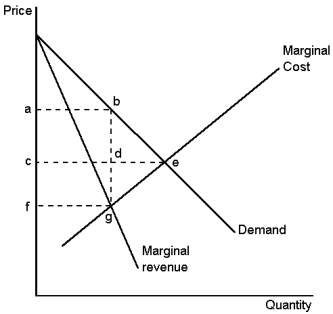 This graph depicts the demand, marginal-revenue and marginal-cost curves of a profit-maximising monopolist. Use the graph to answer the following question(s).
-Refer to Graph 15-5. Which of the following areas represents the deadweight loss due to monopoly pricing?
This graph depicts the demand, marginal-revenue and marginal-cost curves of a profit-maximising monopolist. Use the graph to answer the following question(s).
-Refer to Graph 15-5. Which of the following areas represents the deadweight loss due to monopoly pricing? (Multiple Choice)
4.8/5 (94)
(94) Patents are employed to give drug companies temporary monopoly power in order to:
(Multiple Choice)
4.9/5 (79)
(79) Describe how government is involved in creating a monopoly. Why might the government create one? Give an example.
(Essay)
4.9/5 (85)
(85) Table 15-1
 -Refer to Table 15-1. What is the average revenue received from selling 4 units of the monopolist's product?
 (Multiple Choice)
4.8/5 (92)
(92) The main differences between a competitive firm and a monopoly are: (i) competitive firms do not have to worry about the price effect lowering their total revenue
(ii) marginal revenue for a competitive firm equals price, while marginal revenue for a monopoly is less than the price it is able to charge
(iii) monopolies must lower their price in order to sell more of their product, while competitive firms do not
(Multiple Choice)
4.9/5 (82)
(82) Like monopolies, competitive firms choose to produce a quantity in which marginal revenue equals marginal cost.
(True/False)
4.9/5 (83)
(83) A profit-maximising monopolist will choose a level of output at where:
(Multiple Choice)
4.9/5 (75)
(75) Calculate the deadweight loss due to profit-maximising monopoly pricing under the following conditions.
The price charged for goods produced is $10. The intersection of the marginal-revenue and marginal-cost curves occurs where output is 100 units and marginal revenue is $5. The socially efficient level of production is 110 units. The demand curve is linear and downward-sloping and the marginal-cost curve is linear and upward-sloping.
(Short Answer)
4.8/5 (90)
(90) C.R. Evans, a transportation corporation, has just completed the development of a new subway system in Melbourne. Currently there are plenty of seats on the subway, and it is never crowded. Its capacity well exceeds the needs of the city. After just a few years of operation, the shareholders of C.R. Evans common stock are experiencing incredible rates of return on their investment, due to the profitability of the corporation.
-According to the information provided,C.R. Evans may continue to be a monopolist in the subway transportation industry only if:
(Multiple Choice)
4.9/5 (72)
(72) The inefficiency of a deadweight loss stems from the fact that:
(Multiple Choice)
4.7/5 (92)
(92) A monopolist's marginal-revenue curve is less than price for which of the following reasons? (i) to sell additional units of the good, the price charged on all units must decrease
(ii) with the sale of an additional unit, the monopolist receives less revenue for each of the previous units it planned to sell
(iii) because of the downward-sloping demand curve
(Multiple Choice)
4.8/5 (74)
(74) When a firm operates under conditions of a monopoly, its price is constrained by demand.
(True/False)
4.9/5 (90)
(90) If a monopolist faces a downward-sloping market demand curve, its:
(Multiple Choice)
4.8/5 (74)
(74) Consider the following diagram of a monopoly.
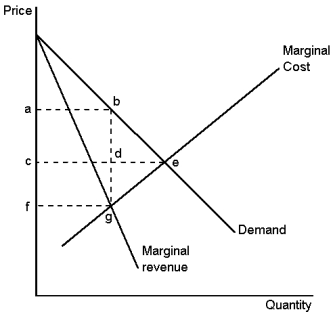 Assuming that the monopoly is at its profit-maximising point, identify the values of its marginal revenue, marginal cost, average revenue and price.
 (Essay)
4.9/5 (73)
(73) An industry is a natural monopoly when which of the following is(are) true? (i) a single firm will supply a good or service at a socially optimal quantity
(ii) a single firm can supply a fixed number of goods or services at a smaller cost than could two or more firms
(iii) a single firm can produce additional units at a smaller marginal cost
(Multiple Choice)
5.0/5 (81)
(81) 
Filters
- Essay(0)
- Multiple Choice(0)
- Short Answer(0)
- True False(0)
- Matching(0)